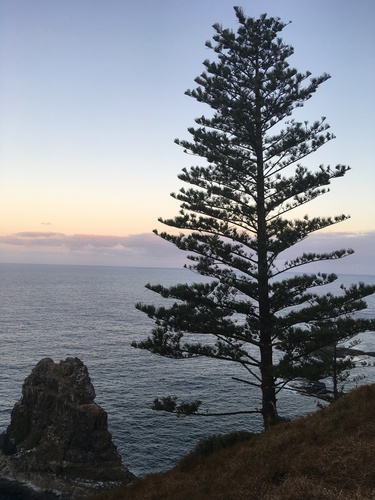
Araucaria, Genus, heterophylla, Species,
- Genus & species
norfolk island pine
Norfolk Island, a 13-square-mile (35-square-kilometer) Australian external territory in the South Pacific Ocean located between New Caledonia, New Zealand, and Australia approximately 1000 miles (1600 km) east of the Australian mainland; subtropical maritime climate with mild winters and warm summers, consistent year-round rainfall, and exposed coastal-cliff and ridge habitats with strong wind exposure that the species' branching architecture is structurally adapted to.
Overview
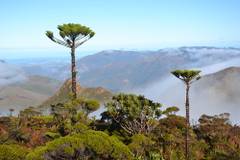
Araucaria heterophylla is the Norfolk Island pine (also called star pine), an evergreen conifer in the ancient gymnosperm family Araucariaceae growing 3-8 feet (90-240 cm) tall in container culture as an indoor specimen tree, and reaching 100-200 feet (30-60 meters) tall as a mature outdoor canopy tree across the species' native subtropical range and in introduced subtropical-climate plantings worldwide. The species is not a true pine — despite the common name, the species is not a Pinus species and is not in the pine family (Pinaceae) — and is instead in the ancient gymnosperm family Araucariaceae, a Southern Hemisphere conifer family with a continuous fossil record extending back to the Jurassic period (approximately 175-200 million years ago) when the family was substantially more widespread across the broader Pangean and Gondwanan supercontinents. The Araucariaceae family today survives as a relict family with three living genera (Araucaria, Agathis, and Wollemia, the latter genus containing the famous 'living fossil' Wollemi pine (Wollemia nobilis) discovered in Australia in 1994), and A. heterophylla is among the more commonly cultivated members of the broader family in indoor and tropical-outdoor ornamental horticulture worldwide. The species' principal physical character is the perfectly symmetrical whorled tier architecture of horizontal lateral branches arranged in regular tiers around the central vertical leader trunk, with each tier supporting densely-clothed lateral branches carrying soft bright green needle-like juvenile foliage. The natural branching architecture is so perfectly symmetrical that mature indoor specimens look almost as if they had been pruned and shaped by a topiary gardener, although the species requires and tolerates no pruning to maintain the form — the symmetrical tier structure is genetically encoded into the species' growth program. Indoor specimens grow slowly under typical houseplant conditions, with a typical 4-foot indoor specimen representing 3-5 years of growth and a 6-foot specimen representing 8-10+ years of cultivation. The species has a substantial cultivation caveat that distinguishes it from most other indoor conifer-resembling species: the central vertical leader (the apical meristem at the very top of the tree) controls the species' entire growth pattern, and any damage or removal of the central leader permanently disrupts the symmetrical tier architecture because the species cannot regenerate a new central leader from the lateral branches below. Once the apical bud is damaged the tree continues to live but produces irregular asymmetric growth from the lateral branches that is structurally and ornamentally distinct from the original symmetrical form, and the tree cannot recover the original perfectly-symmetrical character even with subsequent careful cultivation. Lost lower lateral branches similarly do not regenerate from older portions of the trunk — the species produces new growth only at the apical leader and at the tips of existing lateral branches, never on bare older wood. These two cultivation constraints together mean that indoor gardeners who damage the apical bud or who allow lower branches to die through inadequate light or watering produce a permanently-altered specimen rather than a temporarily-damaged one. The species is non-toxic to humans and pets. Native to Norfolk Island, a 13-square-mile (35-square-kilometer) island in the South Pacific Ocean located between New Caledonia, New Zealand, and Australia approximately 1000 miles east of the Australian mainland, the species' subtropical maritime climate native habitat reflects a physiological tolerance of bright filtered light, moderate humidity, consistent year-round mild temperatures, and exposed coastal-ridge wind exposure. Hardy outdoors only in tropical zones 10-11; in cold-climate zones (3-9) the species is grown exclusively as an indoor houseplant or as a seasonal outdoor container plant brought indoors before the first fall frost. The species is the most popular living-Christmas-tree alternative for indoor holiday display in cold-climate gardens.
Native Range
Araucaria heterophylla is endemic to Norfolk Island, a 13-square-mile (35-square-kilometer) Australian external territory in the South Pacific Ocean located between New Caledonia, New Zealand, and Australia approximately 1000 miles (1600 km) east of the Australian mainland. The species' native habitat is the subtropical maritime climate of Norfolk Island with mild winters, warm summers, consistent year-round rainfall from oceanic moisture sources, and exposed coastal-cliff and ridge habitats where the species' perfectly symmetrical horizontal-tier branching architecture is structurally adapted to strong-wind exposure (the symmetrical tier form distributes wind loading evenly around the central trunk rather than concentrating loading on one side as asymmetric tree forms do). The species has been introduced into ornamental cultivation broadly across subtropical and tropical regions worldwide and is grown outdoors as a landscape specimen tree in coastal California, Hawaii, southern Florida, the Mediterranean basin, southeastern Australia (where the species is native to a different territory), and other comparable subtropical-climate regions, and indoors as a slow-growing specimen houseplant in cold-climate zones across the temperate Northern Hemisphere where the species is the most popular living-Christmas-tree alternative.Suggested Uses
Used as a slow-growing indoor specimen tree in residential and commercial indoor settings, as a living-Christmas-tree alternative for indoor holiday display in cold-climate gardens (the symmetrical tier architecture and the soft green foliage supply the holiday-tree visual contribution without the cut-tree disposal cycle), and as an outdoor landscape specimen tree in subtropical zone-10-11 outdoor gardens. The species is the most popular indoor living-Christmas-tree alternative across the broader U.S. and European household traditions and is grown by gardeners who want a holiday tree that continues as a year-round specimen rather than being discarded after the holiday season. The species is non-toxic to humans and pets, supporting the species' use in households with pets or children where ornamental-plant toxicity is a concern. The species pairs with companion bright-indirect-light tropical and subtropical houseplants including Strelitzia nicolai (giant white bird of paradise), Howea forsteriana (kentia palm), Chamaedorea elegans (parlor palm), Dracaena cultivars, and Ficus cultivars for a multi-species tropical-foliage indoor planting where the Araucaria symmetrical tier architecture supplies a structural and textural contrast against the broad-leafed companion foliage. The species is sited away from positions where active handling traffic might damage the central leader or break lateral branches, because the species cannot recover from leader damage or branch loss.How to Identify
Appearance
Size & Dimensions
Height3' - 8'
Width/Spread2' - 4'
Colors
Foliage Colors
Fall Foliage Colors
Bloom Information
The species does not flower because the species is a gymnosperm (conifer) rather than an angiosperm (flowering plant) and reproduces through seed cones rather than flowers. Outdoor mature specimens in tropical zone-10-11 cultivation produce typical gymnosperm reproductive cones — male pollen cones and female seed cones on separate trees in the species' dioecious reproductive biology — but cone production essentially never occurs in indoor cultivation because indoor specimens rarely reach the mature reproductive size threshold. Indoor cultivation produces no seasonal flowering or coning display.
Detailed Descriptions
Flower Description
The species does not flower in indoor cultivation; outdoor mature specimens in tropical zone-10-11 cultivation produce typical gymnosperm reproductive cones (the species is a conifer, not a flowering plant) but cone production essentially never occurs in indoor cultivationFoliage Description
Bright medium green; soft needle-like (juvenile) foliage 0.5-0.75 inch (12-18 mm) long densely arranged along the horizontal lateral branches in tier whorls; the foliage is much softer than that of true pines (Pinus species) and is technically not pine-needles at all because the species is not a Pinus — the soft texture and the bright green color combined with the perfectly symmetrical horizontal-tier branching architecture supplies the species' principal foliage signature in indoor cultivationGrowing Conditions
Sun Requirements
Requires 4-8 hours of direct sunlight daily
• Full Sun: 6+ hours of direct sunlight
• Partial Shade: 3-6 hours of direct sunlight
• Full Shade: Less than 3 hours of direct sunlight
Care & Maintenance
Care Guide
Place in bright indirect light to support the year-round evergreen foliage display — the species tolerates moderate-shade conditions but produces sparse leggy growth in extremely low light, and bright direct afternoon sun in indoor settings produces foliage scorch and bronzing that damages the year-round ornamental contribution. Rotate the specimen 90-180 degrees every 2-4 weeks to maintain even all-around light exposure and prevent the central leader and lateral branches from leaning toward a single light source — without regular rotation indoor specimens develop asymmetric leaning growth that compromises the species' principal ornamental feature. Water when the top 1-2 inches (2.5-5 cm) of soil dries to the touch — the species tolerates moderate drought between waterings but performs better with consistent moisture across the active growing season. Slightly acidic substrate at pH 5.5-6.5 supports the species reliably. Moderate ambient humidity (30-50%+ relative humidity) reduces the foliage browning and tip necrosis that develops in dry-air indoor environments — a humidifier or pebble tray near the specimen helps maintain adequate humidity in heated indoor settings. Fertilization is at half-strength every 2-3 months during the active growing season (spring through summer) using a balanced or slightly-acidic conifer-specific fertilizer. The central vertical leader at the very top of the tree controls the species' entire growth pattern; the apical bud is handled with extreme care during repotting and routine handling because damage to the apical bud permanently disrupts the symmetrical tier architecture and the species cannot regenerate a new central leader. Pruning of the central leader produces the same permanent result and is therefore avoided. Lost lower lateral branches do not regenerate from older portions of the trunk because the species produces new growth only at the apical leader and at the tips of existing lateral branches. Hardy outdoors only in tropical zones 10-11; in cold-climate zones (3-9) the species is grown exclusively as an indoor houseplant in 7-gallon (26-liter) or larger pots. The species is non-toxic to humans and pets.Pruning
The species is generally not pruned because the natural symmetrical tier branching architecture supplies the principal ornamental character without pruning intervention. Removal of the central vertical leader (the apical meristem at the very top of the tree) permanently disrupts the symmetrical tier form because the species cannot regenerate a new central leader from the lateral branches below — the apical bud accordingly is preserved through routine handling, repotting, and any limited pruning that may be done. Removal of dead or damaged lower lateral branches at the trunk attachment point is the only routine pruning the species typically receives. Lost lateral branches do not regenerate from older portions of the trunk because the species produces new growth only at the apical leader and at the tips of existing lateral branches. The species cannot be cut back for size control because the species cannot recover the symmetrical form once the leader is removed.Container Growing
Suitable for container growing
Minimum container size: 7 gallons