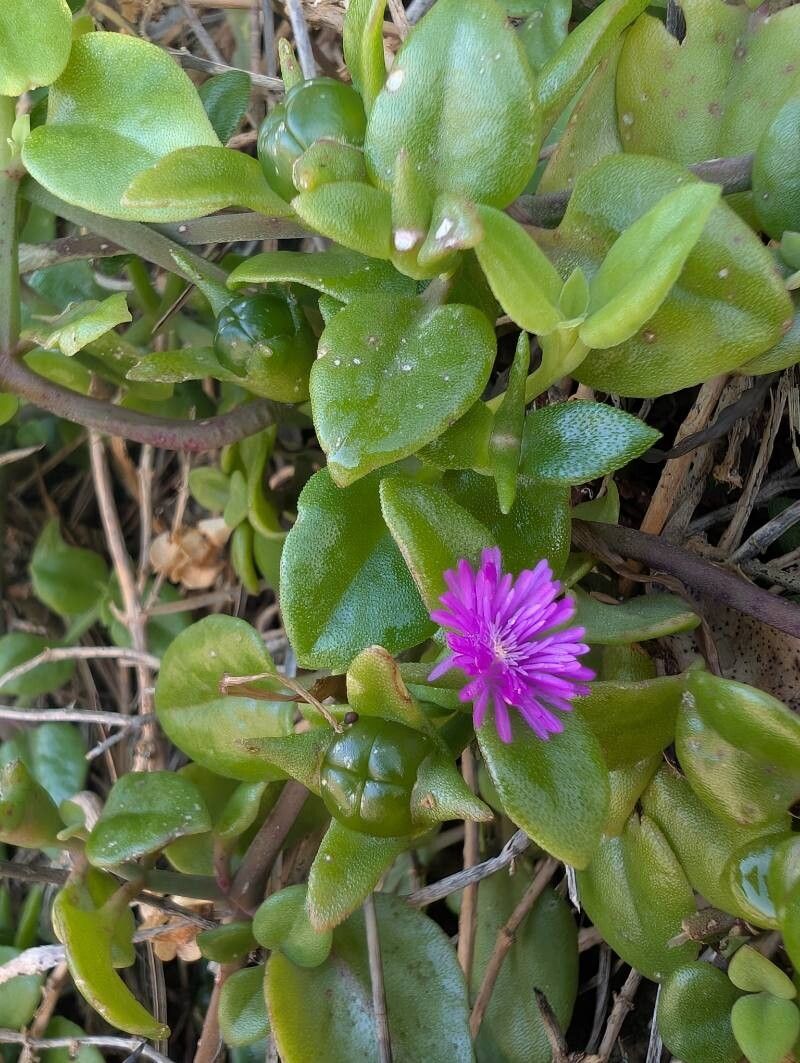
Aptenia, Genus, cordifolia, Species,
- Genus & species
Livingstone daisy
South Africa (Eastern Cape Province)
Overview
Aptenia cordifolia is a tender perennial succulent groundcover reaching 2-4 inches (5-10 cm) tall and spreading 24-36 inches (60-90 cm) wide per plant. Stems are slender, fleshy, and prostrate, rooting at nodes in contact with moist soil. Leaves are heart-shaped to ovate, 0.5-1 inch (1.3-2.5 cm) long, succulent, glossy bright green, arranged opposite on the stem. Flowers are daisy-like, 0.5-0.75 inch (1.3-2 cm) across, with numerous narrow magenta-pink to purple ray-like petals surrounding a yellow center; flowers open in full sun and close in shade or at night. Bloom continues from spring through fall in zones 9-11; flowering decreases in extreme summer heat above 100°F (38°C). Frost-tender: foliage damages at 28°F (-2°C) and the plant dies to the roots at 25°F (-4°C). Growth is fast at 6-12 inches (15-30 cm) of spread per month during warm weather. In zones 9-11 used as a year-round groundcover; in zones 3-8 grown as an annual in containers or as a summer trailing accent. Listed as an invasive species in coastal California and parts of Mediterranean Europe, where the plant displaces native dune and coastal scrub vegetation. Drought-tolerant once established; rots in heavy or poorly drained soils. Non-toxic — leaves are edible and used in some South African cuisines.
Native Range
Native to South Africa, particularly the Eastern Cape Province, where it grows on rocky coastal slopes, sandy flats, and disturbed soils at elevations below 3,000 feet (900 m). Naturalized along coastal California, the Mediterranean Basin, and parts of Australia where the species displaces native vegetation.Suggested Uses
Used as a low groundcover, slope cover, or rock garden filler in zones 9-11 at 18-24 inch (45-60 cm) spacing. Container culture as a trailing spiller in 1-3 gallon (4-12 liter) pots; combines with other succulents and Mediterranean plants. Excluded from coastal plantings in California and Mediterranean Europe where the species is regulated as invasive.How to Identify
Appearance
Size & Dimensions
Height2" - 4"
Width/Spread2' - 3'
Bloom Information
Blooms continuously from spring through fall in zones 9-11 in full sun. Individual flowers last 1-2 days, opening mid-morning and closing by evening; new flowers form in succession for 24-32 weeks total in mild-summer climates. Flower production decreases above 100°F (38°C) and resumes in cooler fall weather.
Detailed Descriptions
Flower Description
Magenta-pink to purpleFoliage Description
Glossy bright green, succulent, heart-shapedGrowing Conditions
Sun Requirements
Requires 6-12 hours of direct sunlight daily
• Full Sun: 6+ hours of direct sunlight
• Partial Shade: 3-6 hours of direct sunlight
• Full Shade: Less than 3 hours of direct sunlight
Care & Maintenance
Care Guide
Water deeply once every 2-3 weeks during the establishment year; established plants tolerate 4-6 weeks without rain in coastal climates and require even less water inland. A low-nitrogen fertilizer applied once in spring maintains color; high nitrogen produces leggy growth at the expense of flowering. Mealybugs and scale occur on indoor container plants. Root rot develops in heavy or poorly drained soils, particularly during winter rains in cool climates. Plants are killed by hard freezes below 25°F (-4°C); in zones 3-8 the species is treated as an annual replaced each year. Cutting back by one-half in late winter refreshes growth and removes the woody base in mild climates.Pruning
Cutting back by one-half in late winter refreshes growth and removes the woody base in zones 9-11. Light shearing through the growing season encourages denser branching and additional flower production. Plants do not require pruning beyond seasonal renewal.Container Growing
Suitable for container growing
Minimum container size: 1 gallons