Apocynum, Genus, androsaemifolium, Species,
- Genus & species
spreading dogbane
Overview
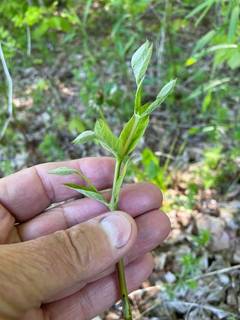
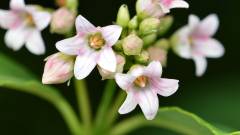
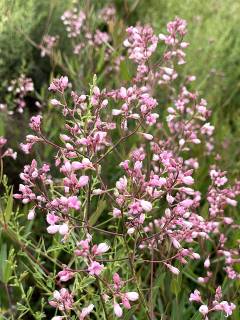
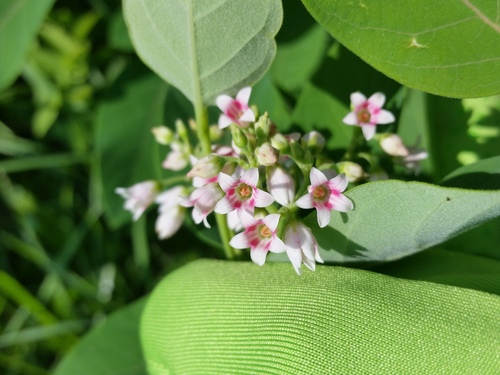
Apocynum androsaemifolium is a herbaceous perennial native to North America, reaching 18-36 inches (45-90 cm) tall and forming colonies 24-36 inches (60-90 cm) wide through long horizontal rhizomes. Branched upright stems exude a milky white latex when broken; stems are smooth and reddish-tinged on the sun-exposed side. Leaves are opposite, ovate to elliptic, 1.5-3 inches (4-7.5 cm) long, mid-green above and slightly paler below with smooth margins; leaves droop on warm afternoons in dry sites. Pendulous bell-shaped flowers appear in branched terminal cymes from late June through August in zones 3-7; each flower is 0.25-0.4 inch (6-10 mm) long and pink with darker pink veining inside the corolla. Bloom runs 3-4 weeks per established colony. Fruit is a paired narrow follicle 3-5 inches (7.5-12 cm) long, splitting in autumn to release silky-tufted seeds dispersed by wind. All parts contain cardiac glycosides (cymarin) toxic to livestock, pets, and humans if ingested. Plants spread aggressively by rhizome in moist garden settings; in dry native habitats, spread is slow.
Native Range
Apocynum androsaemifolium is native to North America, occurring across most of Canada and the United States from Newfoundland and southern Northwest Territories south to North Carolina, Texas, and California. The species grows in dry to moderately moist meadows, woodland edges, prairies, and roadsides at elevations from sea level to 9,500 feet (2,900 m).Suggested Uses
Used in native plant gardens, dry meadow plantings, and pollinator strips at 18-24 inch (45-60 cm) spacing. Planted alongside Asclepias species, Solidago, and prairie grasses in unirrigated mixed plantings. The species is the obligate larval host for the dogbane tiger moth (Cycnia tenera); plantings support specialized pollinator and herbivore communities. Container culture is straightforward when rhizome containment prevents escape into adjacent beds.How to Identify
Appearance
Size & Dimensions
Height1'6" - 3'
Width/Spread2' - 3'
Bloom Information
Late June through mid-August in zones 3-7, with peak bloom in mid-July. In zones 8-9, flowering begins in late May and may end before mid-July. Cool moist summers extend the display by 1-2 weeks compared with hot dry summers. Each cyme produces 5-15 overlapping flowers over a 7-10 day period; total bloom across an established colony spans 3-4 weeks.
Detailed Descriptions
Flower Description
Pink with darker pink veining inside corolla, bell-shapedFoliage Description
Mid-green, ovate to ellipticGrowing Conditions
Sun Requirements
Requires 4-12 hours of direct sunlight daily
• Full Sun: 6+ hours of direct sunlight
• Partial Shade: 3-6 hours of direct sunlight
• Full Shade: Less than 3 hours of direct sunlight
Care & Maintenance
Care Guide
Establish in well-drained loam or sandy loam at pH 5.5-7.5 in full sun to part shade. Water during establishment in the first season; mature plants tolerate 4-6 weeks without rain in cool climates. The species is rarely fertilized; fertile soils encourage aggressive rhizome spread. Dogbane beetles (Chrysochus auratus) feed on foliage but rarely cause significant damage; the metallic blue-green beetles tolerate the toxic sap. Container culture is straightforward in 5-gallon (19 L) pots with rhizome containment. Plants are not normally divided; rhizome cuttings 4-6 inches (10-15 cm) long produce new plants when planted horizontally 2 inches (5 cm) deep.Pruning
Cut stems to ground level in late autumn after first hard frost; standing stems may persist with seedpods through winter as a wildlife and visual feature. Remove rhizome shoots that extend beyond the desired colony footprint by digging in early spring before new growth emerges. Mid-season pruning of stems is rarely needed.Pruning Schedule
Prune: March & November
fallearly spring
Container Growing
Suitable for container growing
Minimum container size: 5 gallons