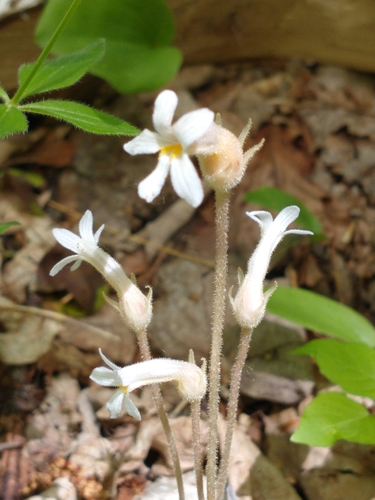
Aphyllon, Genus, uniflorum, Species,
- Genus & species
one-flowered cancer-root
SunPart Shade
WaterMedium
Overview
Aphyllon uniflorum, formerly Orobanche uniflora, is a parasitic herb in the broomrape family that lacks chlorophyll and draws all of its water and nutrients from the roots of host plants. Above ground it consists of one to several slender, leafless flowering stalks 2–4 inches (5–10 cm) tall arising from a small underground base. The stems are pale yellow, tan, or purplish and bear only a few scale-like bracts in place of true leaves. Each stalk is topped by a single tubular flower 0.5–0.8 inch (12–20 mm) long, pale lavender to white, with a yellow-bearded throat and five spreading lobes. The flowers are faintly fragrant. It parasitizes a range of hosts, particularly stonecrops (Sedum), saxifrages, and members of the daisy family, attaching to their roots through a swollen structure called a haustorium. The plant appears above ground only briefly in spring while flowering, spending the rest of its life underground attached to a host. Its distribution spans much of North America in moist, partly shaded sites. Because it depends entirely on living hosts, it cannot be grown as an isolated plant and is not available in cultivation.
Native Range
Aphyllon uniflorum is native to North America, ranging across much of Canada and the United States from coast to coast.Suggested Uses
It has no horticultural use and is observed in natural areas as part of native plant communities. It is of interest in the botanical study of parasitic plants.How to Identify
Appearance
Size & Dimensions
Height2" - 4"
Width/Spread1" - 3"
Bloom Information
Flowering occurs from April to June depending on elevation and latitude. Each stalk produces one flower, and the plant is visible above ground almost entirely during this brief flowering period. After seed set, the visible parts wither.
Detailed Descriptions
Flower Description
pale lavender to white with yellow-bearded throatFoliage Description
no true leaves; scale-like bracts pale tan to purplishGrowing Conditions
Sun Requirements
Requires 3-6 hours of direct sunlight daily
• Full Sun: 6+ hours of direct sunlight
• Partial Shade: 3-6 hours of direct sunlight
• Full Shade: Less than 3 hours of direct sunlight
Water & Climate
Water Needs