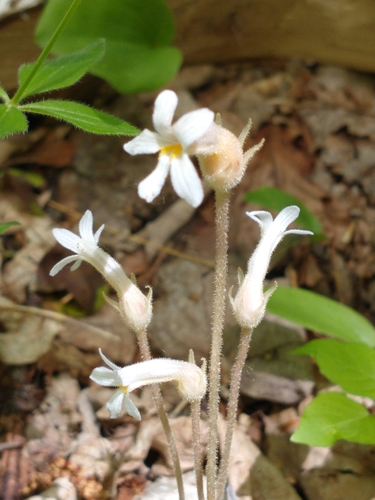
Aphyllon, Genus, spp., Multiple species,
- Genus
- Multiple species
broomrape
SunFull Sun – Part Shade
WaterLow
Overview
Aphyllon is a genus of parasitic herbs in the broomrape family Orobanchaceae, native to North and South America and containing about 20 species once placed in Orobanche. Plants lack chlorophyll and produce no true leaves, drawing all their water and nutrients from the roots of host plants to which they attach by swollen underground connections. The above-ground parts are fleshy flowering stems 2-12 inches (5-30 cm) tall, ranging from pale yellow and tan to purple or brown and clothed only in small scale-like bracts. Snapdragon-shaped flowers 0.4-1 inch (10-25 mm) long appear in spring and summer in shades of pale purple, lavender, yellow, or white, often with darker veins, borne singly or in clusters along the stem. Hosts vary by species and include members of the sunflower, stonecrop, and saxifrage families, among others; A. fasciculatum parasitizes sagebrush and buckwheat, while A. uniflorum attaches to a wide range of herbs. After flowering, each plant sets a capsule holding thousands of dust-like seeds that stay dormant in the soil until chemical signals from a suitable host root trigger germination. Because they depend entirely on their hosts, these plants appear only where their host species grow and cannot be cultivated apart from them.
Native Range
Native to North and South America, from Canada through the western United States and Mexico into the Andes. Plants occur wherever their host species grow, in habitats ranging from coastal scrub and sagebrush steppe to alpine slopes.Suggested Uses
Aphyllon is not a cultivated ornamental but is studied in native-plant and botanical settings as part of intact host communities. In natural areas it forms part of the local flora wherever its hosts occur. Several species are of interest in research on parasitic plants and seed germination.How to Identify
Appearance
Size & Dimensions
Height2" - 1'
Width/Spread2" - 6"
Bloom Information
Flowering occurs in spring and summer, with timing set by the growth of the host plant. Each stem produces a succession of tubular flowers over several weeks. Capsules ripen soon after, releasing very large numbers of tiny seeds that can persist in the soil for years.
Detailed Descriptions
Flower Description
purple to yellowFoliage Description
none; reduced to tan to purple scalesGrowing Conditions
Sun Requirements
Requires 4-10 hours of direct sunlight daily
• Full Sun: 6+ hours of direct sunlight
• Partial Shade: 3-6 hours of direct sunlight
• Full Shade: Less than 3 hours of direct sunlight
Water & Climate
Water Needs
