Anemopsis, Genus, californica, Species,
- Genus & species
yerba mansa
Overview
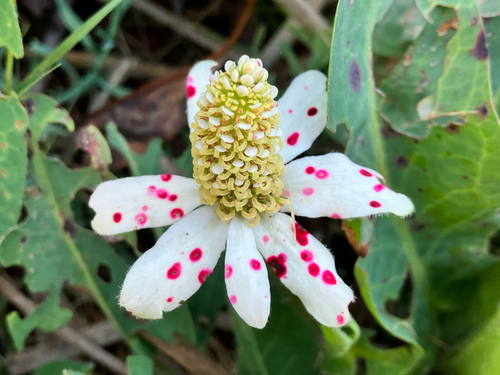
Anemopsis californica is a mat-forming perennial in the lizard's-tail family, spreading by runners to form colonies and sending up flower stalks 8-20 inches (20-50 cm) tall. The leathery, elliptic basal leaves are 2-6 inches (5-15 cm) long on long stalks, turning red as the season ends or under stress. From spring into summer each stalk bears a cone-like spike of many tiny flowers, ringed at the base by 4-9 white petal-like bracts, so the whole structure reads as a single white bloom. The crushed foliage and roots are aromatic. It is native to the southwestern United States and northern Mexico, growing in wet, often alkaline or saline ground around springs, seeps, marshes, and ditch margins. It tolerates salty, waterlogged soils that exclude many plants but spreads quickly by runners and can overrun a small planting. It declines where the soil dries out for long periods.
Native Range
Anemopsis californica is native to the southwestern United States and northern Mexico, from Oregon and California east to Texas and Kansas and south into Baja California and the central Mexican plateau. It grows in wet alkaline and saline habitats below about 6,500 feet (2,000 m).Suggested Uses
Grown as a groundcover in bog gardens, pond edges, and rain gardens, and in restoration of wet alkaline sites. It binds soil in seasonally wet ground and stabilizes margins. The spreading habit suits large damp areas rather than small beds.How to Identify
Appearance
Size & Dimensions
Height8" - 1'8"
Width/Spread2' - 3'
Bloom Information
Detailed Descriptions
Foliage Description
green turning redGrowing Conditions
Sun Requirements
Requires 4-10 hours of direct sunlight daily
• Full Sun: 6+ hours of direct sunlight
• Partial Shade: 3-6 hours of direct sunlight
• Full Shade: Less than 3 hours of direct sunlight
Care & Maintenance
Care Guide
Grow Anemopsis californica in full sun to part shade in wet, heavy, or alkaline soil, including pond margins, bog gardens, and seasonally flooded ground. It needs soil that stays moist to saturated and tolerates salinity that many wetland plants cannot. The runners spread quickly, so the roots are confined in a buried container or basin where a contained clump is wanted. Little feeding is needed in mineral-rich wetland soil. Stems and leaves are cut back after they die down in late autumn. Dividing the runners in spring renews and controls the colony.Pruning
No structural pruning is required. Spent foliage is cut back after it dies down in late autumn. Runners are trimmed or lifted in spring to keep the colony within bounds.Container Growing
Suitable for container growing
Minimum container size: 3 gallons