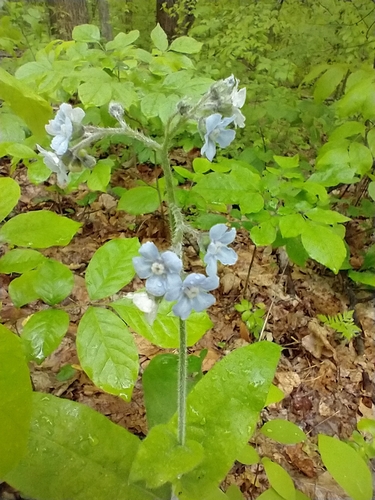
Andersonglossum, Genus, virginianum, Species,
- Genus & species
wild comfrey
Overview
Andersonglossum virginianum is an upright herbaceous perennial of the borage family, growing 1.5-3 feet (45-90 cm) tall from a rosette of large basal leaves. The oblong basal leaves are 4-8 inches (10-20 cm) long, hairy, and taper to winged stalks, while the smaller stem leaves clasp the single hairy flowering stalk. In late spring the stem branches at the top into coiled clusters of small five-lobed flowers about 0.3 inch (8 mm) across, pale blue to lavender, sometimes nearly white. After bloom the flowers form clusters of four bur-like nutlets covered in barbed prickles that cling to fur and clothing, scattering the seed widely. Native to dry to moist open woods, clearings, and wooded slopes of eastern North America, it grows in part shade on rich, well-drained soil. Plants are short-lived, often behaving as biennials or short-lived perennials, and renew from self-sown seed. Hardy in USDA zones 4-8, the foliage dies back in winter. The coarse, hairy leaves and clinging burs make it a plant of informal and woodland settings rather than manicured beds. The flowers draw early bees, and the foliage contains alkaloids that make it bitter and unpalatable to browsers.
Native Range
Native to eastern North America, from New England and Ontario south to Florida and west to Texas and the eastern Great Plains. It grows in dry to moist open woodlands, thickets, clearings, and shaded slopes on rich soil.Suggested Uses
Used in woodland gardens, shaded native plantings, and naturalized wooded edges, spaced 12-18 inches (30-45 cm) apart. Suited to informal shaded areas where its self-sowing and clinging seeds are not a problem.How to Identify
Appearance
Size & Dimensions
Height1'6" - 3'
Width/Spread1' - 1'6"
Bloom Information
Flowering occurs in late spring, April to June. Small pale blue to lavender flowers open in coiled clusters that uncurl as they bloom. Barbed nutlets form soon after and ripen through early summer.
Detailed Descriptions
Flower Description
pale blue to lavenderFoliage Description
greenGrowing Conditions
Sun Requirements
Requires 2-5 hours of direct sunlight daily
• Full Sun: 6+ hours of direct sunlight
• Partial Shade: 3-6 hours of direct sunlight
• Full Shade: Less than 3 hours of direct sunlight
Care & Maintenance
Care Guide
Grow in part shade on rich, well-drained soil of average moisture; the plant tolerates dry shade once established. It is short-lived but renews from self-sown seed where the ground is left undisturbed. No feeding is needed in woodland soil. Spent stalks can be removed before the burs ripen to limit seeding and the clinging nutlets. Hardy in USDA zones 4-8, new rosettes form in fall and overwinter. Deer and other browsers usually leave the bitter foliage alone.Pruning
Cut flowering stalks after bloom and before the burs harden to limit self-seeding and the spread of clinging nutlets. Remove faded foliage in fall. No other pruning is needed.Pruning Schedule
Prune: June–July
summer