Amyema, Genus, spp., Multiple species,
- Genus
- Multiple species
mistletoe
Australia, Malesia, Southeast Asia, and the western Pacific
SunFull Sun – Part Shade
Overview
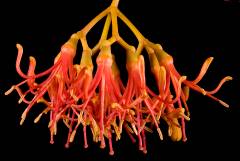
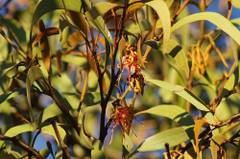
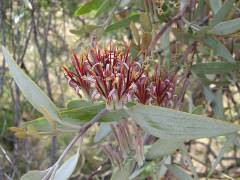
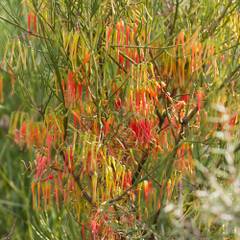
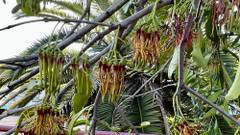
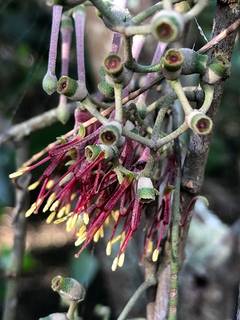
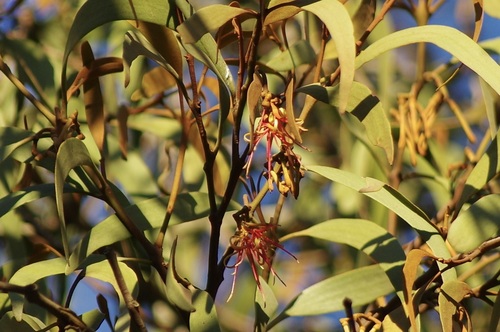
Amyema is a genus of roughly 90 to 100 species of aerial-stem hemiparasitic mistletoes in the family Loranthaceae, centred on Australia and extending through Malesia, Southeast Asia, and the western Pacific. Each plant grows on the branches of a host tree or shrub, attached by a haustorium that taps the host water and mineral supply while the mistletoe green leaves carry out photosynthesis. Stems are woody and pendent or spreading, forming clumps 1-7 ft (0.3-2 m) across. Leaves are usually opposite, leathery, and entire, 1-6 in (2.5-15 cm) long, and in several species closely resemble the foliage of the host. Tubular flowers 0.4-1.6 in (1-4 cm) long appear in stalked clusters and range from red and orange to yellow and green; they hold abundant nectar and are pollinated by honeyeaters and other birds. The fruit is a single-seeded berry with sticky flesh, spread when mistletoebirds wipe or excrete the seed onto a new branch. Heavy infestations can reduce the vigour of host trees and, over time, contribute to limb dieback. A. miquelii and A. pendula are widespread Australian examples.
Native Range
Amyema is native to Australia, where the genus is most diverse, and ranges north and east through New Guinea, Malesia, parts of Southeast Asia, and islands of the western Pacific.Suggested Uses
Amyema is important in native ecosystems as a nectar source for honeyeaters and a fruit source for mistletoebirds, and several species are larval hosts for jewel butterflies. The genus features in studies of parasitism and woodland bird ecology rather than in cultivation.How to Identify
Appearance
Size & Dimensions
Height1' - 6'7"
Bloom Information
Flowering time varies across the genus and its wide range, with many Australian species flowering from late spring through autumn (roughly October-April in the Southern Hemisphere). The tubular nectar-rich flowers open in stalked clusters and are followed by berries over several weeks to months. In tropical species, flowering and fruiting can occur through much of the year.
Detailed Descriptions
Flower Description
red, orange, yellow, or greenFoliage Description
greenGrowing Conditions
Sun Requirements
• Full Sun: 6+ hours of direct sunlight
• Partial Shade: 3-6 hours of direct sunlight
• Full Shade: Less than 3 hours of direct sunlight