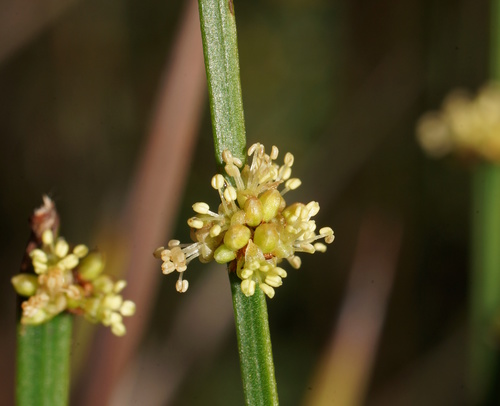
Amperea, Genus, xiphoclada, Species,
- Genus & species
broom spurge
Overview
Amperea xiphoclada is a wiry perennial subshrub in the Euphorbiaceae family reaching 12-36 inches (30-90 cm) tall, forming a clump of slender, flattened green stems. The stems are ribbed and broom-like, 0.04-0.08 inch (1-2 mm) wide, and carry out most of the plant photosynthesis; the true leaves are reduced to small scales 0.04-0.2 inch (1-5 mm) long that drop early. Small greenish to reddish flowers without petals sit in clusters along the stems from late winter through spring, the male and female flowers separate on the same plant. A three-lobed capsule about 0.1 inch (3 mm) wide follows and splits to release the seed. Growth is moderate, with the clump resprouting from a woody rootstock after fire or cutting. The slender stems give a sparse, almost leafless appearance year-round. The species grows on shallow sandy and rocky soils and tolerates low fertility, but does not persist in shaded or heavily watered positions.
Native Range
Native to southeastern Australia, occurring in Queensland, New South Wales, Victoria, Tasmania, and South Australia. Grows in heathland, dry sclerophyll forest, and rocky outcrops on shallow, well-drained sandy soils.Suggested Uses
Planted in native and habitat gardens, rockeries, and low-water plantings on sandy soils, spaced 12-18 inches (30-45 cm) apart. The sparse, broom-like form suits dry mixed plantings rather than dense borders. Tolerates low-fertility sites where many plants decline.How to Identify
Appearance
Size & Dimensions
Height1' - 3'
Width/Spread1' - 2'
Bloom Information
Detailed Descriptions
Flower Description
greenish to reddishFoliage Description
greenGrowing Conditions
Sun Requirements
Requires 6-10 hours of direct sunlight daily
• Full Sun: 6+ hours of direct sunlight
• Partial Shade: 3-6 hours of direct sunlight
• Full Shade: Less than 3 hours of direct sunlight
Care & Maintenance
Care Guide
Grows in full sun on shallow, free-draining sandy or rocky soil of low fertility. Water sparingly during the first season; established plants tolerate extended dry periods and do not persist in soils that stay wet. The woody rootstock resprouts after fire or cutting to ground level. Few pests or diseases affect it in open, airy sites. Shade and rich, moist soils reduce vigor and shorten the plant life.Pruning
Cut stems back near ground level in late winter to remove old growth, as the rootstock resprouts in spring. No flower or seed removal is needed. Dead stems can be cleared by hand from the clump.Pruning Schedule
Prune: July–August
winter