Alyxia, Genus, stellata, Species,
- Genus & species
Maile
Hawaiian Islands and the tropical South Pacific
Overview
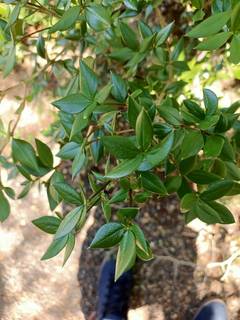
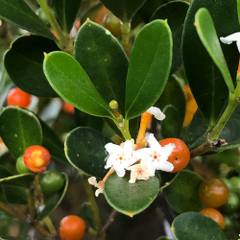
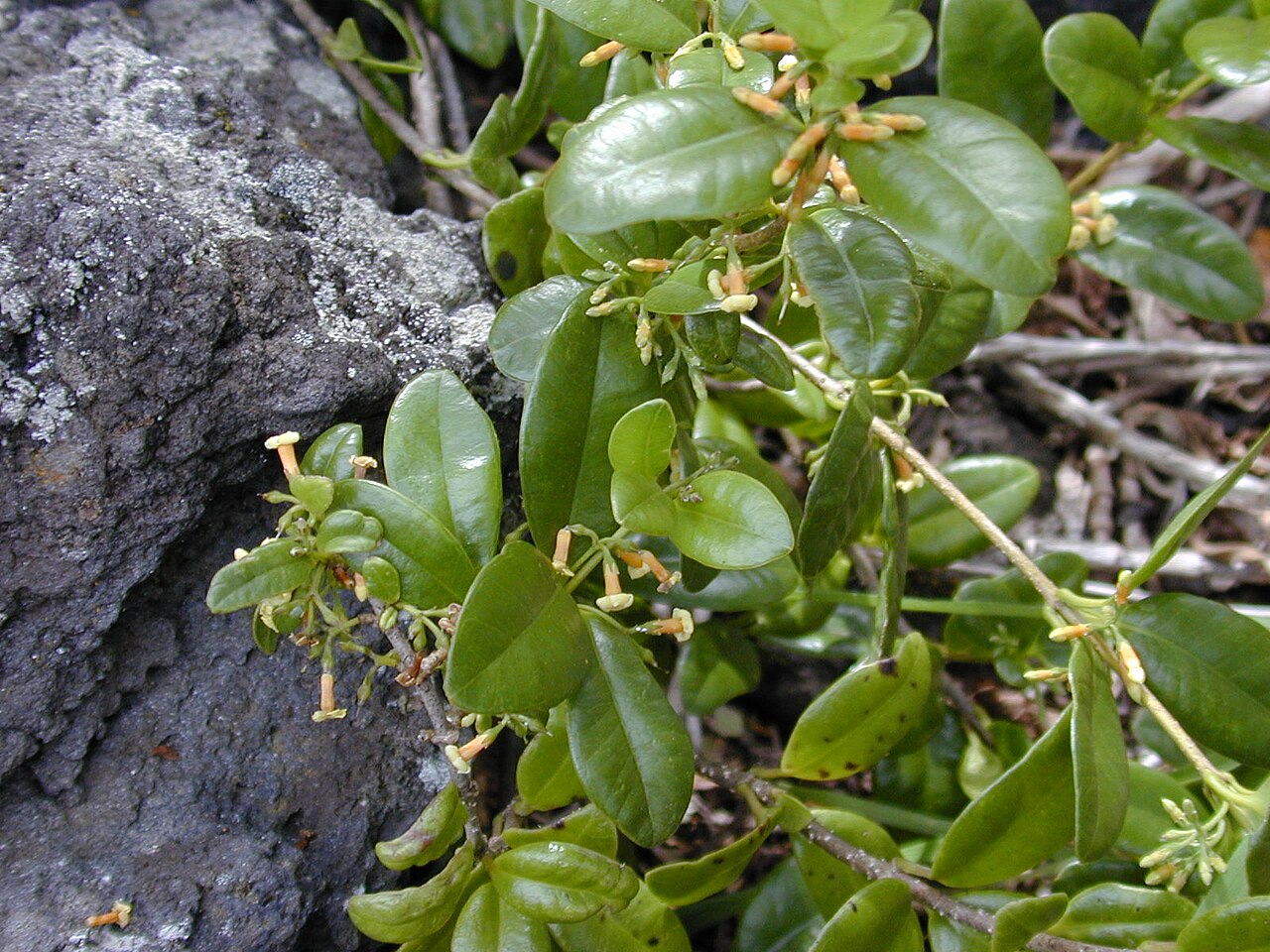
Alyxia stellata is an evergreen woody twiner in the Apocynaceae, climbing 10-30 feet (3-9 m) into supporting trees or forming a sprawling shrub 3-5 feet (0.9-1.5 m) tall where no support is present. Stems are slender, 0.1-0.3 inch (3-8 mm) in diameter, and release white latex when cut. Leaves are leathery, glossy dark green above and paler beneath, arranged opposite or in whorls of three, and measure 1-4 inches (2.5-10 cm) long. Leaf outline varies from linear at 0.3 inch (8 mm) wide to nearly round at 1.5 inches (4 cm) wide, sometimes on the same plant. Flowers are tubular, 0.2-0.3 inch (5-8 mm) across, greenish-yellow to cream, fragrant, and borne in axillary clusters of 3-10. Fruit is a drupe 0.4-0.6 inch (10-15 mm) long, ripening green through orange to purple-black, often produced in chains of two or three segments. Foliage and bark contain coumarin and release a scent of cut hay and vanilla as they wilt and dry. Stem extension runs 12-24 inches (30-60 cm) per year in cultivation, and plants reach flowering size in 4-6 years. Seedlings establish poorly in full sun, and roots decline in soil that stays saturated.
Native Range
Native to the Hawaiian Islands, occurring on all main islands from near sea level to about 6,500 feet (2,000 m). Habitat spans dry shrubland, mesic Acacia koa forest, and wet Metrosideros polymorpha forest, usually in the understory or scrambling through canopy gaps. The wider species range extends across islands of the tropical South Pacific, including Fiji, Samoa, Tonga, and the Society Islands.Suggested Uses
Grown on trellises, arbors, and fence lines in Hawaiian gardens at 4-6 foot (1.2-1.8 m) spacing, and used in native-plant restoration under Metrosideros polymorpha and Acacia koa. Stems and leaves are harvested for open-ended lei worn at graduations, weddings, and hula performances, a practice that has generated collection pressure on accessible wild populations. Container culture succeeds in pots of 5 gallons (19 L) or larger with a trellis, though growth is slower than in ground and plants rarely exceed 6 feet (1.8 m).How to Identify
Appearance
Size & Dimensions
Height10' - 30'
Width/Spread3' - 6'
Bloom Information
Flowering runs mainly from March through August, with scattered flowers in other months at elevations below 1,500 feet (460 m). Individual flowers last 3-5 days, and a plant carries open flowers across 8-12 weeks. Fruit ripens 4-6 months after flowering, so green and purple-black drupes are often present together. Flowering is sparse on plants in deep shade receiving less than 20 percent of full sunlight.
Detailed Descriptions
Flower Description
greenish-yellow to creamFoliage Description
glossy dark green above, pale green beneathGrowing Conditions
Sun Requirements
Requires 2-6 hours of direct sunlight daily
• Full Sun: 6+ hours of direct sunlight
• Partial Shade: 3-6 hours of direct sunlight
• Full Shade: Less than 3 hours of direct sunlight
Care & Maintenance
Care Guide
Young plants establish under 30-50 percent shade cloth and move to a permanent position after 12-18 months, once stems reach 12 inches (30 cm). Water twice weekly through the first year in the absence of rain, then reduce to weekly; established plants tolerate 2-3 weeks of dry weather but shed older leaves during longer droughts. Soil must drain freely, since roots decline in ground that stays saturated more than a few days; cinder or coarse volcanic soil amended with 25-30 percent organic matter carries the species well. Stem extension of 12-24 inches (30-60 cm) per year means a trellis, fence, or host shrub is needed within the first two years. Scale insects and mealybugs colonize stem joints where air movement is limited. Foliage is damaged below 32 degrees F (0 degrees C), restricting outdoor culture to zones 10-12.Pruning
Stems are cut back in early spring before the main flush of new growth, removing no more than one third of total stem length in a season. Cuts into wood thicker than 0.5 inch (13 mm) regrow slowly and can take two seasons to produce replacement shoots. Stems harvested for lei are severed rather than stripped, since removing bark around the full circumference kills the stem above the cut. Unpruned plants climb to the top of their support and flower mainly in the upper third.Pruning Schedule
Prune: February–March
early spring
Container Growing
Suitable for container growing
Minimum container size: 5 gallons