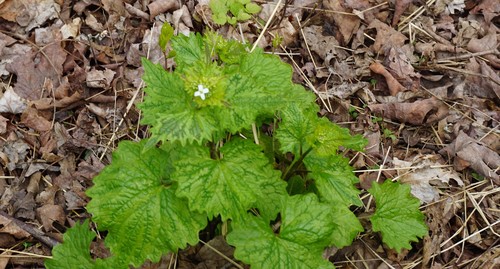
Alliaria, Genus, petiolata, Species,
- Genus & species
garlic mustard
Europe, western and central Asia, northwestern Africa
Overview
Alliaria petiolata is a biennial herbaceous plant in the mustard family (Brassicaceae) reaching 12–48 inches (30–120 cm) tall. First-year plants form a low rosette of kidney-shaped, scallop-edged basal leaves 2–4 inches (5–10 cm) across. Second-year plants bolt to an upright, unbranched or sparsely branched flowering stem. Stem leaves are alternate, triangular to heart-shaped, 2–3 inches (5–8 cm) long, with coarsely toothed margins. All parts emit a garlic-like odor when crushed. Flowers are four-petaled, white, 0.25 inch (6 mm) across, borne in terminal racemes from April through June. Fruit is a narrow silique 1–2.5 inches (2.5–6 cm) long containing black seeds. Roots produce compounds that suppress mycorrhizal fungi in the soil, disrupting native plant root symbioses. Listed as an invasive species in most of the United States and Canada. Seed bank persists in the soil for 5–10 years, making eradication difficult once established. Plants are shade-tolerant and colonize forest understories, floodplains, and disturbed roadsides.
Native Range
Native to Europe, western and central Asia, and northwestern Africa. Occurs across a wide elevational range from sea level to approximately 5,000 feet (1,500 m), typically in shaded or semi-shaded habitats including woodland margins, hedgerows, and riverbanks.Suggested Uses
Studied in invasive species management research and ecological restoration programs. Young leaves and roots have historical culinary use in European cuisine. Included in weed identification courses for land managers and forestry professionals.How to Identify
Appearance
Size & Dimensions
Height1' - 4'
Width/Spread6" - 1'6"
Bloom Information
Flowers from April through June in USDA zones 3–8. Individual racemes bloom over 2–3 weeks, with total flowering extending 4–6 weeks as lateral stems develop. Flowers are self-fertile and also cross-pollinated by small bees and flies. Seed set begins within 2 weeks of pollination.
Detailed Descriptions
Foliage Description
Dark green, kidney-shaped to triangular with coarsely toothed margins; crushed foliage emits garlic odorGrowing Conditions
Sun Requirements
Requires 2-6 hours of direct sunlight daily
• Full Sun: 6+ hours of direct sunlight
• Partial Shade: 3-6 hours of direct sunlight
• Full Shade: Less than 3 hours of direct sunlight