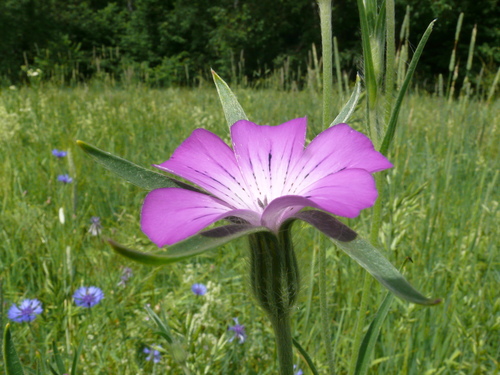
Agrostemma, Genus, githago, Species,
- Genus & species
corn cockle
Eastern Mediterranean and western Asia
SunFull Sun
Overview
Agrostemma githago is a slender, erect annual 12-40 inches (30-100 cm) tall, with unbranched or sparingly branched stems clothed in soft, flattened white hairs. The narrow, grey-green leaves are 2-5 inches (5-13 cm) long, lance-shaped, and joined in opposite pairs at the stem nodes. Solitary flowers 1.2-2 inches (3-5 cm) across open at the tips of long stalks from June to August. Each flower has five broad, notched petals in magenta to purple-pink, paler toward the centre and marked with dark dotted lines, surrounded by a calyx whose five narrow green lobes extend well beyond the petals. The flowers are followed by capsules holding large, black, roughened seeds. All parts, especially the seeds, contain toxic saponins (githagin) and are poisonous if eaten. A cornfield annual that completes its cycle in one season, it germinates with autumn or spring crops and once contaminated grain harvests widely. It is now scarce in the wild after seed cleaning removed it from cereal fields. Growth is poor in shade or dense vegetation.
Native Range
Native to the eastern Mediterranean and western Asia, and formerly naturalised across Europe and beyond as a weed of cereal fields. It grows on cultivated and disturbed ground, field margins, and waste places on well-drained soils, now mainly persisting from sown wildflower mixes.Suggested Uses
Grown in cornfield and wildflower meadow mixes, annual borders, and pollinator plantings on open, sunny ground, sown thinly where it can self-seed. Suited to disturbed, fertile or poor soils rather than shaded or crowded beds. Flowers draw bees and other long-tongued insects in summer.How to Identify
Appearance
Size & Dimensions
Height1' - 3'4"
Width/Spread6" - 1'
Bloom Information
Flowers from June to August, with peak bloom in midsummer. Each flower lasts a few days, and a plant blooms over several weeks as successive buds open on long stalks. Bloom finishes as plants set seed and die in late summer.
Detailed Descriptions
Flower Description
magenta to purple-pinkFoliage Description
grey-greenGrowing Conditions
Sun Requirements
Requires 6-10 hours of direct sunlight daily
• Full Sun: 6+ hours of direct sunlight
• Partial Shade: 3-6 hours of direct sunlight
• Full Shade: Less than 3 hours of direct sunlight
Water & Climate
Water Needs
Drought Tolerance
Drought tolerant when established
Care & Maintenance
Care Guide
Grows in full sun on free-draining, fertile to poor soils and tolerates dry, disturbed ground. It is raised from seed sown in autumn or spring where it is to flower, scattered on open soil, and needs no feeding. Tall stems may lean in rich soils or exposed sites and can need support. Self-sown seed maintains a stand on bare ground, though it competes poorly with dense vegetation. All parts are toxic if eaten, particularly the seeds, which are harmful to people and livestock. It has few pests or diseases and is pulled once seed has set.Pruning
No structural pruning is needed. Spent stems are cut or pulled once seed has formed, with some seed left to renew the planting. Removing capsules before they shed limits self-seeding where the plant is unwanted.Toxicity Warning
Toxic to pets and humansPlanting Guide
Planting Methods & Timing
Planting Method
direct sow
Direct Sow Timing
autumn or spring
Plant Spacing
9 inches