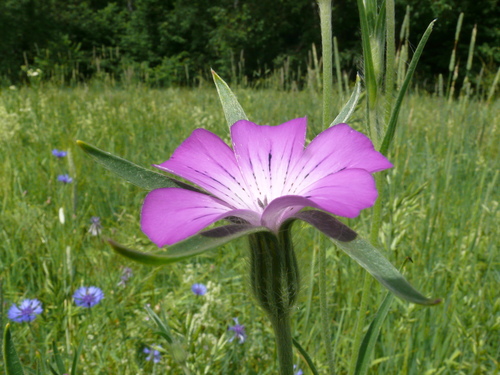
Overview
Agrostemma is a small genus of slender annual plants in the pink family, represented mainly by the corncockle, A. githago, once a common weed of cereal fields across Europe. Plants grow 24-36 inches (60-90 cm) tall on thin, branching, softly hairy stems with narrow, grey-green, opposite leaves. From early summer they carry large, solitary flowers 1.5-3 inches (4-7 cm) across, magenta to purple-pink with a paler centre and thin dark radiating lines, the narrow green sepals projecting beyond the five broad petals. The flowers open in sun and are followed by capsules holding large, hard black seeds. These seeds contain saponin compounds and are poisonous to people and livestock if eaten, and were historically a contaminant of harvested grain. The plant grows fast from seed on poor, dry, sunny soils, flowers over many weeks, and self-sows freely before dying at the end of the season. As farming and seed-cleaning improved, the corncockle has grown rare as an arable weed but is still grown in gardens and meadow mixes for its flowers.
Native Range
Agrostemma is native to the eastern Mediterranean and spread with cereal growing across Europe, western Asia, and North Africa. As a weed of cultivated grain it was carried worldwide, including to North America, though it has declined sharply with modern seed cleaning and now survives mostly in gardens and sown meadows.Suggested Uses
Grown in cottage gardens, annual borders, cut-flower plots, and wildflower or meadow seed mixes for its tall magenta flowers. It suits informal, naturalistic plantings and combines with cornfield annuals such as poppies and cornflowers. As a cut flower it lasts well on long stems in the vase.How to Identify
Appearance
Size & Dimensions
Height2' - 3'
Width/Spread9" - 1'
Bloom Information
Flowering runs from early summer to early autumn, roughly June to September, with single flowers opening over a long succession on branching stems. Each bloom is short-lived but is quickly followed by others. Seed capsules ripen from late summer.
Detailed Descriptions
Foliage Description
grey-greenGrowing Conditions
Sun Requirements
Requires 6-12 hours of direct sunlight daily
• Full Sun: 6+ hours of direct sunlight
• Partial Shade: 3-6 hours of direct sunlight
• Full Shade: Less than 3 hours of direct sunlight
Water & Climate
Water Needs
Drought Tolerance
Drought tolerant when established
Care & Maintenance
Care Guide
Grow in full sun in light, well-drained, even poor soil; rich ground produces tall, soft growth that flops. Sow seed in autumn or early spring where the plants are to flower, as the genus resents being transplanted. Water only in dry spells, since the plants tolerate lean, dry conditions once up. They need no feeding, and close spacing or light support helps hold up the slender stems. The seeds are poisonous, so plants are kept away from food crops and grazing animals, and self-sown seedlings are thinned where they crowd.Pruning
Deadhead spent flowers to prolong bloom and to limit self-seeding where it is not wanted. Cutting stems for the vase also keeps new buds coming. Plants are pulled up once flowering ends and the seed has ripened.Container Growing
Suitable for container growing
Minimum container size: 3 gallons
Toxicity Warning
Toxic to pets and humansPlanting Guide
Planting Methods & Timing
Planting Method
direct sow
Direct Sow Timing
autumn or early spring
Days to Maturity
60–90 days
Plant Spacing
10 inches
Companion Planting
Good Companions
