Adonidia, Genus, spp., Multiple species,
- Genus
- Multiple species
christmas palm
Overview
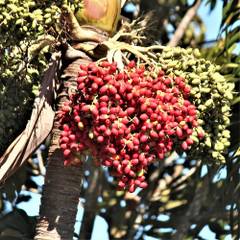
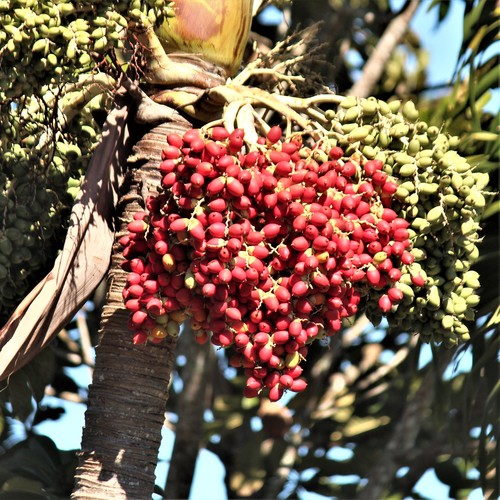
Adonidia is a small genus of pinnate-leaved palms in the family Arecaceae, with two species native to the Philippines and northern Borneo. The widely grown A. merrillii, the Manila or Christmas palm, makes a solitary trunk 15-25 feet (4.5-7.5 m) tall, smooth, grey, and ringed with old leaf scars, topped by a green crownshaft. The crown holds about 5 to 12 arching, feather-shaped fronds 4-5 feet (1.2-1.5 m) long, each with many narrow leaflets set in a flat plane. Branched flower clusters emerge below the crownshaft bearing small cream to white flowers, followed by egg-shaped fruits that ripen bright red, often around midwinter, which gives the Christmas palm its name. The crownshaft is self-cleaning, so spent fronds drop on their own. The genus is fully tropical, growing in warm, frost-free climates in full sun to part shade on moist, well-drained soil, and is killed or disfigured by temperatures near freezing. It tolerates some salt and suits coastal planting but has no frost hardiness. Young palms grow slowly, then speed up once the trunk forms.
Native Range
Adonidia is native to the Philippines and northern Borneo, where A. merrillii grows in coastal and lowland tropical forest on limestone soils. It is now planted throughout the tropics and subtropics as an ornamental and has naturalised in parts of Florida and the Caribbean.Suggested Uses
Planted as a specimen, in groups, and as a street or courtyard palm in tropical and subtropical gardens, and widely used in containers indoors and on patios in cooler climates. Its modest size suits small gardens and narrow spots where larger palms would not fit. Several palms are often set together in a clump for a fuller outline.How to Identify
Appearance
Size & Dimensions
Height15' - 25'
Width/Spread5' - 10'
Bloom Information
Flowering can occur through the year in the tropics but often peaks in summer, with branched sprays of small cream to white flowers below the crownshaft. Pollinated flowers develop into green fruit that ripen red over several months. Fruit colour most often peaks in winter, around the Christmas season.
Detailed Descriptions
Flower Description
cream to whiteFoliage Description
greenGrowing Conditions
Sun Requirements
Requires 4-12 hours of direct sunlight daily
• Full Sun: 6+ hours of direct sunlight
• Partial Shade: 3-6 hours of direct sunlight
• Full Shade: Less than 3 hours of direct sunlight
Care & Maintenance
Care Guide
Grow in full sun to part shade in moist, well-drained soil; young palms take light shade, but trunk and crown develop fastest in sun. Water regularly to keep the soil evenly moist, easing off only in cool spells, as the roots dislike both drought and waterlogging. Feed with a palm fertiliser carrying magnesium, manganese, and potassium, since the genus is prone to nutrient shortages that yellow the older fronds. It grows outdoors only in USDA zones 10 and 11 and is kept under glass or as an indoor palm elsewhere. Cold below about 30°F (-1°C) burns the foliage and sustained frost kills the palm.Pruning
Little pruning is needed, as the self-cleaning crownshaft sheds old fronds on its own. Fully brown, dead fronds can be cut off close to the trunk, while green and yellowing fronds are left in place, since the palm draws nutrients back from them. Removing the fruit clusters keeps seedlings from springing up beneath the palm.Container Growing
Suitable for container growing
Minimum container size: 10 gallons