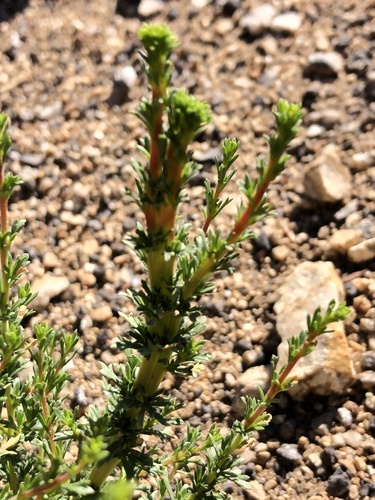
Adenostoma, Genus, fasciculatum, Species,
- Genus & species
chamise
California and northern Baja California
Overview
Adenostoma fasciculatum is an evergreen shrub reaching 2-12 feet (0.6-3.7 m) tall and about as wide, with many slender, flexible stems rising from a woody basal burl. The leaves are needle-like, 0.2-0.4 inch (4-10 mm) long, borne in small bundles (fascicles) along the stems, resinous, and dark green. Small white flowers about 0.1 inch (2-3 mm) across are crowded into branched clusters 1-4 inches (2.5-10 cm) long at the stem tips from late spring into summer. The flowers fade to a rusty brown and the dried clusters persist for months. Foliage and stems carry flammable resins, and the shrub is shaped by recurring fire, resprouting from the burl and germinating from seed afterward. Older stems shed reddish, shreddy bark. Growth is moderate, and plants form dense, twiggy thickets that dominate dry slopes.
Native Range
Native to California and northern Baja California, where it is a dominant shrub of chaparral on dry slopes and ridges from sea level to about 6,000 feet (1,800 m). It grows on poor, rocky, well-drained soils.Suggested Uses
Used in habitat restoration, erosion control on dry slopes, and native chaparral plantings, spaced 4-8 feet (1.2-2.4 m) apart. Its flammable foliage limits placement near buildings in fire-prone areas. Birds and small mammals shelter in the dense growth and feed on the seed.How to Identify
Appearance
Size & Dimensions
Height2' - 12'
Width/Spread2' - 12'
Bloom Information
Detailed Descriptions
Foliage Description
dark greenGrowing Conditions
Sun Requirements
Requires 6-12 hours of direct sunlight daily
• Full Sun: 6+ hours of direct sunlight
• Partial Shade: 3-6 hours of direct sunlight
• Full Shade: Less than 3 hours of direct sunlight
Care & Maintenance
Care Guide
Grows in full sun on dry, rocky, well-drained soils and tolerates extended summer drought without water. It establishes slowly and is harmed by summer irrigation, which promotes root rot. The resinous foliage is highly flammable, and dense stands raise fire risk near structures. After fire or cutting, plants resprout from the basal burl. Few pests affect it, and it needs no fertilizing in native soils. Growth is slow to moderate once established.Pruning
Prune in late summer after flowering to reduce size or remove dead wood; the shrub resprouts from the base after hard cutting. Thinning dead twiggy growth lowers flammability. Heavy pruning is followed by vigorous regrowth in the wet season.Pruning Schedule
Prune: August–September
summerfall