Adelinia, Genus, grandis, Species,
- Genus & species
Pacific hound's tongue
Overview
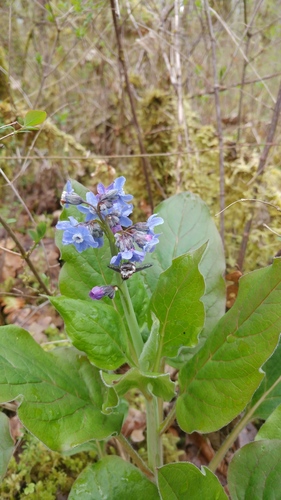
Adelinia grandis, Pacific hound's tongue, is a woodland perennial in the borage family of western North America, long known as Cynoglossum grande. It grows 12-36 inches (30-90 cm) tall from a deep, thickened root, sending up a few upright stems in late winter. The large basal leaves are oval to oblong, 4-8 inches (10-20 cm) long, on long stalks, deep green above and paler beneath. In early spring the stems carry loose clusters of flowers that resemble large forget-me-nots, each 0.5-0.75 inch (12-18 mm) across, deep blue to blue-purple with a ring of white, toothed appendages at the throat. The flowers feed early bees and other spring pollinators. Four barbed nutlets follow, which cling to fur and clothing and spread the seed. The plant grows in the shade of oak and mixed-evergreen woodland on slopes and canyon banks. As the soil dries in summer it sets seed and dies back, going dormant until the next wet season, so it occupies the garden for only part of the year.
Native Range
Native to western North America, from British Columbia south through Washington and Oregon to the mountains of southern California. It grows on shaded slopes, canyon walls, and the floor of oak and mixed-evergreen forest, mostly below 5,000 feet (1,500 m).Suggested Uses
Used in woodland and native shade gardens, under oaks, and in naturalized plantings for early-spring blue flowers. Combines with ferns and other spring ephemerals suited to a dry-summer dormancy.How to Identify
Appearance
Size & Dimensions
Height1' - 3'
Width/Spread1' - 1'6"
Bloom Information
Detailed Descriptions
Flower Description
deep blue to blue-purpleFoliage Description
deep greenGrowing Conditions
Sun Requirements
Requires 2-6 hours of direct sunlight daily
• Full Sun: 6+ hours of direct sunlight
• Partial Shade: 3-6 hours of direct sunlight
• Full Shade: Less than 3 hours of direct sunlight