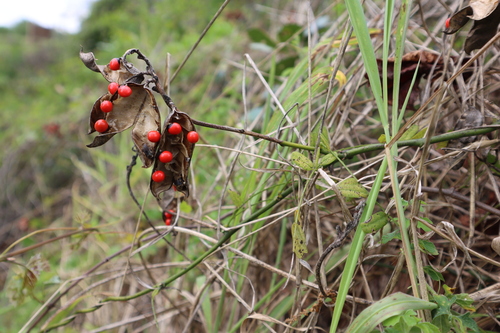
Abrus, Genus, precatorius, Species,
- Genus & species
rosary pea
Overview
Abrus precatorius is a slender, woody-based perennial vine in the pea family, twining to 10-20 feet (3-6 m) over supporting vegetation. The leaves are pinnately compound with 5-15 pairs of small oblong leaflets 0.4-0.7 inch (1-1.8 cm) long, giving a feathery outline. Small pea-shaped flowers, pale pink to lavender, are clustered in short racemes among the leaves. Flowering is followed by short, curved pods that split to reveal glossy seeds about 0.25 inch (6 mm) long, each bright scarlet with a single black spot at the attachment end. The seeds contain abrin, a highly toxic ribosome-inactivating protein, and ingestion of a single chewed seed can be fatal to humans and animals. The vine grows quickly in warm climates and climbs into shrubs and trees, where its weight and shade can smother host plants. Native to tropical Asia and Africa, it has naturalized across tropical and subtropical regions and is listed as a noxious invasive in Florida and other warm areas. It tolerates poor soils, heat, and drought once established.
Native Range
Abrus precatorius is native to tropical Asia and Africa. It has naturalized widely across tropical and subtropical regions worldwide, including Florida, Hawaii, and other warm parts of the United States, where it colonizes hammocks, pinelands, roadsides, and disturbed ground.Suggested Uses
In its native tropical range the dried seeds are used as beads and traditional weights, but the plant is not grown ornamentally in the United States because of its toxicity and invasive spread. It is listed as a noxious weed in Florida and is targeted for removal rather than cultivation. Within warm regions it grows wild on disturbed land, fence lines, and forest edges.How to Identify
Appearance
Size & Dimensions
Height10' - 20'
Width/Spread6' - 15'
Bloom Information
Pale pink to lavender flowers appear mainly in late summer and fall in warm climates, though flowering can occur year-round in frost-free areas. Seed pods follow within weeks and split to release the red-and-black seeds. Seeds persist on the vine and on the ground for long periods.
Detailed Descriptions
Flower Description
pale pink to lavenderFoliage Description
greenGrowing Conditions
Sun Requirements
Requires 4-12 hours of direct sunlight daily
• Full Sun: 6+ hours of direct sunlight
• Partial Shade: 3-6 hours of direct sunlight
• Full Shade: Less than 3 hours of direct sunlight
Care & Maintenance
Care Guide
Grows in full sun to part shade in warm, frost-free climates. It tolerates a wide range of soils, including poor and sandy ground, and withstands heat and drought once established. Growth is rapid, and the twining stems climb high into surrounding vegetation. The plant is cold-sensitive and is killed or cut back by frost. In its naturalized range it spreads by seed, and seeds remain viable for years in the soil. All parts, especially the seeds, contain abrin and are toxic to people, pets, and livestock.Pruning
Stems can be cut back at any time to control growth, with cut material containing toxic plant parts. In its invasive range, repeated cutting and removal of seed pods limit spread, though established root crowns resprout. Frost kills top growth in marginal climates.Pruning Schedule
Prune: January–February
winter