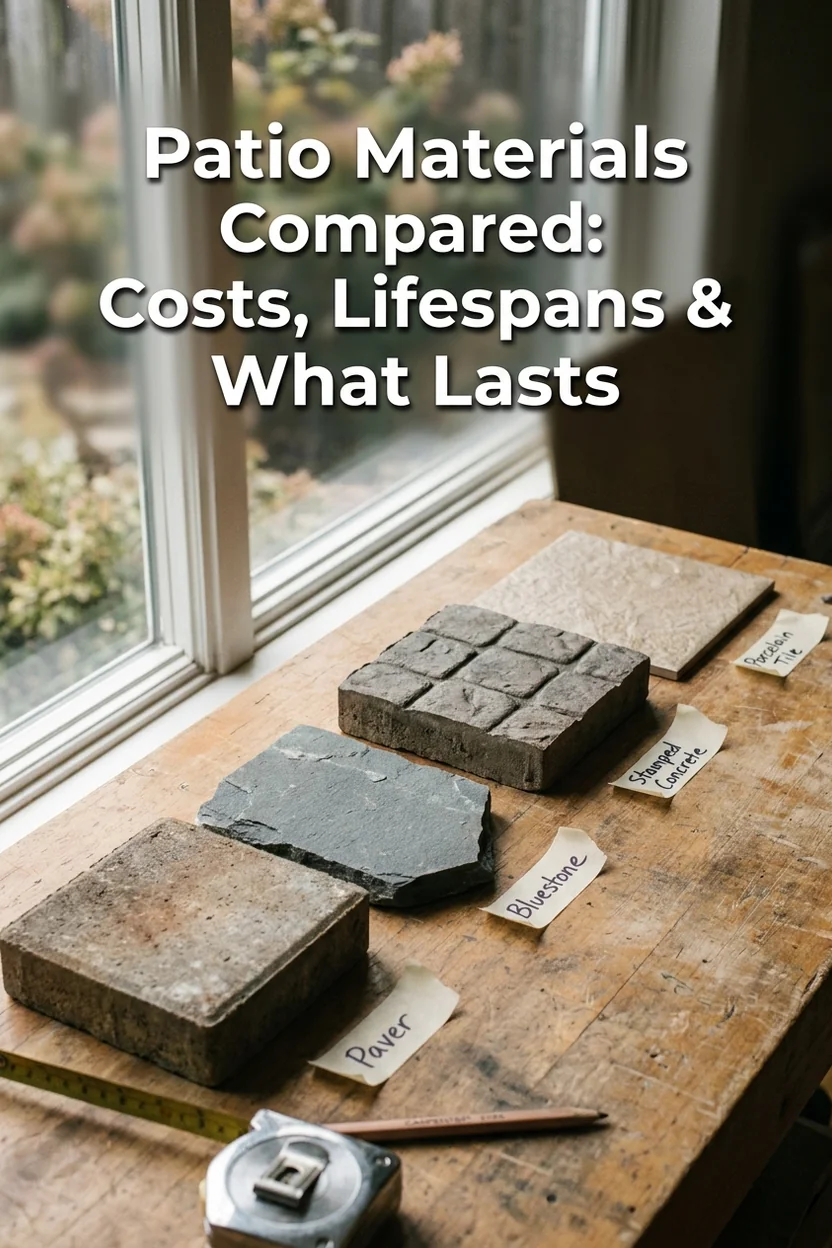
Patio Materials Compared: Pavers, Stone, Concrete & More
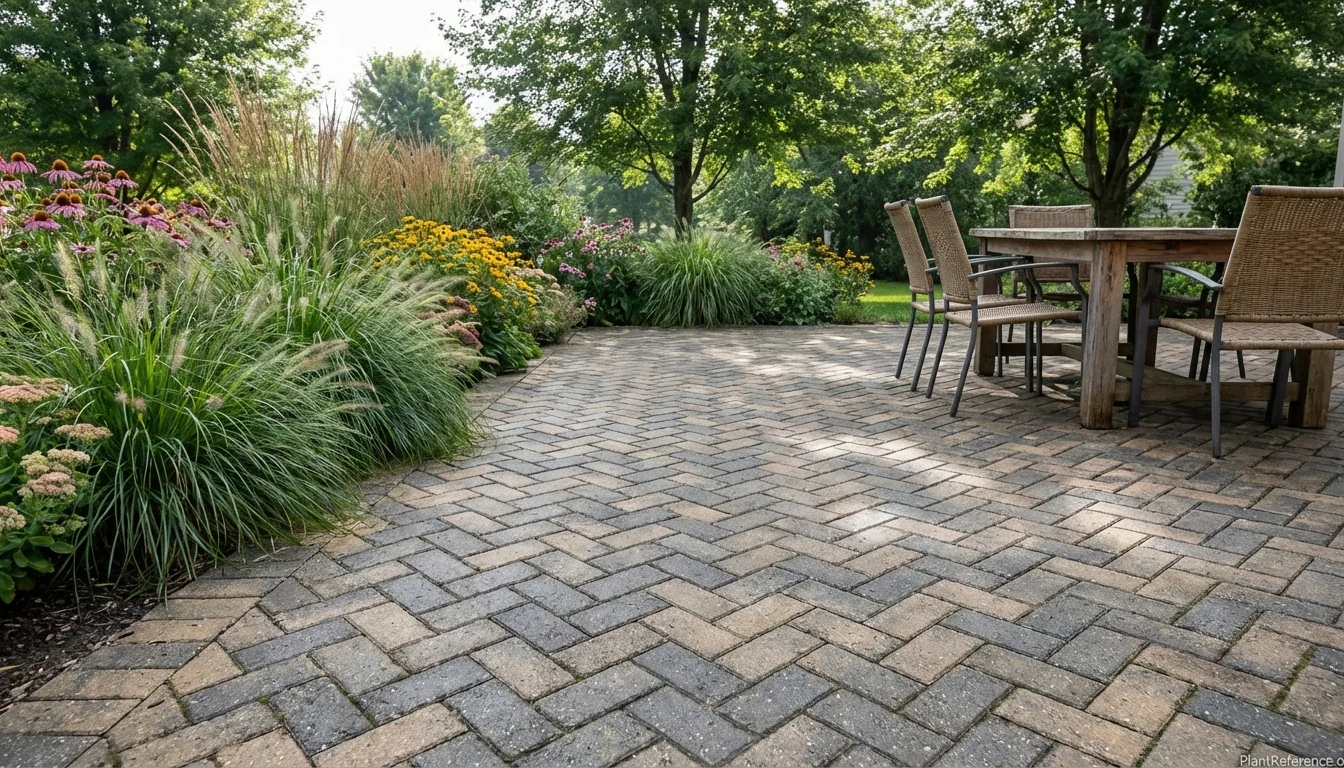
— Image © Plant Reference 2026
Choosing a patio material is a 30-year decision. The surface you pick has to survive freeze-thaw cycles, furniture loads, UV exposure, and everything your regional climate delivers — often without the option to replace individual sections when something fails. The cost gap between a $7/sq ft ($67/sq m) gravel patio and a $30/sq ft ($323/sq m) bluestone terrace looks completely different when you're thinking in decades rather than seasons.
Concrete Pavers: The Residential Standard
Concrete pavers dominate residential hardscape because they combine freeze-thaw durability with repairability, offer the widest range of colors and profiles, and perform equally well on a New England patio that sees six months of frost and a Texas courtyard that regularly hits 110°F (43°C). Standard interlocking units from manufacturers like Belgard, Unilock, Techo-Bloc, Pavestone, and Nicolock run $2–$8/sq ft ($22–$86/sq m) for materials, or $10–$25/sq ft ($97–$242/sq m) fully installed.
Pedestrian-grade pavers are 2⅜ inches (60mm) thick. Driveway or vehicle-traffic applications require 3⅛-inch (80mm) units. Lifespan runs 25–50 years with proper installation. Individual pavers can be pulled and replaced without disturbing the surrounding surface — a significant advantage over poured concrete when freeze-thaw cycles or tree roots shift the base. They flex as individual units rather than cracking monolithically.
The two major system types each suit different projects:
Pin systems (Versa-Lok, Keystone): fiberglass pins between courses provide the most positive connection and allow variable bond patterns; Versa-Lok Standard units sit at 82 lbs (37 kg) each with a 7° backward batter
Lip/channel systems (Allan Block, CornerStone): built-in raised lip creates batter without hardware, installs faster, equally effective for walls under 4 feet (1.2m)
Permeable pavers: wider joints filled with ASTM #8 or #9 aggregate instead of polymeric sand, allowing stormwater to infiltrate through an open-graded base system beneath
One maintenance item to budget for: pavers need polymeric sand swept back into joints every 5–10 years as it weathers out, and sealing every 3–5 years at $1–$2/sq ft ($11–$22/sq m) to protect color and simplify cleaning. Sealing is optional structurally — pavers perform fine without it — but unsealed surfaces stain more readily. Patio Materials Compared: Pavers, Stone, Concrete & More
Natural Stone: Character That Improves With Age
Natural stone has one advantage no manufactured product can replicate: it gets better with age. A bluestone terrace installed in the 1950s has more character today than when it was first laid. No concrete paver achieves that. Best Wood for Raised Garden Beds: Material Comparison and Longevity Test
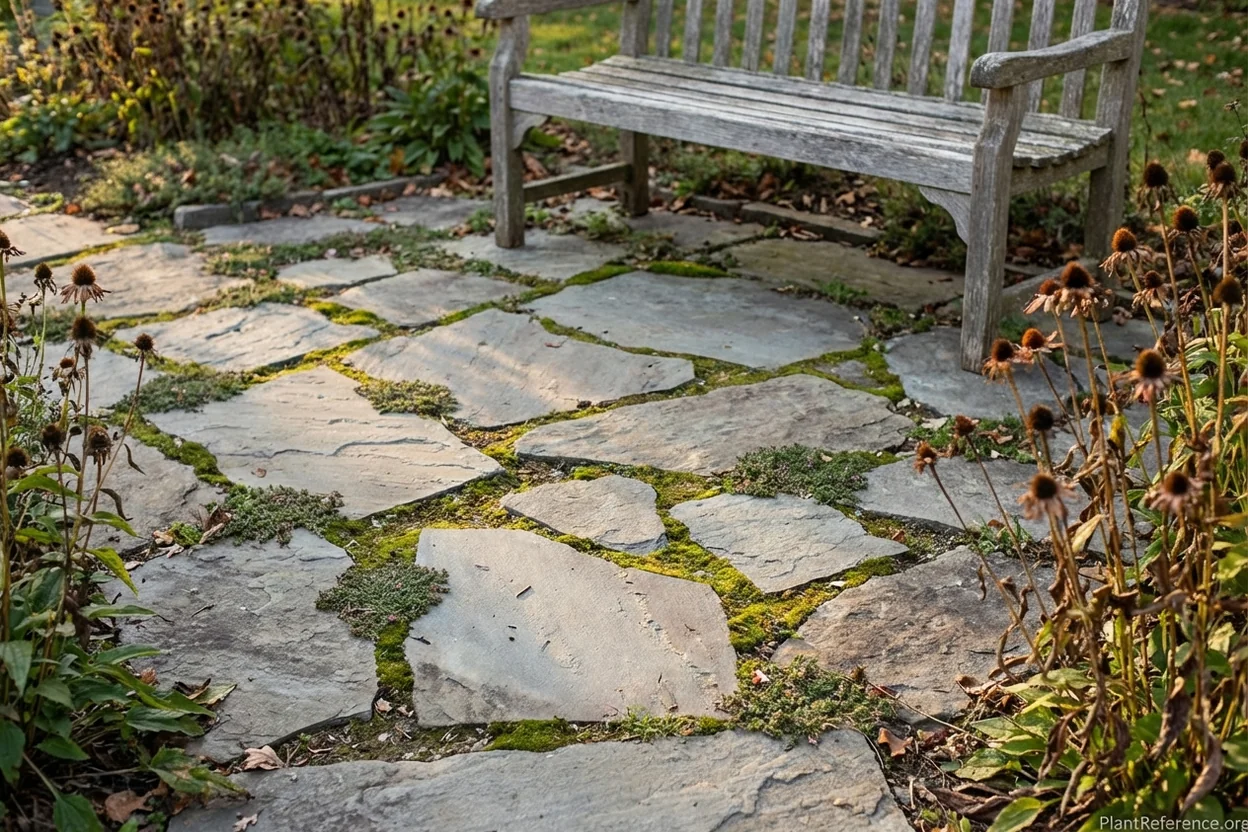
Bluestone ($18–$30/sq ft, $194–$323/sq m installed) is the premier cold-climate choice for northeastern U.S. patios, quarried primarily in Pennsylvania and the Shenandoah Valley. It handles freeze-thaw cycles exceptionally well, provides excellent slip resistance through its granular surface texture, and suits both cottage gardens and formal landscapes. Dark-colored bluestone absorbs significant heat on summer afternoons — a consideration for south-facing patios in hot climates.
Travertine ($16–$26/sq ft, $172–$280/sq m installed) stays naturally cool underfoot. Its porous surface dissipates heat rather than storing it, making it the standard choice for pool decks and hot-climate patios across the South and Southwest. That porosity requires sealing to prevent staining from food, drinks, and organic matter.
Slate ($10–$20/sq ft, $108–$215/sq m installed) offers the lowest porosity of common stones and excellent weatherproofing. Polished finishes become dangerously slippery when wet outdoors — always specify natural-cleft or honed surfaces.
Flagstone ($15–$30/sq ft, $161–$323/sq m installed) covers irregularly shaped stone of many types. Pennsylvania bluestone, Tennessee crab orchard, and Arizona sandstone all fall under this term but behave quite differently in freeze-thaw climates. Lifespan for well-installed natural stone runs 50–100+ years.
Dry-stacked flagstone installations without mortar between pieces allow water to pass freely through open joints, eliminating the hydrostatic pressure that can fracture mortared joints in freeze-thaw regions. The trade-off is that joints need periodic re-leveling as the ground shifts over decades. How to Build a Raised Garden Bed: Step-by-Step Construction Guide
Poured Concrete: Lowest Entry Cost, No Section Repairs
Poured concrete is the most cost-effective option for large, uncomplicated surfaces. Plain broom-finish runs $4–$12/sq ft ($43–$129/sq m), stamped concrete $12–$25/sq ft ($129–$269/sq m), and exposed aggregate $7–$18/sq ft ($75–$194/sq m). Standard patio thickness is 4 inches (100mm) minimum, with 5 inches (125mm) recommended for heavy outdoor furniture and planters.
The structural advantage is a seamless, monolithic surface with no joints to maintain and no risk of individual units shifting. The structural disadvantage is identical: when concrete cracks — and it eventually always does — you cannot replace a section. Cracks are permanent and visible, and there is no hiding a significant fracture in the middle of a 300 sq ft (28 sq m) slab.
In freeze-thaw climates, concrete requires 4–7% air entrainment in the mix. These microscopic bubbles act as pressure relief valves when water trapped inside the concrete expands 9% upon freezing. Without air entrainment, surface scaling and accelerated cracking are predictable outcomes within a few winters. Never allow water to be added on-site to a concrete delivery — every additional gallon reduces compressive strength by approximately 200 PSI (1.4 MPa). Raised Bed Soil Settling and Compaction: Prevention and Solutions
Stamped concrete achieves excellent visual results mimicking stone or wood, but the stamping process is time-critical and absolutely requires professional execution. The embossed texture also traps organic debris in impressions, demanding more frequent cleaning than smooth surfaces.
Porcelain, Brick, and Budget Options
Porcelain pavers represent the fastest-growing residential hardscape category. At 20mm thickness for pedestrian use (30mm for vehicular), these near-zero-porosity tiles from brands like MSI Arterra and Archatrak never need sealing, resist UV fading, and achieve superior freeze-thaw performance with water absorption below 0.5%. Materials cost $10–$22/sq ft ($108–$237/sq m). Large formats up to 48"×48" (1220mm×1220mm) can convincingly mimic wood, stone, or concrete planks.
The trade-offs are real: diamond-blade cutting equipment is required, precise leveling is non-negotiable, and porcelain chips more readily from point loads than concrete pavers. A planter dropped on a porcelain tile will likely chip where a concrete paver would survive intact.
Clay brick pavers ($10–$20/sq ft, $108–$215/sq m installed) carry one genuine advantage: color runs through the entire unit, fired in at kiln temperatures. That color will not fade or bleach the way some concrete pigments do over decades. Bricks meeting ASTM C67 carry lifespans of 25–100+ years in well-constructed installations.
Material | Installed Cost | Lifespan | Repairability | Freeze-Thaw | Maintenance |
|---|---|---|---|---|---|
Concrete Pavers | $10–$25/sq ft | 25–50 yrs | Individual units | Excellent | Seal every 3–5 yrs (optional) |
Natural Stone | $15–$30/sq ft | 50–100+ yrs | Moderate | Very good | Seal porous types |
Poured Concrete | $4–$25/sq ft | 30–40 yrs | None — cracks visible | Good w/ air entrainment | Seal every 2–3 yrs |
Porcelain Pavers | $14–$30/sq ft | 30–50 yrs | Individual tiles | Excellent | None required |
Clay Brick | $10–$20/sq ft | 25–100+ yrs | Individual bricks | Very good | Minimal |
Decomposed Granite | $4–$6/sq ft | 7–10 yrs | N/A | Poor | Periodic replenishment |
At the budget end, decomposed granite (DG) costs $0.30–$0.70/sq ft ($3–$8/sq m) for materials and $4–$6/sq ft ($43–$65/sq m) installed with stabilizer. Pea gravel runs $1.25–$1.80/sq ft ($13–$19/sq m). Both drain excellently but track indoors, shift in heavy rain, and fail ADA accessibility requirements for firm, stable surfaces. Poor Drainage in Raised Beds: Causes and Fixes for Waterlogged Soil
Design Principles That Drive Successful Patios
Scale and proportion drive patio success more than material choice. The Golden Rectangle ratio of roughly 1:1.6 produces naturally pleasing dimensions — a 15'×24' (4.6m×7.3m) patio fits this proportion. Size to actual use: a bistro set for two needs 10'×12' (3m×3.7m) minimum, dining for four to six requires 12'×14' to 16'×18' (3.7m×4.3m to 4.9m×5.5m), and a fire pit area needs 12'×12' to 16'×16' (3.7m×3.7m to 4.9m×4.9m).
The rule I apply on every project: whatever size seems right, add 2 feet (60cm) to each dimension. You need chair-pull distance, a circulation path around the table, and visual breathing room that prevents the patio from looking like furniture crammed onto a postage stamp.
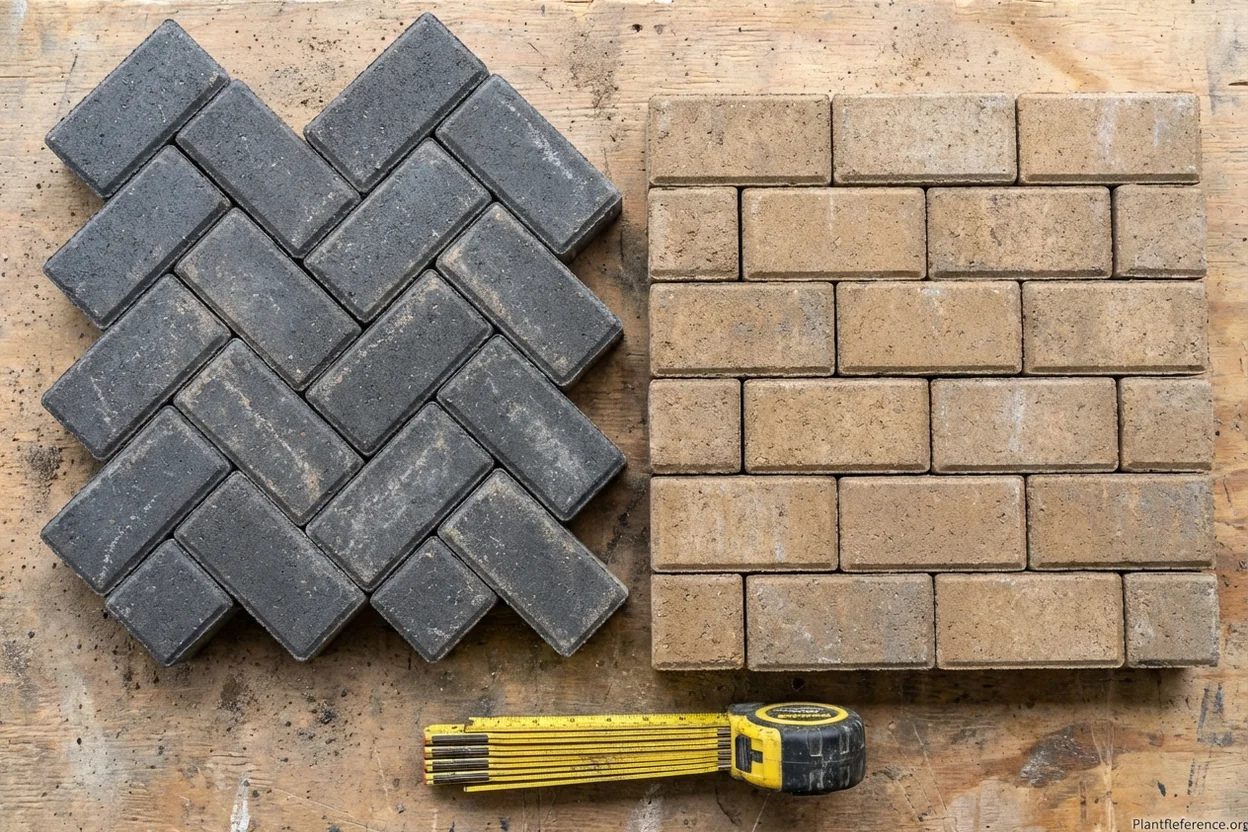
Laying patterns affect both aesthetics and structural performance. Herringbone at 45° provides the strongest interlock — the right choice for driveways and high-traffic areas, though the diagonal orientation requires roughly 20% extra material for edge cuts. Running bond (half-offset) suits most residential patios. Stack bond creates a clean modern grid but provides the weakest interlock — avoid it for driveways. Raised Bed Vegetable Garden Layout: Planning for Maximum Production The Complete Guide to Raised Bed Gardening for Beginners (2025)
Border treatments define the field pattern and contain pavers structurally. A soldier course — pavers set upright on the long edge — or a contrasting material border adds visual definition while also preventing the natural tendency of pavers to migrate outward over time.
Installation Fundamentals: Base, Sand, and Drainage
Approximately 90% of patio failures trace not to the surface material but to inadequate base preparation. An insufficient base on clay soil shifts and creates a wavy surface within 5–10 years regardless of how expensive the pavers are. A properly built base keeps even budget concrete pavers flat for 40 years.
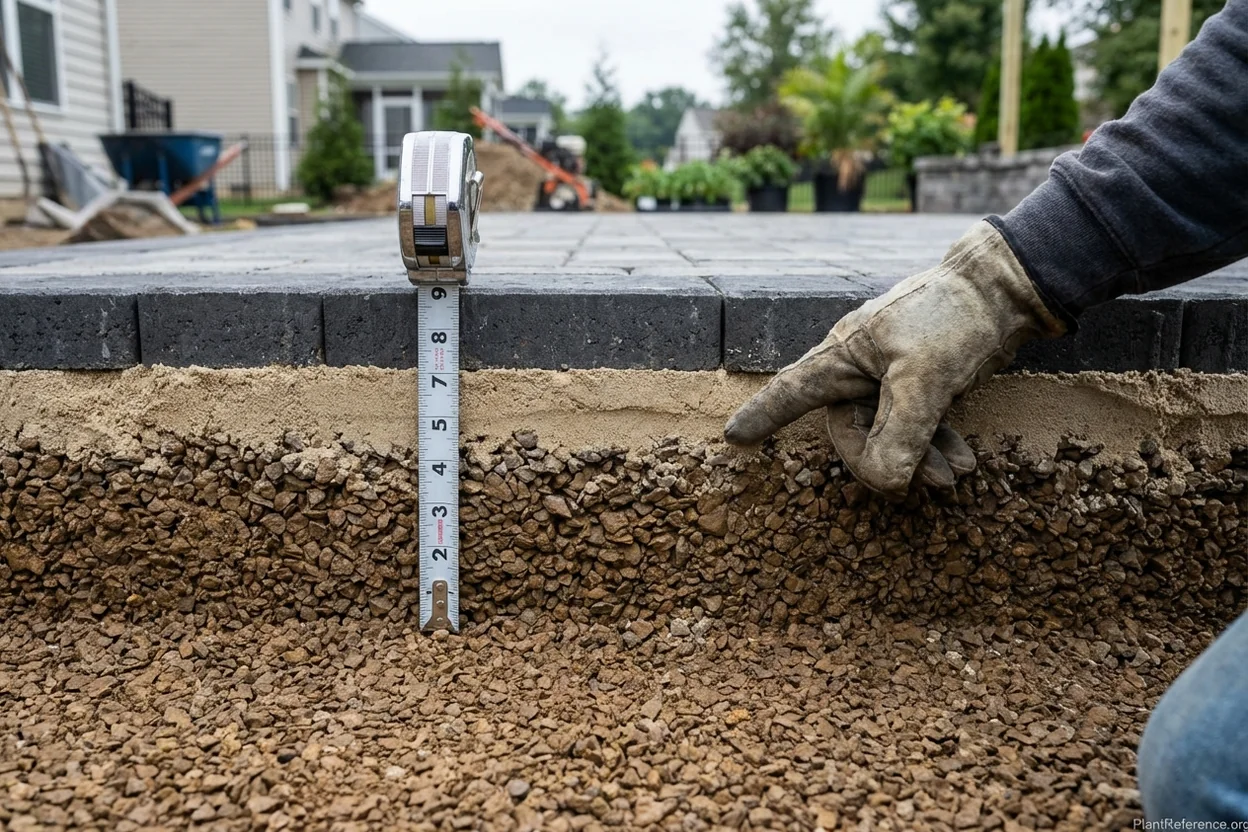
Excavation depth is calculated as: paver thickness + 1 inch (25mm) sand bed + base depth. Residential pedestrian patios need 6–8 inches (150–200mm) of compacted angular aggregate sub-base, for a total excavation of 9–11 inches (230–280mm). In cold climates, increase base depth to 10–12 inches (250–300mm). On clay soils, lay a non-woven geotextile fabric on the subgrade before any gravel to block fine particles from wicking upward into the aggregate over time.
The sub-base uses ¾-inch-minus (19mm) crushed angular aggregate — never recycled concrete, which causes efflorescence, and never stone dust, which traps water. Install in 2–3 inch (50–75mm) lifts, compacting each to 95%+ Proctor density with a plate compactor. Maintain a 1–2% slope away from structures throughout all base layers. Install edge restraints — plastic or aluminum, spiked with 10-inch (250mm) steel spikes every 8–12 inches (200–300mm) — before any paving. Without edge restraints, pavers migrate outward over years. This is the single most common failure in DIY installations.
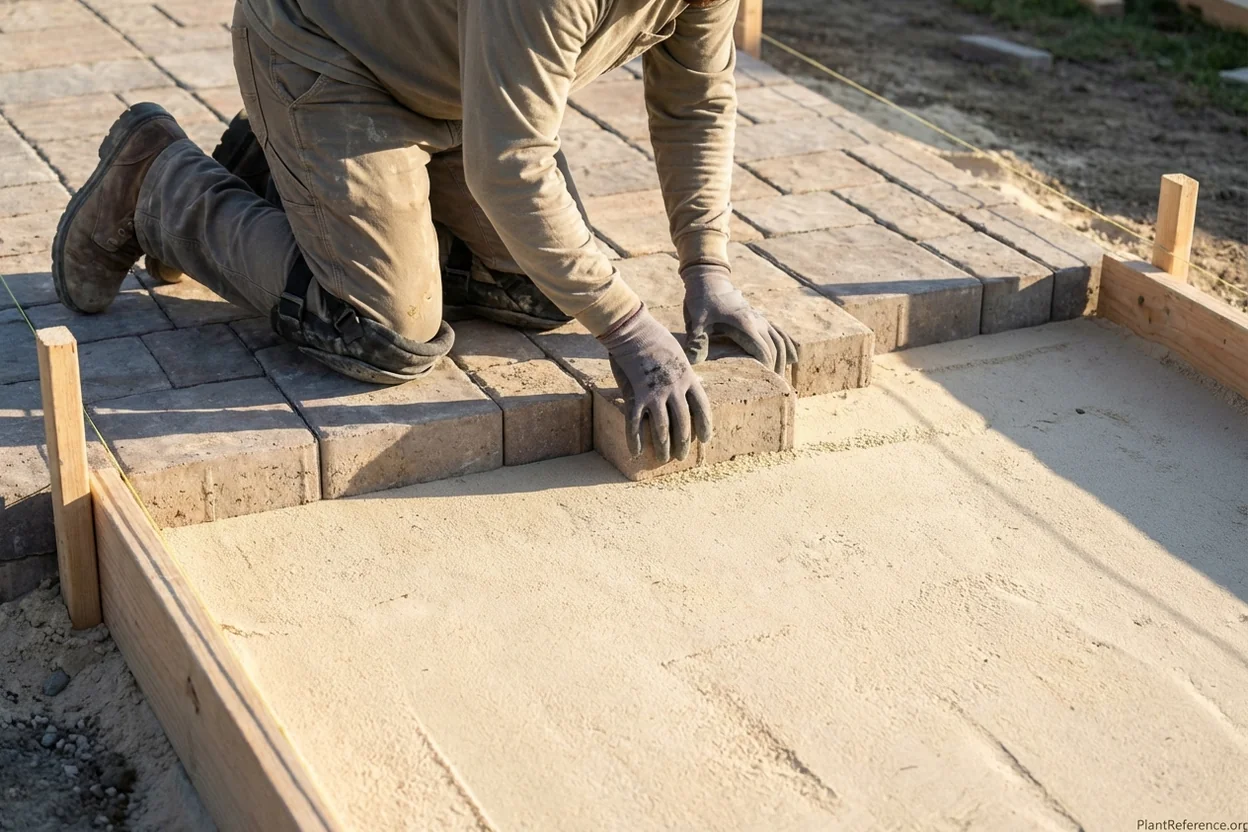
The sand setting bed uses coarse concrete sand meeting ASTM C33 specification, screeded to a uniform 1 inch (25mm) depth. Never use stone dust or limestone screenings — they trap moisture and do not compact correctly.
For jointing sand, top-tier polymeric products include Alliance Gator Maxx G2 (rain-safe in 15 minutes, 15-year warranty) and Techniseal HP NextGel (20-year warranty). Coverage averages 50–85 sq ft (4.6–7.9 sq m) per 50 lb (23 kg) bag depending on joint width.
Surface drainage requires a minimum slope of ⅛ inch per foot (1%), with ¼ inch per foot (2%) strongly preferred. Every patio needs somewhere for water to go. A beautiful patio that pools water after rain will cause exactly the freeze-thaw damage and base settlement that proper installation exists to prevent. Raised Bed Irrigation Systems: Watering Solutions for Consistent Growth
Regional Considerations and When to Hire a Pro
Freeze-thaw climates (the northern tier of the U.S.) require materials meeting ASTM C1645-16 for concrete pavers or ASTM C67 for clay brick, base depth of 10–12 inches (250–300mm) minimum, and polymeric sand rated for use below 32°F (0°C). Concrete patios in cold climates require air entrainment — if a contractor does not mention it when bidding a concrete project in a freeze-thaw region, ask specifically before signing anything.
Hot climates benefit from light-colored pavers and travertine over dark bluestone or slate, which absorb heat and become uncomfortable barefoot. Porcelain pavers are UV-stable and maintain consistent color through years of intense sun exposure.
Heavy-rain regions need slopes of 2%+ designed in from the start and integrated channel or catch-basin drains at hardscape perimeters.
DIY is realistic for simple rectangular patios under 200 sq ft (18.6 sq m) with basic patterns — saving 40–60% over professional installation, with DIY costs around $5–$10/sq ft ($54–$108/sq m) in materials versus $12–$40/sq ft ($129–$430/sq m) professionally installed. A professional crew completes a 300 sq ft (28 sq m) paver patio in 2–3 days; the same project takes a motivated homeowner 50+ hours across multiple weekends.
Hire a professional for anything over 300 sq ft (28 sq m), complex laying patterns, natural stone, stamped concrete, significant grade changes, or poor soil conditions. Look for ICPI/CMHA certification, verify at least $1 million in general liability insurance, and ask three questions before signing: What is your base preparation process? What jointing sand do you use? How do you handle drainage? Any contractor who cannot answer those three questions clearly should not be building your patio. Is My Tree Dangerous? 10 Warning Signs Every Homeowner Should Know Do I Need a Permit to Remove a Tree? A State-by-State Guide
Frequently Asked Questions
Reading about plants and recognising them are different skills. These three build the second.
- Daily PlantIdentify the day’s mystery plant from a close-up photograph.
- Keyed OutWork a dichotomous key, lead by lead, to name a hidden specimen.
- Name That PlantName a specimen from botanical clues dealt hardest first.
Free to play, no account needed
Tagged with
Kevin is a landscape contractor in the Boston area who specializes in cold-climate perennial gardens and hardscaping. He studied landscape design and worked at a prominent nursery on the North Shore before starting his own design-build firm. Kevin's gardens are built to handle New England weather—freeze-thaw cycles, nor'easters, late springs, and heavy snow loads. He's particularly interested in native perennials and shrubs that provide four-season interest without constant maintenance. Kevin writes about cold-hardy plant selection, winter garden structure, and building landscapes that look good even in February.