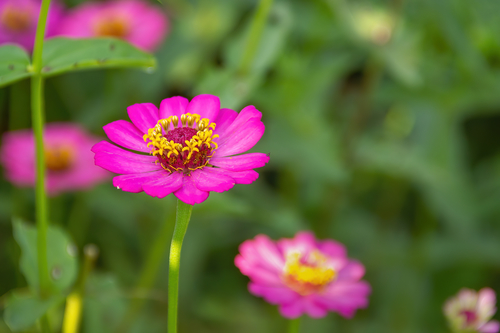
Zinnia, Genus, spp., Multiple species,
- Genus
- Multiple species
zinnias
Mexico, southwestern United States, and Central and South America
Overview
Zinnia is a genus of about 20 species in the daisy family (Asteraceae), ranging from annual herbs to perennial subshrubs. Plants grow 6 inches to 4 feet (15–120 cm) tall on stiff, upright stems lined with opposite, stalkless leaves 1–4 inches (2.5–10 cm) long. Solitary flower heads measure 1–6 inches (2.5–15 cm) across and occur in red, orange, yellow, pink, purple, and white, with single, semi-double, and fully double forms across cultivated species. Flowering runs from early summer until frost, with each head holding color for one to three weeks. Most garden zinnias derive from Z. elegans and Z. haageana, while Z. grandiflora is a low perennial of dry grassland. The genus is native to scrub, grassland, and disturbed ground from the southwestern United States through Mexico to South America, with the center of diversity in Mexico. Plants withstand heat and short dry spells once established but are sensitive to frost, which kills annual species outright. Powdery mildew develops on the foliage in humid conditions and where air movement is restricted. Flowering is heaviest in full sun and open soil.
Native Range
The genus is native to the Americas, with greatest species diversity in Mexico. Its range extends north into the southwestern United States and south through Central America into South America. Zinnia species grow in dry grassland, scrubland, and disturbed open ground, often on well-drained slopes.Suggested Uses
Zinnia is grown in annual borders, cutting gardens, and container plantings, spaced 9–12 inches (23–30 cm) apart. The flowers draw butterflies and other pollinators and hold up as cut stems. Lower-growing species and cultivars edge paths and fill seasonal gaps in mixed beds.How to Identify
Appearance
Size & Dimensions
Height6" - 4'
Width/Spread6" - 1'6"
Bloom Information
Flowering begins in early summer and continues until the first hard frost, typically June through October in temperate gardens. Individual heads hold color for one to three weeks, and removal of spent heads lengthens the display. Peak bloom falls in the heat of mid- to late summer.
Detailed Descriptions
Flower Description
red, orange, yellow, pink, purple, and whiteFoliage Description
greenGrowing Conditions
Sun Requirements
Requires 6-12 hours of direct sunlight daily
• Full Sun: 6+ hours of direct sunlight
• Partial Shade: 3-6 hours of direct sunlight
• Full Shade: Less than 3 hours of direct sunlight
Water & Climate
Water Needs
Drought Tolerance
Drought tolerant when established
Care & Maintenance
Care Guide
Plants grow in full sun, needing at least 6 hours of direct light for dense flowering. Well-drained loam or sandy soil at a pH of 5.5–7.5 suits the genus, and established plants withstand short dry periods. Overhead watering and crowded spacing encourage powdery mildew, so plants flower most freely with open spacing and watering at the base. Annual species are sown after the last frost once soil reaches 70°F (21°C), and seedlings flower within 60–70 days. Excess nitrogen produces foliage at the expense of flowers, so feeding is light.Pruning
Pinching the growing tips of young plants at 6–8 inches (15–20 cm) tall produces branching and additional flower stems. Removal of faded heads through the season redirects energy into new buds. Annual species are pulled after frost, while perennial species such as Z. grandiflora are cut to the base in late winter.Container Growing
Suitable for container growing
Toxicity
Non-toxicPlanting Guide
Planting Methods & Timing
Planting Method
both
Indoor Start
5 weeks before last frost
Direct Sow Timing
after last frost when soil reaches 70°F (21°C)
Days to Maturity
60–70 days
Plant Spacing
9 inches
