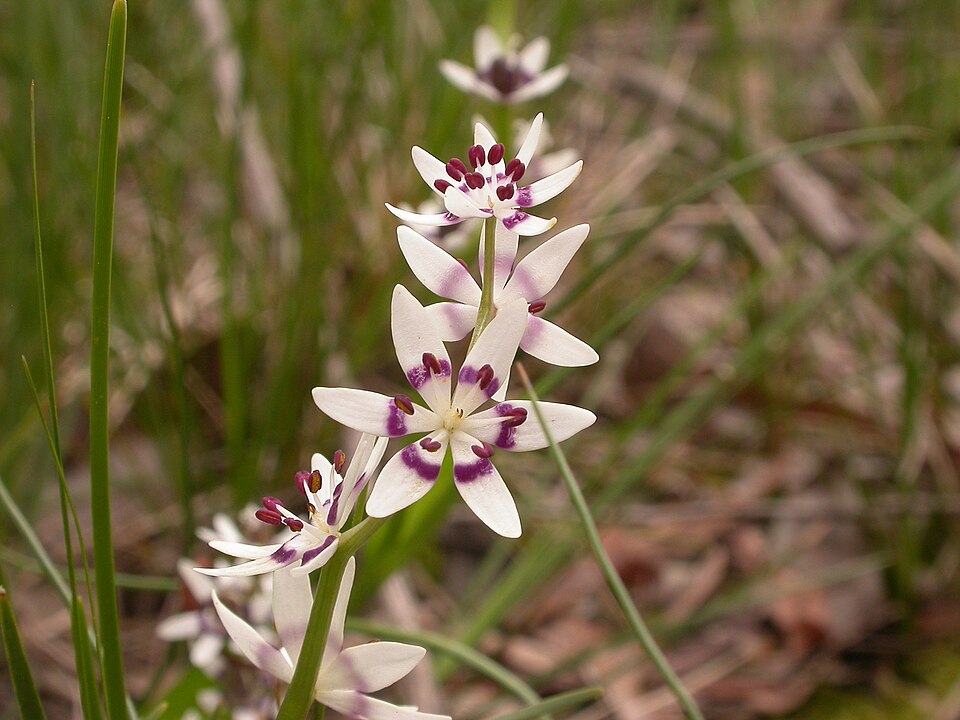
Wurmbea, Genus, spp., Multiple species,
- Genus
- Multiple species
early nancy
Overview
Wurmbea is a genus of about 50 small bulb-like perennials in the family Colchicaceae, native to Australia and to Africa. Each plant grows from an underground corm and sends up a short, slender stem 5-30 cm (2-12 in) tall bearing two or three narrow, channelled leaves and a small spike of star-shaped flowers. The flowers are usually white to pink, often marked with a darker maroon or purple band across each petal, and many species carry a contrasting nectary at the petal base. In several species the male and female flowers are borne on separate plants. Plants appear, flower, and set seed within a few weeks in late winter and spring, then die back to the dormant corm through the dry season. The genus grows in seasonally moist grassland, woodland, and damp depressions on a range of soils, surviving summer drought underground. Like other members of the family, the corms and foliage contain colchicine-type alkaloids that are poisonous to people and grazing animals. Across the genus, flower colour and size vary, and the small stature makes the plants easy to miss outside their brief flowering season.
Native Range
Species are native to Australia, where they grow across the southern and eastern states, and to central and southern Africa. They occupy seasonally wet grassland, open woodland, and the margins of swamps and claypans. The Australian species are widely known as early Nancy for their late-winter flowering.Suggested Uses
Used in rockeries, native and meadow plantings, and seasonal bulb displays in mild, dry-summer climates. The small flowers suit containers, troughs, and the front of gravelly beds. Also grown by bulb enthusiasts and in grassland restoration within its native range.How to Identify
Appearance
Size & Dimensions
Height2" - 1'
Width/Spread2" - 6"
Bloom Information
Flowering is brief and concentrated in late winter and spring, roughly August to October in southern Australia, with African species flowering in their own spring. Each plant blooms for only a few weeks before setting seed and dying back. Flowering depends on seasonal moisture and is heavier after a wet start to the season.
Detailed Descriptions
Flower Description
white to pink, banded with maroon or purpleFoliage Description
greenGrowing Conditions
Sun Requirements
Requires 5-9 hours of direct sunlight daily
• Full Sun: 6+ hours of direct sunlight
• Partial Shade: 3-6 hours of direct sunlight
• Full Shade: Less than 3 hours of direct sunlight
Care & Maintenance
Care Guide
Plants grow in full sun to light shade in soils that are moist during the winter-spring growing season and dry as the corms go dormant in summer. Sharp drainage and a dry summer rest suit them, while summer watering of dormant corms causes rot. They tolerate light frost during growth. The corms are planted in autumn at shallow depth, and clumps are left undisturbed to multiply. Feeding is light, using a low-strength balanced fertiliser as growth begins. All parts are poisonous if eaten, and few pests trouble the short-lived top growth.Pruning
No pruning is needed. The withered leaves and flower stems are left to die down naturally, which returns energy to the corm for the next season. Spent growth is cleared only once it has fully dried.Container Growing
Suitable for container growing
Minimum container size: 1 gallons
