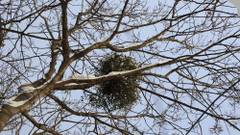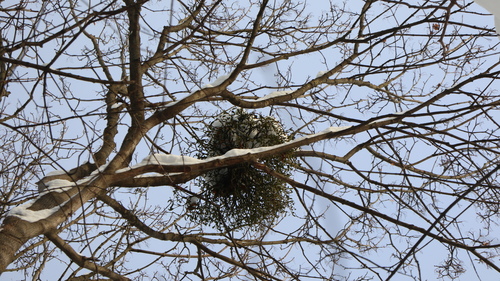
Viscum, Genus, spp., Multiple species,
- Genus
- Multiple species
mistletoe
Europe, Asia, Africa, and Australasia
SunFull Sun – Part Shade
WaterLow
Overview
Viscum is a genus of about 100 species of evergreen hemiparasitic shrubs that grow attached to the branches of trees and other woody plants. The most familiar species, V. album, is the mistletoe of European folklore and the winter holiday trade. Plants form rounded or pendulous bushes 0.3-1 m (1-3 ft) across, branching repeatedly in equal forks, with paired, leathery, yellow-green leaves; a few species are nearly leafless. Rather than rooting in soil, the genus attaches to a host through modified roots called haustoria that penetrate the bark and tap the host water and mineral supply while the green shoots make their own sugars. The small flowers are yellow-green and inconspicuous, with male and female flowers usually on separate plants, and they ripen into sticky one-seeded berries of white, yellow, pink, or red. Birds eat the berries and spread the seeds to new branches, where the sticky coat glues them in place. All parts contain viscotoxins and lectins that are poisonous to people and pets if eaten. Heavy infestations can weaken or deform host trees over time. The genus ranges across Europe, Asia, Africa, and Australasia.
Native Range
The genus is native to Europe, temperate and tropical Asia, Africa, and Australasia, and is absent as a native from the Americas. V. album ranges across Europe and into western and central Asia. Other species occur in African woodlands, Asian forests, and Australian scrub, always growing on the branches of host trees and shrubs.Suggested Uses
Gathered traditionally for winter and holiday decoration, especially V. album. Of interest in wildlife plantings because the berries feed birds in winter and the clumps shelter insects. Sometimes deliberately established on orchard or amenity trees by enthusiasts, accepting the cost to the host.How to Identify
Appearance
Size & Dimensions
Height1' - 3'
Width/Spread1' - 3'
Bloom Information
The small yellow-green flowers open in late winter and early spring and are easy to overlook. Male and female flowers occur on separate plants, so both must be present near each other for berries to set. Berries ripen the following autumn and winter and can persist on the plant for months.
Detailed Descriptions
Foliage Description
yellow-greenGrowing Conditions
Sun Requirements
Requires 4-8 hours of direct sunlight daily
• Full Sun: 6+ hours of direct sunlight
• Partial Shade: 3-6 hours of direct sunlight
• Full Shade: Less than 3 hours of direct sunlight
Water & Climate
Water Needs