Overview
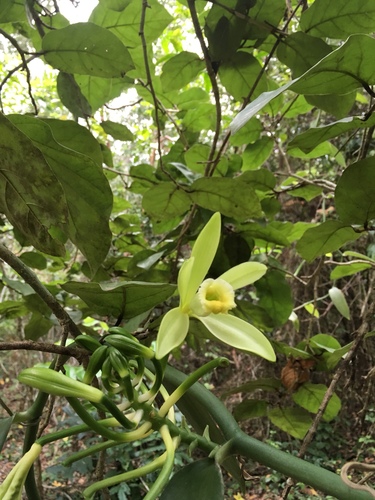
Vanilla planifolia is the commercial vanilla orchid, a climbing vine reaching 48–120 inches (120–300 cm) in indoor cultivation (much longer in tropical habitat). Thick succulent oblong dark green leaves 4–8 inches (10–20 cm) on a vining stem with aerial roots at each node that cling to supports. The source of commercial vanilla flavoring — the cured seed pods ('beans') are the vanilla of commerce, which is the second most expensive spice by weight after saffron. Yellow-green to pale yellow flowers 2 inches (5 cm) open for a single day and must be hand-pollinated within that window to produce beans. In commercial production in Mexico, the native pollinator is the Melipona bee; outside Mexico, all vanilla is hand-pollinated. The vine requires 3–5 years of growth (reaching 10+ feet / 3+ m) before flowering, and flowering in home cultivation is rare without tropical greenhouse conditions: high humidity (80%+), temperatures consistently above 60°F (16°C), and a support structure for the climbing vine. The curing process for harvested green beans takes 3–6 months of alternating sun exposure and sweating. Non-toxic. Native to Mexico, Central America, and the Caribbean. Bright indirect light. Well-draining orchid-type media (bark, perlite, peat). Mealybugs and scale. Growth rate is moderate.
Native Range
Native to Mexico, Central America, and the Caribbean. The Totonac people of Mexico were the first to cultivate vanilla. Madagascar is now the largest producer.Suggested Uses
Grown in containers of 3–5 gallons (12–20 liters) on a moss pole or trellis in bright indirect light with high humidity. The source plant of commercial vanilla. Bean production requires tropical greenhouse conditions and hand-pollination. Non-toxic.How to Identify
Appearance
Size & Dimensions
Height4' - 10'
Width/Spread2' - 4'
Bloom Information
Yellow-green to pale yellow flowers in spring on mature vines (3–5 years, 10+ feet / 3+ m). Each flower opens for a single day. Hand-pollination required for bean production. Flowering is rare in home cultivation without tropical greenhouse conditions.
Detailed Descriptions
Flower Description
Yellow-green to pale yellowFoliage Description
Dark green, thick, succulent, oblongGrowing Conditions
Sun Requirements
Requires 3-6 hours of direct sunlight daily
• Full Sun: 6+ hours of direct sunlight
• Partial Shade: 3-6 hours of direct sunlight
• Full Shade: Less than 3 hours of direct sunlight
Care & Maintenance
Care Guide
Bright indirect light. High humidity (80%+) for flowering. Temperatures above 60°F (16°C). Well-draining orchid media (bark, perlite, peat). Support structure for climbing. 3–5 years to potential flowering. Hand-pollination required for beans. Non-toxic. Mealybugs and scale.Pruning
Train the vine on a support (moss pole, trellis, or stake). Trim to control length. The vine can be looped back on itself on the support to keep it within a manageable size while accumulating the length needed for potential flowering.Container Growing
Suitable for container growing
Minimum container size: 3 gallons