Overview
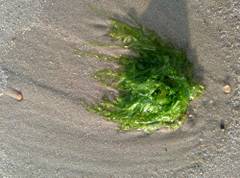
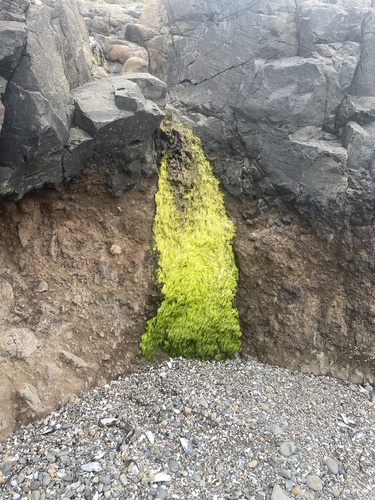
Ulva intestinalis is a bright green marine alga of the sea-lettuce family, forming hollow, tubular fronds that grow in clustered tufts. Each frond is unbranched, inflated like a thin intestine, and 10-30 cm (4-12 in) long, occasionally longer, often constricted at intervals and filled with gas that lets it float. The thallus is one cell layer thick, translucent grass-green, and attached to rock, shell, or other surfaces by a small basal holdfast. It lacks roots, stems, and leaves, taking nutrients directly from the surrounding water. The alga grows on rocks, pools, and mud in the intertidal zone, in estuaries, and in brackish water, tolerating a wide range of salinity and nutrient levels. It often grows heavily in nutrient-rich or polluted shallows, where dense floating mats can form. As an opportunistic species it grows and reproduces quickly, breaking up and decaying when conditions change.
Native Range
Ulva intestinalis is cosmopolitan, occurring on temperate and subtropical coasts worldwide, including throughout Europe, North America, Asia, and the Southern Hemisphere. It is common in intertidal and estuarine waters across this range. It readily colonises new and disturbed coastal surfaces.Suggested Uses
Ulva intestinalis is harvested as an edible sea vegetable, eaten fresh or dried in several coastal cuisines, and used as a feed and fertiliser ingredient. It also serves as an indicator of nutrient enrichment in coastal monitoring. It is foraged from clean shores rather than grown in gardens.How to Identify
Appearance
Size & Dimensions
Height4" - 1'
Colors
Foliage Colors
Bloom Information
As an alga it produces no flowers and reproduces by releasing swimming spores and gametes into the water. Reproduction peaks in the warmer months, when growth is fastest. Heavy growth and reproductive release often coincide with nutrient-rich conditions in late spring and summer.
Detailed Descriptions
Foliage Description
bright grass-greenGrowing Conditions
Water & Climate
Water Needs