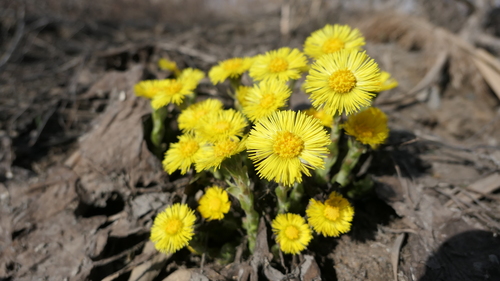
Tussilago, Genus, farfara, Species,
- Genus & species
colt's-foot
Europe, North Africa, and temperate Asia
Overview
Tussilago farfara is a low, rhizomatous perennial in the aster family that produces its flowers before its leaves, growing from a network of creeping underground rhizomes. In early spring it sends up leafless flower stalks 4-12 inches (10-30 cm) tall, clothed in reddish scales, each topped by a single yellow head 0.6-1.4 inches (1.5-3.5 cm) across with many narrow ray florets around a yellow disc. After the flowers fade, the leaves expand: broad, hoof- to heart-shaped blades 4-8 inches (10-20 cm) wide, green above and densely white-woolly beneath, on long stalks. The flower heads close at night and form round, dandelion-like seed clusters that disperse on the wind. The plant spreads mainly by its deep, brittle rhizomes, which fragment readily and regrow, forming colonies on clay banks, ditches, roadsides, and disturbed ground. It favors moist, heavy soils and bare ground, where it often appears as an early colonizer. In North America it has naturalized and is treated as invasive in parts of the Northeast and Pacific Northwest. All parts contain pyrrolizidine alkaloids that can damage the liver if consumed, despite the plant's long record of use in herbal preparations.
Native Range
Tussilago farfara is native to Europe, North Africa, and temperate Asia. It has naturalized in North America, where it grows on roadsides, streambanks, and disturbed clay soils and is listed as invasive in several northeastern states.Suggested Uses
Tussilago farfara is grown occasionally for its early yellow flowers and large leaves on damp banks and in wild areas, though its rhizomatous spread and toxicity limit garden use. It can stabilize bare clay and disturbed slopes where its spreading habit is contained. In most settings it occurs as a weed of roadsides and ditches rather than a chosen plant.How to Identify
Appearance
Size & Dimensions
Height4" - 1'
Width/Spread1' - 2'
Bloom Information
Flowering occurs in early spring, often February to April, before the leaves emerge. The solitary yellow heads open on scaly stalks and close at night, later forming round, white seed clusters carried on the wind. By the time the leaves are full-sized, flowering has finished.
Detailed Descriptions
Foliage Description
green above, white beneathGrowing Conditions
Sun Requirements
Requires 4-8 hours of direct sunlight daily
• Full Sun: 6+ hours of direct sunlight
• Partial Shade: 3-6 hours of direct sunlight
• Full Shade: Less than 3 hours of direct sunlight
Care & Maintenance
Care Guide
Tussilago farfara grows in full sun to partial shade in moist, heavy soils, including clay banks and compacted ground, and needs no watering or feeding. It spreads by deep rhizomes that fragment and resprout, so colonies enlarge quickly and reach well beyond the original planting. Cultivation and digging break the rhizomes and spread them further rather than controlling the plant. Removing it requires lifting the full depth of the brittle rhizome system, as any piece left regrows. The plant tolerates poor drainage and bare, disturbed sites where many others fail. Its early growth and rhizome spread make it persistent once established.Pruning
Removing flower stalks before the seed heads form limits windborne seed spread. Cutting or pulling the leaves through the season weakens the rhizomes over time but does not remove them. The deep rhizomes regrow from fragments, so repeated removal across seasons is usually needed.Pruning Schedule
Prune: March–April
early spring
Container Growing
Suitable for container growing
Minimum container size: 3 gallons