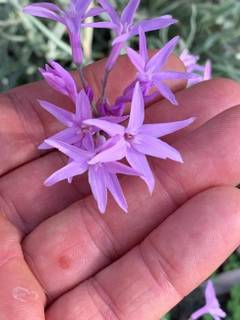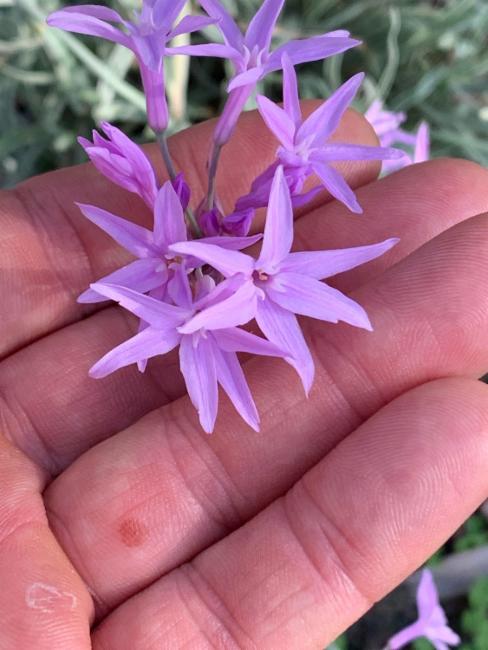
Tulbaghia, Genus, spp., Multiple species,
- Genus
- Multiple species
wild garlics
Overview
Tulbaghia is a genus of about 20 to 30 species of clump-forming perennial herbs in the family Amaryllidaceae, native to southern and eastern Africa and centered on South Africa. The plants grow from short rhizomes or corm-like bases and form tufts of narrow, strap-like to grass-like leaves 8-14 in (20-35 cm) long that smell strongly of garlic when bruised. From late spring through autumn they send up bare flower stalks 12-24 in (30-60 cm) tall, each topped by an open umbel of small, tubular, six-pointed star flowers. The flowers are usually mauve, lilac, or pink, with white and greenish forms in some species, and many carry a small central crown or corona. The species most often grown, T. violacea, the society garlic, blooms over many months and has edible, garlic-flavored leaves and flowers. Tulbaghia grows in full sun in well-drained soil and tolerates heat, drought, and poor ground once established. It is half-hardy, surviving outdoors mainly in USDA zones 7-10, and the foliage is damaged or killed by hard frost. The garlic scent of the leaves deters deer and rabbits but can carry in the garden, and clumps need dividing every few years as they crowd.
Native Range
Tulbaghia is native to southern and eastern Africa, with most species occurring in South Africa and extending north into tropical East Africa. The plants grow in grassland, on rocky slopes, and in open scrub, often in seasonally dry summer- or winter-rainfall regions.Suggested Uses
Tulbaghia is grown in sunny borders, gravel and rock gardens, edging, and containers, and as low massed planting in warm-climate and water-thrifty gardens. The long-blooming T. violacea is used along paths and walls where its scent and flowers are close at hand, and its leaves and flowers serve as a mild garlic seasoning. The flowers draw bees, butterflies, and other pollinators.How to Identify
Appearance
Size & Dimensions
Height1' - 2'
Width/Spread8" - 1'6"
Bloom Information
Tulbaghia flowers over a long season, mainly late spring through autumn, with T. violacea blooming from spring until frost in mild climates. Fresh umbels open in succession on new stalks across the warm months. In frost-free regions some species bloom nearly year-round.
Detailed Descriptions
Flower Description
mauve, lilac, pink, or whiteFoliage Description
green to gray-greenGrowing Conditions
Sun Requirements
Requires 6-12 hours of direct sunlight daily
• Full Sun: 6+ hours of direct sunlight
• Partial Shade: 3-6 hours of direct sunlight
• Full Shade: Less than 3 hours of direct sunlight
Care & Maintenance
Care Guide
Grow Tulbaghia in full sun in light, well-drained soil, including sandy and rocky ground, where it tolerates heat, drought, and coastal conditions once established. Plants take regular summer water for the heaviest flowering but rot in wet, heavy soils, especially in winter. Most species are half-hardy, surviving outdoors in USDA zones 7-10, while in colder regions they are grown in containers and overwintered frost-free. Lift and divide crowded clumps every few years in spring to keep them flowering well. A spring feed supports the long bloom season. The garlic-scented foliage is little troubled by deer, rabbits, or most pests.Pruning
Tulbaghia needs little pruning beyond removing spent flower stalks to keep it tidy and prolong bloom. Frost-damaged or tattered leaves are trimmed in spring as new growth begins. Crowded clumps are lifted and divided every three to four years rather than pruned.Container Growing
Suitable for container growing
Minimum container size: 2 gallons