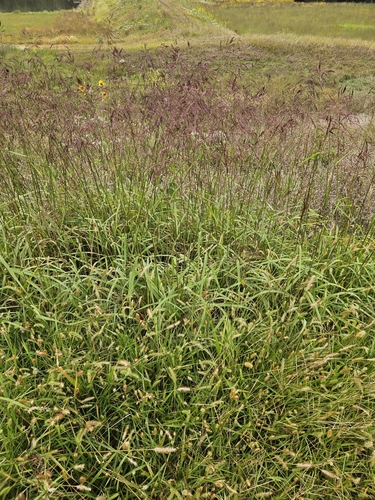
Tridens, Genus, flavus, Species,
- Genus & species
purpletop tridens
Overview
Tridens flavus is a warm-season perennial bunchgrass native to eastern and central North America, forming clumps 3-5 ft (90-150 cm) tall in flower. Flat green leaf blades 8-16 in (20-40 cm) long and about 0.25 in (6 mm) wide arise mostly from the base and turn bronze in autumn. From late summer into fall it sends up open, nodding flower panicles 8-16 in (20-40 cm) long, the branches spreading and drooping, tinged deep purple. The panicle surface is coated with a sticky, oily film that gives the plant its other common name, grease grass, and catches dust and pollen. It grows in old fields, prairie remnants, roadsides, woodland edges, and disturbed open ground in full sun. The plant self-seeds and can colonize bare soil, spreading into adjacent areas. Foliage is coarse and thins in winter once the panicles shatter. It hosts skipper butterfly larvae and produces seed eaten by birds.
Native Range
Native to eastern and central North America, from New Hampshire and Michigan south to Florida and Texas, with scattered populations farther west. It grows in old fields, open woods, prairie remnants, roadsides, and disturbed ground.Suggested Uses
Used in meadow and prairie plantings, naturalized borders, and erosion control on poor or disturbed soils. It is planted in groups spaced 18-24 in (45-60 cm) apart for a clumping mass. The purple panicles add late-season height and the seed draws birds.How to Identify
Appearance
Size & Dimensions
Height3' - 5'
Width/Spread2' - 3'
Bloom Information
Detailed Descriptions
Foliage Description
greenGrowing Conditions
Sun Requirements
Requires 6-12 hours of direct sunlight daily
• Full Sun: 6+ hours of direct sunlight
• Partial Shade: 3-6 hours of direct sunlight
• Full Shade: Less than 3 hours of direct sunlight
Care & Maintenance
Care Guide
Tridens flavus grows in full sun to light shade on a wide range of soils, from sand to clay, and tolerates poor, dry, and disturbed ground at a pH of 5.5-7.5. Established clumps are drought-tolerant and need no irrigation in most climates. It requires no fertilizer and grows readily on low-nutrient sites. Cutting the clump back in late winter clears old growth before spring regrowth. It spreads by seed and can move into open ground beyond a planting. It has few pest or disease problems.Pruning
Cut the clump to a few inches above the ground in late winter before new growth begins, removing the previous season stems and shattered panicles. No other pruning is needed. Division in spring can rejuvenate old, woody clumps.Pruning Schedule
Prune: February–March
winterearly spring