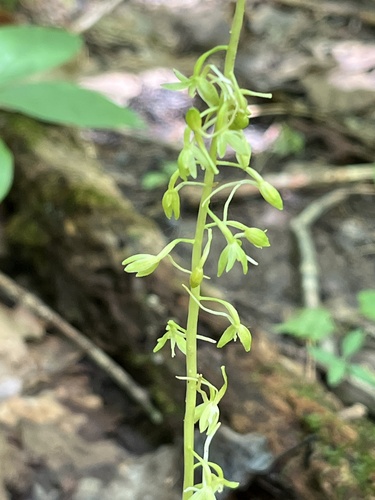
Tipularia, Genus, discolor, Species,
- Genus & species
crane-fly orchid
Overview
Tipularia discolor is a terrestrial orchid in the Orchidaceae that grows from a chain of underground corms in the shaded leaf litter of eastern North American woods. A single leaf appears in autumn and persists through winter, green or purple-tinged above and deep purple beneath, then withers by late spring before the plant flowers. In mid to late summer a leafless flowering stalk 8-20 inches (20-50 cm) tall rises and carries 20-40 small, translucent flowers in shades of green, bronze, and purple, each with a slender spur and an asymmetric, lopsided form that recalls a crane fly. The flowers are pollinated at night by moths. The plant grows slowly, depends on soil fungi to survive, and rarely survives transplanting or cultivation. The wintering leaf is easily hidden beneath fallen leaves and overlooked. Hardy in USDA zones 5-9, it grows in deep to partial shade in moist, humus-rich, acidic soil, often over decaying wood. Native to the eastern United States, Tipularia discolor grows in oak and beech woodland and along shaded slopes.
Native Range
Tipularia discolor is native to the eastern United States, from New England and New York south to Florida and west to Texas and the lower Midwest. It grows in moist, shaded deciduous woodland, often over rotting logs and in deep leaf litter.Suggested Uses
Grown only in established woodland and native plant gardens with undisturbed, fungus-rich soil, where existing colonies are protected in place. It is not suited to ordinary beds, containers, or transplanting.How to Identify
Appearance
Size & Dimensions
Height8" - 1'8"
Width/Spread4" - 8"
Bloom Information
A leafless flowering stalk rises in mid to late summer, typically July to August, well after the winter leaf has withered. It carries 20-40 small, translucent flowers that open over two to three weeks. Moths pollinate the flowers at night.
Detailed Descriptions
Flower Description
green, bronze, and purpleFoliage Description
green to purple above, deep purple beneathGrowing Conditions
Sun Requirements
Tolerates up to 3 hours of direct sunlight daily
• Full Sun: 6+ hours of direct sunlight
• Partial Shade: 3-6 hours of direct sunlight
• Full Shade: Less than 3 hours of direct sunlight