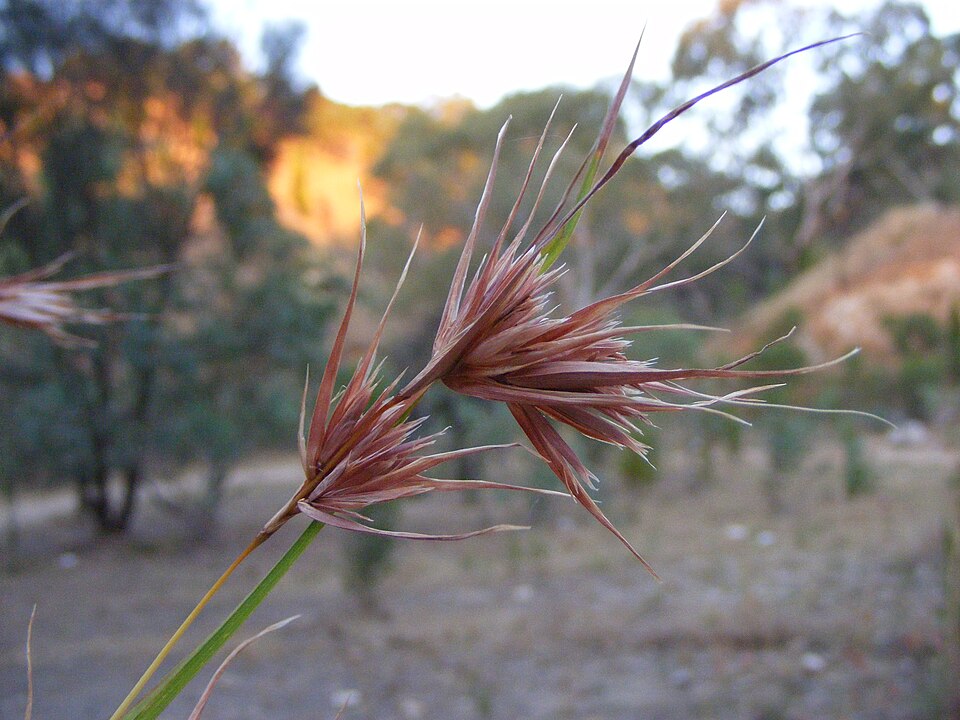
Themeda, Genus, spp., Multiple species,
- Genus
- Multiple species
kangaroo grass
Overview
Themeda is a genus of about 20 perennial and annual grasses in the family Poaceae, native to the grasslands and open woodlands of Africa, Asia, and Australia. Most are warm-season tussock grasses forming dense clumps of narrow, blue-green to grey-green leaves 2-5 feet (60-150 cm) tall, with the foliage flushing red, bronze, and orange through autumn. The kangaroo grass, T. triandra, dominates large areas of native grassland and savanna and is grazed as forage. Flowering stems carry drooping, asymmetric spikelet clusters with long, bent awns, ripening reddish-brown in summer and autumn. Plants are deep-rooted and fire-adapted, regrowing from the base after burning or cutting. They tolerate heat, drought, and poor soils once established but go dormant and brown in cold or dry winters. Themeda can be slow to establish from seed and may be outcompeted on rich, fertile ground by faster, weedier grasses. Clumps are long-lived where conditions suit.
Native Range
Themeda is native to the Old World tropics and subtropics, across Africa, southern and eastern Asia, and Australia. It grows in grassland, savanna, and open woodland, often on seasonally dry soils.Suggested Uses
Used in native grassland restoration, meadow and prairie-style plantings, and as an ornamental clumping grass for autumn color. Suited to dry, sunny banks and low-water gardens, and grown as forage in pasture.How to Identify
Appearance
Size & Dimensions
Height2' - 5'
Width/Spread1' - 2'
Bloom Information
Flowering stems appear in summer and autumn, carrying drooping clusters of reddish-brown spikelets with long, twisted awns. The wind-pollinated flowers are subtle but the bronze seed heads are conspicuous. Seed ripens and scatters through the warm season.
Detailed Descriptions
Foliage Description
blue-green, turning red and bronze in autumnGrowing Conditions
Sun Requirements
Requires 6-10 hours of direct sunlight daily
• Full Sun: 6+ hours of direct sunlight
• Partial Shade: 3-6 hours of direct sunlight
• Full Shade: Less than 3 hours of direct sunlight
Care & Maintenance
Care Guide
Grow in full sun on free-draining sandy, loamy, or rocky soil of low to moderate fertility. Water during establishment, then rely on rainfall, as plants tolerate heat and drought. Cut or burn back old growth in late winter to make way for fresh spring shoots. Plants need little or no feeding and suit lean soils. Foliage browns and goes dormant in cold or dry winters, recovering in spring.Pruning
Cut clumps back close to the ground in late winter before new growth begins to remove old, browned foliage. Plants tolerate this hard renewal and resprout from the base. No other pruning is needed.Container Growing
Suitable for container growing
Minimum container size: 3 gallons
