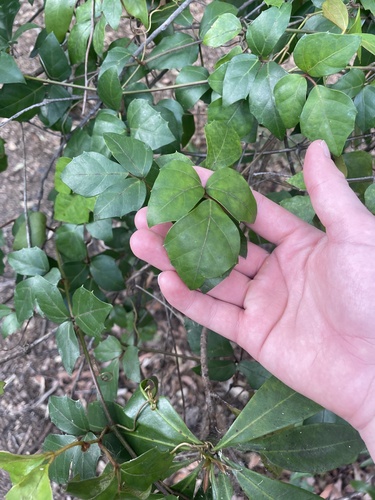
Tetrastigma, Genus, nitens, Species,
- Genus & species
native grape
Overview
Tetrastigma nitens is a woody climbing vine that uses forked tendrils to scramble high into rainforest canopies, with stems reaching 30-65 feet (9-20 m) long. The glossy compound leaves are divided into three to five leaflets, each 2-5 inches (5-13 cm) long, with toothed margins and a dark green upper surface. Small greenish-yellow flowers are borne in branched clusters and are followed by round black berries about 0.3-0.5 inch (8-12 mm) across that resemble small grapes. Flowering occurs in spring and early summer, with fruit ripening over the following months and taken by rainforest birds and mammals. It grows in subtropical and warm-temperate rainforest of eastern Australia, climbing over shrubs and trees toward light gaps. The tendrils coil around twigs and other supports rather than clinging to flat surfaces. Established vines are heavy and vigorous and can weigh down or shade smaller host plants. Growth slows in cool conditions, and the vine performs poorly in dry, exposed positions away from the moist, sheltered sites it occupies in the wild.
Native Range
Tetrastigma nitens is native to eastern Australia, from Queensland to New South Wales. It grows in subtropical and warm-temperate rainforest, often along margins and in canopy gaps.Suggested Uses
Tetrastigma nitens is grown on pergolas, large trellises, and trees in frost-free gardens and in rainforest restoration plantings in eastern Australia. Its dense cover suits screening on sturdy structures and habitat plantings for fruit-eating birds.How to Identify
Appearance
Size & Dimensions
Height30' - 65'
Width/Spread10' - 20'
Bloom Information
Small greenish-yellow flowers open in spring and early summer, roughly September to December in eastern Australia. They are carried in branched clusters and are easy to overlook against the foliage. Round black berries ripen over the following months.
Detailed Descriptions
Foliage Description
dark greenGrowing Conditions
Sun Requirements
Requires 3-7 hours of direct sunlight daily
• Full Sun: 6+ hours of direct sunlight
• Partial Shade: 3-6 hours of direct sunlight
• Full Shade: Less than 3 hours of direct sunlight
Care & Maintenance
Care Guide
Tetrastigma nitens grows in moist, sheltered, partly shaded positions on humus-rich, free-draining soils, with its roots in cool ground and stems climbing toward light. It needs a strong support such as a tree, pergola, or trellis to carry its weight. Young plants benefit from steady moisture and shelter from drying wind, and established vines tolerate short dry spells. It grows in frost-free to light-frost areas, roughly USDA zones 10-11, and is damaged by hard frost. Growth is fast once established, so it suits large structures rather than confined spaces. Regular thinning keeps the vine within bounds.Pruning
Thinning crowded stems and shortening long growth after fruiting keeps the vine in bounds and reduces its weight on supports. It reshoots strongly from cut stems. Older vines can be cut back hard to renew growth from the base.Pruning Schedule
Prune: January–February
summer