Templetonia, Genus, retusa, Species,
- Genus & species
cockies tongue
Overview
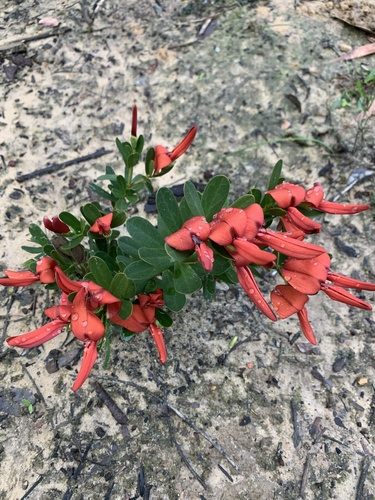
Templetonia retusa is an erect to rounded evergreen shrub in the family Fabaceae, reaching 39-118 inches (1-3 m) tall and 39-98 inches (1-2.5 m) wide. The stiff, blue-green leaves are obovate to wedge-shaped, 0.6-1.6 inch (1.5-4 cm) long, leathery, and notched or rounded at the tip. From autumn through spring the shrub carries showy pea flowers 0.8-1.2 inch (2-3 cm) long, usually deep red, sometimes cream or yellow forms, held singly or in pairs in the leaf axils along the stems. The flowers are rich in nectar and draw honeyeaters and other nectar-feeding birds. Flat, oblong pods follow, 1.2-2.4 inch (3-6 cm) long, ripening brown and splitting to release hard seeds. Templetonia retusa grows naturally on coastal limestone, dunes, and cliff scrub, and withstands salt wind, drought, and alkaline soils. It is sensitive to wet, poorly drained ground and to hard frost, which limits its use in cold inland gardens. The dense, leafy habit and long flowering period suit it to coastal screening.
Native Range
Templetonia retusa is native to southern Australia, along the coasts of Western Australia, South Australia, and western Victoria. It grows on coastal limestone, calcareous dunes, cliff-top scrub, and nearby mallee, often within reach of salt-laden wind.Suggested Uses
Used as a coastal screen, windbreak, and feature shrub in seaside and low-water native gardens. It suits limestone soils and sloped, free-draining sites, and supports nectar-feeding birds through winter.How to Identify
Appearance
Size & Dimensions
Height3'3" - 9'10"
Width/Spread3'3" - 8'2"
Bloom Information
Flowering extends through the cooler half of the year, mainly autumn to spring, around April to October in its native range. The deep red, nectar-rich pea flowers draw honeyeaters that pollinate them. Cream and yellow-flowered forms occur and bloom over the same period.
Detailed Descriptions
Flower Description
Red (also cream to yellow forms)Foliage Description
Blue-greenGrowing Conditions
Sun Requirements
Requires 6-10 hours of direct sunlight daily
• Full Sun: 6+ hours of direct sunlight
• Partial Shade: 3-6 hours of direct sunlight
• Full Shade: Less than 3 hours of direct sunlight
Care & Maintenance
Care Guide
Grow Templetonia retusa in full sun on light, free-draining, neutral to alkaline soil, including sandy and limestone-based soils. It withstands coastal exposure, salt wind, and extended dry periods once established. Water sparingly after establishment, as the shrub is prone to root rot on heavy or poorly drained ground. It is frost-sensitive when young and is damaged by hard freezes, so it performs in mild and coastal climates. As a legume it fixes its own nitrogen, so feed little if at all, using low-phosphorus native fertiliser where soils are very poor.Pruning
Tip prune lightly after flowering to maintain a dense, rounded shape. Cutting back by up to one-third of the stem length renews older, leggy plants, which respond with fresh growth from lower wood. Frost-damaged shoots can be removed in spring once new growth resumes.Pruning Schedule
Prune: October–November
late spring
Container Growing
Suitable for container growing
Minimum container size: 5 gallons