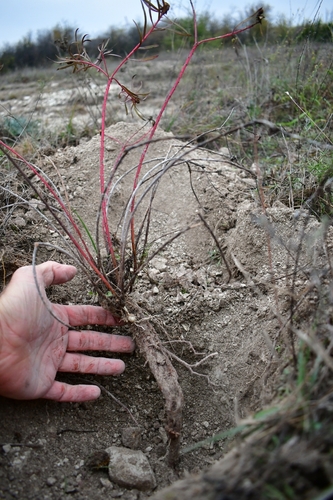
Stillingia, Genus, texana, Species,
- Genus & species
Texas stillingia
South-central United States and northern Mexico
Overview
Stillingia texana is an erect herbaceous perennial 8-20 inches (20-50 cm) tall, growing in clumps of several stems from a woody base and exuding a milky sap when cut. The leaves are alternate, narrow to lance-shaped, 1-2.5 inches (2.5-6 cm) long, with finely toothed margins and a leathery texture. From spring into summer the stems end in slender yellow-green flower spikes 1-2 inches (2.5-5 cm) long, with many tiny petal-less male flowers above a few female flowers at the base. The female flowers form three-lobed capsules that split to eject seeds. The plant grows on dry limestone soils of prairies, rocky slopes, and open brush in Texas and adjacent regions, where it withstands heat and drought. The milky sap contains irritant compounds typical of the spurge family and is toxic if eaten. It goes summer-dormant in dry spells and resprouts from the base with rain. Growth is slow and the plant stays compact. It does not tolerate wet or heavy soils or shade.
Native Range
Stillingia texana is native to the south-central United States and northern Mexico, mainly in Texas and extending into New Mexico, Oklahoma, and northeastern Mexico. It grows on dry limestone prairies, rocky calcareous slopes, and open brushland.Suggested Uses
Used in native prairie and rock garden plantings on dry, alkaline soils in its range. Planted for drought tolerance on hot, rocky sites where many plants fail. Suited to xeric and restoration plantings rather than irrigated borders.How to Identify
Appearance
Size & Dimensions
Height8" - 1'8"
Width/Spread8" - 1'4"
Bloom Information
Slender yellow-green flower spikes form at the stem tips from spring into summer, each carrying many tiny petal-less male flowers above a few female flowers. Insects and wind move the pollen. Three-lobed capsules follow and split to scatter the seeds.
Detailed Descriptions
Foliage Description
greenGrowing Conditions
Sun Requirements
Requires 6-12 hours of direct sunlight daily
• Full Sun: 6+ hours of direct sunlight
• Partial Shade: 3-6 hours of direct sunlight
• Full Shade: Less than 3 hours of direct sunlight
Care & Maintenance
Care Guide
Stillingia texana grows in full sun on dry, well-drained, alkaline limestone soils and tolerates heat and prolonged drought. It needs sharp drainage and fails in wet or heavy ground. Propagation is from seed, which can be slow and uneven to germinate. It needs no fertilizer and little water once established, and it goes dormant in dry spells, resprouting from the woody base after rain. The milky sap contains irritant, toxic compounds typical of the spurge family. Hardy in USDA zones 7-9, it withstands hot, dry, exposed sites.Pruning
Little pruning is needed for this compact plant. Dead stems can be cut back to the base in late winter before new growth. The milky sap can irritate skin where stems are cut.Pruning Schedule
Prune: February
winter