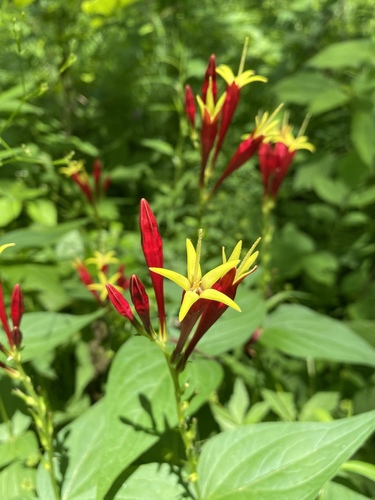
Spigelia, Genus, marilandica, Species,
- Genus & species
Indian pink
Southeastern United States (Maryland to Florida, west to Texas; moist deciduous woodlands, streamsides, shaded slopes)
Overview
Spigelia marilandica is a deciduous herbaceous perennial in the Loganiaceae family reaching 12–18 inches (30–45 cm) tall with a spread of 12–18 inches (30–45 cm). The habit is upright and clump-forming, with sturdy stems rising from a short creeping rhizome. Native to the southeastern United States — from Maryland south to Florida and west to Texas — the species occurs in moist deciduous woodlands, along streams, and on shaded slopes. Opposite sessile ovate to lanceolate glossy dark green leaves 2–4 inches (5–10 cm) long are carried in pairs along the stem. Tubular upward-facing flowers 1.5–2 inches (4–5 cm) long open in terminal clusters of 6–12 in May–June; each flower is bright red on the outside and bright yellow on the inside, with the corolla tips flaring into a five-pointed yellow star. The bicolor red-outside-yellow-inside combination is uncommon among eastern North American wildflowers. Hummingbirds are the primary pollinator, accessing nectar through the narrow tubular corolla. Growth rate is slow; plants reach full size in 2–3 growing seasons and spread slowly by rhizome into modest clumps of 18–30 inches (45–75 cm) across after 5–10 years. Hardy to zone 5. All parts of the plant contain alkaloids (spigeline) and gastrointestinal glycosides; ingestion causes nausea, vomiting, and convulsions in humans and pets.
Native Range
Spigelia marilandica is native to the southeastern United States — from Maryland south to Florida and west to Texas — where it grows in moist deciduous woodlands, along streams, and on shaded slopes.Suggested Uses
Grown in woodland gardens, shade borders, and native plant collections at 12–15 inch (30–38 cm) spacing. The early summer tubular red-and-yellow flowers draw ruby-throated hummingbirds (Archilochus colubris) through the migration and breeding window in the eastern US. Container culture requires 2 gallon (8 L) or larger pots with humus-rich mix, sited in morning sun with afternoon shade. Dry sites, full sun without irrigation, and alkaline soils produce poor results. Toxicity of all plant parts means the species is not sited where children routinely handle or taste foliage and where pets graze herbaceous plantings.How to Identify
Appearance
Size & Dimensions
Height1' - 1'6"
Width/Spread1' - 1'6"
Bloom Information
Terminal clusters of 6–12 tubular upward-facing flowers 1.5–2 inches (4–5 cm) long open in May–June. Each flower is bright red on the outside and bright yellow inside, with the corolla tips flaring into a five-pointed yellow star. Bloom duration is 3–4 weeks. Deadheading spent clusters triggers a lighter second flush in July in most of the range. Hummingbirds are the primary pollinators.
Detailed Descriptions
Flower Description
Bicolor: bright red outside and bright yellow inside, tubular 1.5-2 inches flaring to five-pointed yellow stars at the tipsFoliage Description
Glossy dark green, opposite sessile ovate to lanceolate 2-4 inchesGrowing Conditions
Sun Requirements
Requires 2-5 hours of direct sunlight daily
• Full Sun: 6+ hours of direct sunlight
• Partial Shade: 3-6 hours of direct sunlight
• Full Shade: Less than 3 hours of direct sunlight
Care & Maintenance
Care Guide
Grows in partial shade to full shade in moist humus-rich well-drained soil at pH 5.5–7.0. Hardy to zone 5. Consistent moisture through the growing season is required; full sun is tolerated only with regular irrigation. Mulching the root zone 2 inches (5 cm) deep with leaf mould maintains soil moisture and matches the woodland native habitat. Establishment is slow — first-year plants produce few flowers, with full display arriving in the second or third year — but established clumps are long-lived. All parts contain spigeline alkaloids and gastrointestinal glycosides; ingestion produces nausea, vomiting, and neurological symptoms in humans and pets.Pruning
Cut dead stems to ground level in late winter (February–March) before new growth emerges. Deadheading spent flower clusters in mid-June encourages a second flush in July. No other pruning is required; the clump expands slowly by rhizome.Pruning Schedule
Prune: February–March
early spring
Container Growing
Suitable for container growing
Minimum container size: 2 gallons