Sisyrinchium, Genus, angustifolium, Species,
- Genus & species
blue-eyed grass
Eastern North America (from Newfoundland and Quebec south through New England and the Atlantic and Gulf coastal plains to Florida and west through the Great Lakes region to Minnesota); moist meadow positions, woodland-margin habitats, and open grassland habitats with consistent moisture and full-to-partial sun exposure.
Overview
Sisyrinchium angustifolium is blue-eyed grass (also called narrowleaf blue-eyed grass), a native eastern North American perennial in the iris family (Iridaceae) growing 6-12 inches (15-30 cm) tall and 6-10 inches (15-25 cm) wide. The species name 'angustifolium' is Latin for 'narrow-leafed' and references the narrow grass-like leaf form that gives the species the common name 'blue-eyed grass' despite the species being unrelated to the true grass family (Poaceae). The grass-vs-iris-family distinction is the species' principal teaching point: despite the grass-like appearance at viewing distance, Sisyrinchium angustifolium is a member of the iris family with the equitant flat-fan-shaped basal rosette leaf arrangement (leaves flattened in a single plane rather than radially distributed around the stem) typical of the broader Iridaceae family that the species shares with Iris, Crocus, Gladiolus, and other iris-family genera. The small flowers further confirm the iris-family placement: violet-blue star-shaped flowers with 6 tepals (the iris-family pattern of 3 outer petal-like sepals plus 3 inner petals indistinguishable in form and color from each other, in contrast to the typical angiosperm pattern of clearly differentiated sepals and petals) and bright yellow central eyes that supply the species' principal field-identification character at the floral-display level. The genus name Sisyrinchium is derived from ancient Greek for an iris-related plant with fibrous roots, and the genus is the largest in the Iridaceae family with approximately 200 species native to the Americas. Each individual flower is approximately 1/2 to 3/4 inch (12-20 mm) across — small in absolute terms compared to the larger Iris relatives but accumulating into a meadow-scale flowering display when the species establishes self-sown colonies in suitable substrate. Flowers open in the morning and close by mid-afternoon — a daily opening-and-closing cycle that the species shares with many other Iridaceae genera and that is itself a family-recognition character. The species is a short-lived perennial (2-4 years per individual plant) that maintains permanent colonies in suitable meadow substrate by gentle self-sowing of wind-dispersed seed; the self-sowing replaces individual aging plants and the species fills an ecological niche as a recurring meadow-scale wildflower across favorable habitats. Native to moist meadow, woodland-margin, and open grassland habitats across most of the eastern North American range, the species' meadow-substrate cultivation requirement reflects the open-habitat native ecology and the species struggles in heavily-shaded or excessively dry positions. Hardy to zone 3 with reliable performance across zones 3-8. Drought tolerance is limited and the species performs better with consistent moisture than with extended dry conditions. Deer avoid the foliage. The species is non-toxic to humans and pets.
Native Range
Sisyrinchium angustifolium is native to eastern North America with a continuous native range from Newfoundland and Quebec south through New England, the Atlantic and Gulf coastal plains to Florida, and west through New York, Pennsylvania, the Great Lakes region, Wisconsin, Iowa, and Minnesota. The species occurs in moist meadow positions, woodland-margin habitats, open grassland positions, prairie fringes, roadside cuts, and other moist-substrate open habitats across the eastern North American native range, where the consistent moisture, the open-canopy light exposure, and the relatively lean meadow substrate together create the cultivation conditions the species evolved with. The species is grown in native-plant gardens, wildflower meadow plantings, rock-garden plantings, and educational botanical-collection plantings across the eastern and central United States as a teaching example for the iris family and as a native meadow-scale spring wildflower for self-sowing colony plantings.Suggested Uses
Used in native-plant meadow gardens, wildflower meadow plantings, rock gardens, educational and teaching gardens, and 1-gallon (3.8 liter) container plantings. The species is a teaching example for the iris family and is grown in educational gardens specifically for the family-recognition demonstration: the grass-like leaf form combined with the iris-family flower architecture (6 tepals, yellow centers, morning-opening daily cycle) makes the species a memorable example of how plant-family identification depends on multiple morphological characters rather than on superficial visual similarity. The small-scale flowers reward close-range viewing and the species is sited in front-of-border, walkway-edge, and patio-adjacent positions where the small flowers can be viewed at near distance. The species pairs with companion small-scale meadow native perennials including Viola (violets), Phlox subulata (creeping phlox), Antennaria (pussytoes), and short native grasses (Bouteloua gracilis blue grama) for a multi-species native-meadow planting where the Sisyrinchium blue-and-yellow flowers contribute a small-scale spring color element to the broader meadow palette.How to Identify
Appearance
Size & Dimensions
Height6" - 1'
Width/Spread6" - 10"
Colors
Bloom Information
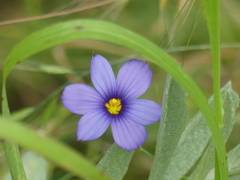
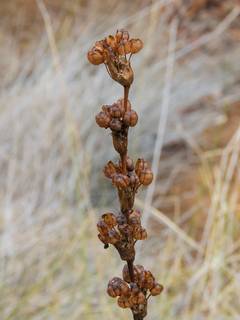
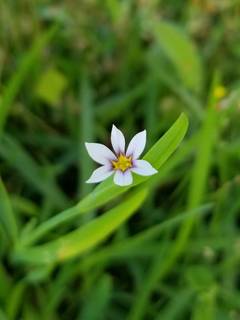
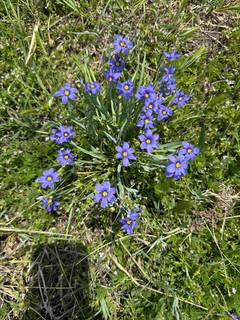
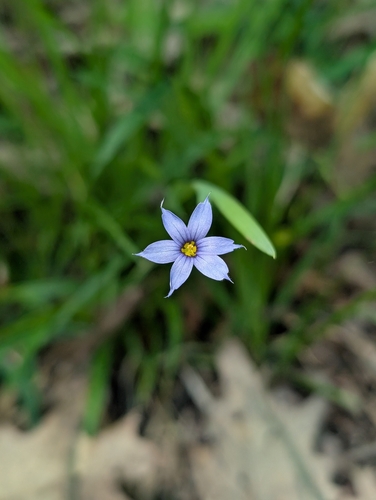
Violet-blue 6-tepaled star-shaped flowers with bright yellow central eyes open in May and June across a 4-week active flowering window. Each individual flower is approximately 1/2 to 3/4 inch (12-20 mm) across, with the flowers opening in the morning and closing by mid-afternoon in a daily opening-and-closing cycle typical of the broader Iridaceae family. The accumulating sequential bloom across the 4-week window produces a meadow-scale flowering display when the species establishes self-sown colonies in suitable substrate. Pollination is by small bees, syrphid flies, and other small-bodied pollinators working the small accessible flowers; the species produces wind-dispersed seed following bloom that supports the self-sowing colony-persistence the species depends on for population persistence in suitable meadow habitats.
Detailed Descriptions
Flower Description
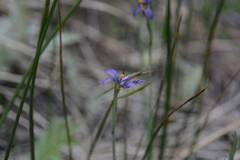
Violet-blue with bright yellow centers; small (1/2 to 3/4 inch / 12-20 mm) star-shaped flowers with 6 tepals (the iris-family pattern of 3 outer petal-like sepals plus 3 inner petals indistinguishable in form and color from each other); each flower carries a small bright yellow central eye that supplies the species' principal field-identification character and the source of the common name 'blue-eyed grass'Foliage Description
Dark green; narrow grass-like leaf blades arranged in a flat fan-shaped basal rosette (the equitant leaf arrangement typical of the Iridaceae family — leaves arranged in a flattened plane rather than radially) that distinguishes the species from true grasses (Poaceae) at the foliage-arrangement scale despite the superficial visual similarity that gives the species its common name 'blue-eyed grass'Growing Conditions
Sun Requirements
Requires 5-10 hours of direct sunlight daily
• Full Sun: 6+ hours of direct sunlight
• Partial Shade: 3-6 hours of direct sunlight
• Full Shade: Less than 3 hours of direct sunlight
Care & Maintenance
Care Guide
Plant in full sun to partial shade with 5-10 hours of direct light. Moist meadow soil at pH 5.5-7.5 supports the species reliably; the species' moist-meadow native habitat reflects a strong physiological preference for consistent moisture and the species struggles in extended drought conditions or in lean dry exposed positions. Watering is during establishment and through extended summer drought to maintain consistent moisture. Fertilization is generally not needed because the species is adapted to lean meadow substrate. The species is a short-lived perennial (2-4 years per individual plant) that maintains permanent colonies in suitable meadow substrate by gentle self-sowing of wind-dispersed seed; the self-sowing replaces individual aging plants and supports the meadow-scale colony persistence that gardeners depend on for reliable annual-flowering display. Annual maintenance is essentially nil — the species does not require deadheading, dividing, or annual cutting. Hardy to zone 3 with reliable performance across zones 3-8. Container culture in 1-gallon (3.8 liter) or larger pots works for individual specimens but the species' colony-forming self-sowing habit favors in-ground meadow positions over long-term container plantings.Pruning
No pruning is needed. The species is self-maintaining through gentle self-sowing in meadow substrate and does not require deadheading, dividing, or annual cutting. Allow the wind-dispersed seeds to disperse from the spent flower stems for colony persistence — early-season removal of seed stems prevents the self-sowing on which colony persistence depends.Container Growing
Suitable for container growing
Minimum container size: 1 gallons