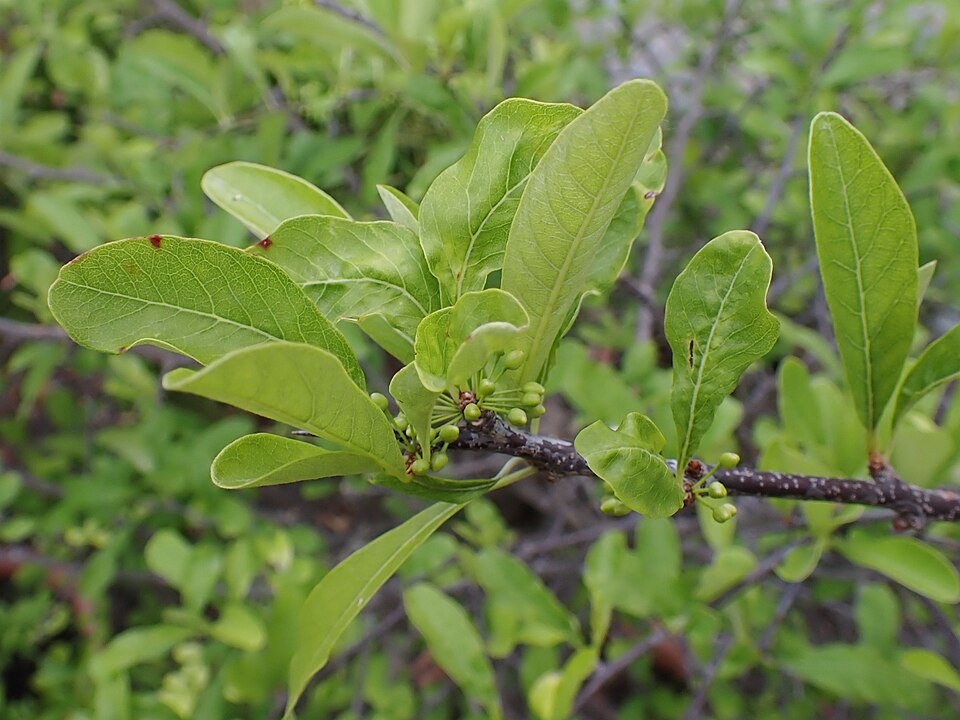
Image 1 of 10
1 / 10
© Krzysztof Ziarnek, Kenraiz, some rights reserved (CC-BY-SA) · Wikimedia Commons
Sideroxylon, Genus, lanuginosum, Species,
- Genus & species
gum bumelia
South-central and southeastern United States
Overview
Sideroxylon lanuginosum is a deciduous to semi-evergreen shrub or small tree in the sapodilla family, reaching 15-50 feet (4.5-15 m) tall and 10-25 feet (3-7.5 m) wide, though it is often shorter and shrubby on dry sites. The crooked branches bear sharp spines and exude a sticky gum where wounded. Spoon-shaped leaves 1-3 inches (2.5-7.5 cm) long are dark green above and densely coated below with woolly hairs ranging from white to rusty brown. Clusters of small white flowers open at the leaf axils in early summer and carry a strong scent. Round purple-black fruits about 0.5 inch (13 mm) wide ripen in fall and are eaten by birds and mammals. The plant grows on limestone soils, rocky slopes, prairie margins, fencerows, and disturbed ground across the south-central United States. It tolerates heat, drought, and poor soil but spreads from root suckers and can form thickets. The spines and suckering habit limit its use in small or formal gardens. Milky latex flows from cut stems.
Native Range
Native to the south-central and southeastern United States, from Kansas and Missouri south through Texas to Florida, and into northeastern Mexico. It grows on limestone uplands, rocky slopes, prairie edges, and fencerows.Suggested Uses
Grown in native windbreaks, wildlife plantings, and naturalized areas on dry or alkaline soils. The fruit feeds birds and small mammals, and the summer flowers support bees.How to Identify
Appearance
Size & Dimensions
Height15' - 50'
Width/Spread10' - 25'
Bloom Information
Fragrant white flowers open in dense axillary clusters from May to July. The flowers are small, five-lobed, and draw many bees. Purple-black drupes ripen from September into fall.
Detailed Descriptions
Foliage Description
greenGrowing Conditions
Sun Requirements
Requires 6-10 hours of direct sunlight daily
• Full Sun: 6+ hours of direct sunlight
• Partial Shade: 3-6 hours of direct sunlight
• Full Shade: Less than 3 hours of direct sunlight
Care & Maintenance
Care Guide
Grows in full sun to light shade in well-drained soils, including shallow limestone, sand, and clay, and tolerates alkaline ground. Established plants withstand prolonged drought and summer heat with no irrigation. Root suckers can be removed to prevent thicket formation in cultivated settings. The species needs no fertilizer on native soils and carries few serious pests. Young plants establish more reliably from containers, as the taproot makes bare-root moves difficult. It accepts a wide pH range but declines in soils that stay wet.Pruning
Pruning in late winter removes suckers, crossing branches, and lower limbs where a single trunk is wanted. The wood is hard and the spines slow the work, so cuts are kept small.Pruning Schedule
winter