Securigera, Genus, varia, Species,
- Genus & species
purple crownvetch
Europe, southwestern Asia, North Africa
Overview
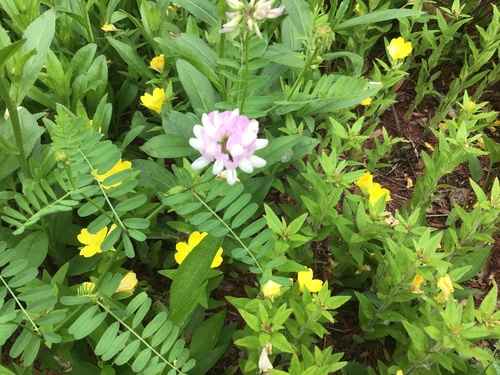
Securigera varia, purple crownvetch, is a sprawling herbaceous perennial legume that forms dense mats of trailing stems 2-6 feet (60-180 cm) long, mounding to about 1-2 feet (30-60 cm) deep. The leaves are pinnately compound with 11-25 small oblong leaflets, each 0.3-0.7 inch (8-18 mm) long. Through summer it bears rounded, crown-like clusters of pea-flowers, each cluster about 1 inch (2.5 cm) across, in shades of pink, lavender, and white that fade with age. The flowers are followed by slender, segmented, finger-like seed-pods that break into one-seeded joints. The plant spreads both by seed and by strong creeping rhizomes, forming colonies that exclude other vegetation. As a nitrogen-fixing legume it grows on poor, dry, and disturbed soils, and it was once widely planted for erosion control on banks and roadsides. It is now considered invasive across much of North America, where it overruns prairies and natural areas. The foliage contains nitroglycosides that are toxic to horses and other non-ruminant animals.
Native Range
Native to Europe, southwestern Asia, and North Africa, where it grows in grassland and on rocky, disturbed slopes. It was introduced to North America in the 20th century for erosion control and as a forage and cover plant. It has since naturalized and spread aggressively across much of the United States and southern Canada.Suggested Uses
It was once planted widely for bank stabilization, erosion control, and roadside cover, uses now limited by its invasive spread. In current practice it is managed or removed rather than planted. It has little garden use in regions where it is regulated.How to Identify
Appearance
Size & Dimensions
Height1' - 2'
Width/Spread2' - 4'
Bloom Information
Flowers from early summer into early autumn, mainly June through September. The crown-shaped clusters open pink and pale to white as they age, so a colony shows mixed shades at once. Bees are the main pollinators of the pea-flowers.
Detailed Descriptions
Foliage Description
greenGrowing Conditions
Sun Requirements
Requires 6-12 hours of direct sunlight daily
• Full Sun: 6+ hours of direct sunlight
• Partial Shade: 3-6 hours of direct sunlight
• Full Shade: Less than 3 hours of direct sunlight
Care & Maintenance
Care Guide
Grows in full sun in poor, dry, well-drained soil and tolerates drought, heat, and disturbed ground once established. It needs no feeding, fixing its own nitrogen, and spreads quickly by rhizome and seed. Because it is invasive across much of North America, planting is discouraged or restricted in many states. Control combines repeated mowing with herbicide over several seasons, since cut stems and rhizomes regrow. Mowing before seed set slows its spread. It has few pests and persists with no care.Pruning
Mowing or cutting through the growing season holds back top growth but does not remove the rhizomes. Cut stems regrow, and dead growth mats over winter. Removal is treated as control rather than ornamental pruning.Pruning Schedule
Prune: June–August
summer