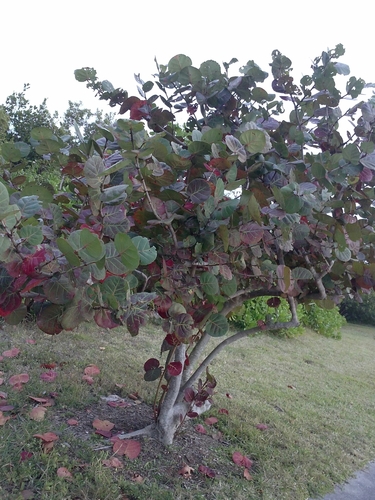
Coccoloba, Genus, uvifera, Species,
- Genus & species
sea grape
Coastal beaches and dunes of the southeastern United States (Florida, Texas, Bermuda), the Bahamas, the Caribbean, the Gulf Coast of Mexico, Central America, and South America south to Brazil
Overview
Coccoloba uvifera is the sea grape — a salt-tolerant evergreen tree of Atlantic and Caribbean coastlines from Florida south to Brazil, growing 15–35 ft (4.5–10.5 m) tall and 15–25 ft (4.5–7.5 m) wide as a multi-stemmed tree, or pruned as a 6–10 ft (1.8–3 m) hedge in coastal landscape use. The species is native to coastal beaches and dunes of the southeastern United States (Florida, Texas, Bermuda), the Caribbean, the Gulf Coast of Mexico, Central America, and South America to Brazil, where it grows directly on sand at the high-tide line and tolerates salt spray, salt-laden wind, sandy soil, and reflected heat from beach surfaces that defeat most other trees. Each leaf is leathery, broadly rounded to nearly circular, 4–10 inches (10–25 cm) across, with prominent reddish veins on a glossy medium-to-dark green surface; new leaves emerge red-bronze and age to green with age. The genus name Coccoloba translates as 'berry-bearing pod' from Greek references to the persistent fruit, and 'uvifera' translates as 'grape-bearing'. The plant is dioecious — separate male and female plants — and produces 6–12 inch (15–30 cm) drooping racemes of small fragrant white flowers in spring and summer, followed on female plants by 6–10 inch (15–25 cm) pendant clusters of grape-like 0.5–0.75 inch (12–19 mm) drupes that ripen from green through pink to deep purple in late summer; the ripe drupes are edible and used to make jelly, and the species name 'sea grape' refers to this fruit cluster. The bark is smooth and mottled gray-tan, peeling in irregular flakes on mature trees. Hardy outdoors only in USDA zones 9b–11; foliage drops at 28°F (−2°C) and the tree dies in temperatures below 22°F (−6°C). Salt tolerance is the species' defining cultivation trait — sea grape grows directly on beach sand within reach of salt spray, where few other trees of comparable size survive.
Native Range
Coccoloba uvifera is native to coastal beaches and dunes of the southeastern United States (Florida, Texas, Bermuda), the Bahamas, the Caribbean, the Gulf Coast of Mexico, Central America, and South America south to Brazil, where it grows directly on sand at the high-tide line.Suggested Uses
Used as a coastal specimen tree, beachfront windbreak, salt-tolerant hedge, and shade tree on Florida, Caribbean, and Gulf Coast properties in zones 9b–11. The species is among the few evergreen trees of substantial size that tolerate direct salt spray and beach-site conditions. Combines with other salt-tolerant coastal plants such as Cocos nucifera, Conocarpus erectus, and Hibiscus tiliaceus. Suitable for households with cats and dogs due to non-toxic status; the ripe drupes are edible and used in regional jellies and preserves.How to Identify
Appearance
Size & Dimensions
Height15' - 35'
Width/Spread15' - 25'
Bloom Information
Mature dioecious plants flower in spring and summer (about 16 weeks across the season), producing 6–12 inch (15–30 cm) drooping racemes of small fragrant white flowers; female plants follow with 6–10 inch (15–25 cm) pendant clusters of grape-like drupes that ripen from green through pink to deep purple in late summer. Sweet honey-like fragrance from the flowers.
Detailed Descriptions
Flower Description
Small fragrant white flowers in 6-12 inch (15-30 cm) drooping racemes; pendant clusters of green-to-pink-to-purple grape-like drupes 0.5-0.75 inch (12-19 mm) follow on female plantsFoliage Description
Leathery broadly rounded to nearly circular leaves 4-10 inches (10-25 cm) across with prominent reddish veins on a glossy medium-to-dark green surface; new leaves emerge red-bronzeGrowing Conditions
Sun Requirements
Requires 6-12 hours of direct sunlight daily
• Full Sun: 6+ hours of direct sunlight
• Partial Shade: 3-6 hours of direct sunlight
• Full Shade: Less than 3 hours of direct sunlight
Care & Maintenance
Care Guide
Place in full sun for 6 or more hours daily on coastal sandy soils. The species accepts a wide range of soils — sandy beach, sandy loam, calcareous, and limestone-derived — at pH 6.0–8.5, with sharp drainage required. Salt spray, salt-laden wind, and salty groundwater are tolerated; sea grape is planted on beach sites where few other trees of comparable size survive. Water during the first year of establishment, then irrigate only during severe drought; mature trees draw groundwater and survive on natural rainfall in the native range. Maintain temperatures above 28°F (−2°C) for evergreen foliage; brief frost causes leaf drop and resprout from woody stems, and temperatures below 22°F (−6°C) kill the tree. Feed lightly during the first 2–3 years of establishment with a palm-and-tropical-tree fertilizer; mature trees rarely need feeding on natural sandy soils.Pruning
Prune to maintain hedge form, lift the canopy on tree forms, or shape after the main bloom in late summer. The species responds well to hard cutbacks and resprouts from woody stems and the base. Removing female trees in dense plantings near walkways may be considered where ripe drupe drop creates slip hazards on hardscape.Pruning Schedule
Prune: August–September
summerfall