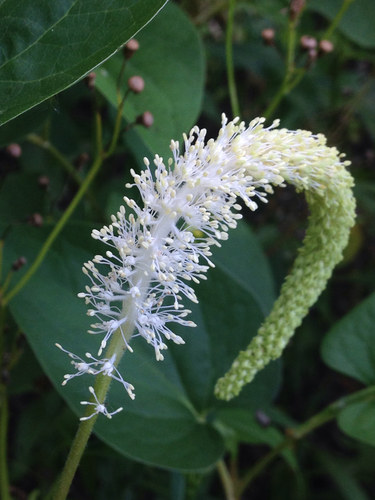
Saururus, Genus, cernuus, Species,
- Genus & species
Lizard's tail
Eastern North America (from Quebec south through the Atlantic and Gulf coastal plains to Florida and west to Texas, Oklahoma, and Kansas); swamp, streambank, pond-margin, and shallow-standing-water habitats with consistent moisture and partial-shade exposure.
Overview
Saururus cernuus is lizard's tail (also called water dragon), a native eastern North American wetland perennial in the lizard's-tail family (Saururaceae) growing 18-36 inches (45-90 cm) tall and spreading 24-48+ inches (60-120+ cm) wide by underground rhizomes in wet-soil conditions. The genus name Saururus is derived from the Greek 'sauros' meaning lizard and 'oura' meaning tail, and the species name 'cernuus' is Latin for 'nodding' or 'drooping' — both names reference the species' principal field-identification character: white small flowers in dense slender drooping curved spikes 4-6 inches (10-15 cm) long that nod and curve at the tip in a shape resembling the tail of a lizard or salamander. The curved nodding spike form is recognizable at viewing distance and is the species' single most reliable identification trait. The spikes are sweetly fragrant — the sweet floral scent carries on warm humid summer air across the bloom window — and the species is among the few fragrant native eastern North American wetland perennials in commercial cultivation. The family Saururaceae is an ancient angiosperm lineage with only four genera worldwide (Saururus from eastern North America and East Asia, Anemopsis from western North America, Houttuynia from East Asia, and Gymnotheca from southwestern China), and the family is placed in the order Piperales alongside the pepper family (Piperaceae, which produces black pepper Piper nigrum and the Peperomia houseplant genus) and several other primitive flowering-plant lineages. The Saururaceae lineage diverged from other angiosperm groups early in the angiosperm evolutionary history and the family is sometimes used as a teaching example for primitive-angiosperm floral architecture: the small flowers lack petals and sepals (in contrast to the typical angiosperm flower with both calyx and corolla), and the simple flower structure with only stamens and pistil is considered evolutionarily ancestral. The species is native to swamp, streambank, pond-margin, and shallow-standing-water habitats across the eastern North American native range, and the wet-substrate physiology means cultivation success depends on consistent moisture: the species tolerates standing water to a depth of 6 inches (15 cm) seasonally and grows reliably in wet-bottom planting positions where most ornamental perennials cannot survive. The species spreads vigorously by underground rhizomes in favorable wet conditions and forms a connected colony from each individual plant within 2-3 growing seasons; the spreading habit makes the species a working ground-cover choice for large wet-area plantings (pond margins, swale plantings, rain gardens) but the same habit makes the species inappropriate for small contained water-feature plantings without root-barrier installation. Bright green glossy heart-shaped foliage on upright stems supplies the year-round structural foliage feature beyond the bloom window. Hardy to zone 4 with reliable performance across zones 4-9. The species is non-toxic to humans and pets.
Native Range
Saururus cernuus is native to eastern North America with a continuous native range from southern Quebec and Ontario south through New England, the Atlantic and Gulf coastal plains to Florida, and west through Tennessee, the Ohio River Valley, Kentucky, and the central plains to Texas, Oklahoma, and eastern Kansas. The species occurs in swamp habitats, streambank positions, pond-margin shallow water, marsh edges, slow-moving stream backwaters, and other consistently wet-substrate riparian habitats across the eastern and central North American native range. The species is a foundational native perennial for rain-garden plantings, pond-margin plantings, wet woodland-garden positions, and large-scale wetland-restoration projects across the eastern and central United States, with the species' wet-substrate physiology and the curved nodding spike form together placing the species at the top of native-perennial recommendations for wet-shade garden positions where a recognizable flower form supplies summer ornamental display.Suggested Uses
Used in pond-margin plantings, rain-garden plantings, shallow-water ornamental positions, wet woodland gardens, swale and rain-water-collection plantings, large-scale wetland-restoration projects, and naturalized riparian plantings where the wet-substrate cultivation requirement matches the planting position. The species is a foundational native ground-cover choice for large wet-area plantings where the spreading-rhizome habit fills the planting role and the curved nodding fragrant spikes supply summer ornamental display. The sweet floral fragrance is among the few fragrance contributions from the native wet-soil perennial flora and gardeners interested in wetland fragrance plant the species specifically for the scent role. The Saururaceae family is an ancient angiosperm lineage and the species is grown in educational and teaching gardens specifically for the primitive-angiosperm floral-architecture demonstration (small flowers without petals or sepals, simple stamen-and-pistil structure). The species pairs with companion wet-soil native perennials including Iris versicolor (blue flag iris), Lobelia cardinalis (cardinal flower), Hibiscus coccineus (scarlet rose mallow), Hibiscus moscheutos (rose mallow), Eupatorium perfoliatum (boneset), and Conoclinium coelestinum (blue mistflower) for a multi-species wet-meadow native composition where the Saururus fragrant nodding white spikes complement the colorful companion blooms with a quieter white-and-fragrance contribution.How to Identify
Appearance
Size & Dimensions
Height1'6" - 3'
Width/Spread2' - 4'
Colors
Bloom Information
White small fragrant flowers open in dense slender drooping curved spikes 4-6 inches (10-15 cm) long from June through July across a 4-week active flowering window. The spikes nod and curve at the tip in a shape resembling the tail of a lizard or salamander, and the curved nodding spike form is the species' principal ornamental feature; the spikes are sweetly fragrant and the floral scent carries on warm humid summer air across the bloom window. Each individual flower lacks petals and sepals — the small flowers carry only stamens and a pistil in the primitive-angiosperm floral architecture typical of the Saururaceae family. Pollination is by small bees, beneficial flies, and beetles working the dense aggregation of small fragrant flowers along each spike.
Detailed Descriptions
Flower Description
White small flowers in dense slender drooping curved spikes 4-6 inches (10-15 cm) long that nod and curve at the tip in a shape resembling the tail of a lizard or salamander — the curved nodding spike form is the species' signature character and the source of both the genus name Saururus (literally 'lizard tail') and the species name cernuus ('nodding'); the spikes are sweetly fragrantFoliage Description
Bright green; heart-shaped (cordate) glossy leaves arranged alternately along upright stems, with the heart-shaped leaf form and the glossy upper-leaf-surface quality together producing the species' principal foliage feature; the bright-green glossy heart-shaped foliage is the year-round structural plant body and supplies a recognizable foliage texture in shaded wet-soil planting positionsGrowing Conditions
Sun Requirements
Requires 4-8 hours of direct sunlight daily
• Full Sun: 6+ hours of direct sunlight
• Partial Shade: 3-6 hours of direct sunlight
• Full Shade: Less than 3 hours of direct sunlight
Care & Maintenance
Care Guide
Plant in partial shade to full sun with 4-8 hours of direct light; the species tolerates more sun in cooler regions and benefits from afternoon shade in warmer zones. Wet to consistently saturated soil at pH 5.5-7.0 supports the species reliably; the species' swamp and shallow-standing-water native habitat reflects a strong physiological preference for consistent moisture, and the species tolerates standing water to a depth of 6 inches (15 cm) seasonally and grows well in pond-margin, rain-garden, swale-bottom, and consistently saturated planting positions. Watering is essentially continuous because the species' wet-substrate physiology depends on consistent soil moisture; the species struggles or fails in dry exposed positions where the soil dries between waterings. Fertilization is generally not needed because the species is adapted to mineral-rich freshwater wetland substrate. The species spreads vigorously by underground rhizomes in favorable wet conditions and forms a connected colony from each individual plant within 2-3 growing seasons; the spreading habit means containment management may be needed in small contained plantings — root-barrier installation, pot-sleeve cultivation, or aggressive seasonal edging contains the spread effectively where strict containment is required. Annual cleanup is essentially limited to early-spring removal of standing dead stems before new spring growth emerges. Hardy to zone 4 with reliable performance across zones 4-9.Pruning
Cut all stems to ground level either after frost in fall or in early spring (March) before new spring growth emerges from the rhizome network. Manage the rhizomatous spread with root-barrier installation, pot-sleeve cultivation, or aggressive seasonal edging if strict containment is required in small contained plantings; in large naturalized wet-area plantings the spreading habit fills the species' ecological role and active containment is not needed.Pruning Schedule
Prune: March
early spring