Sarcodes, Genus, sanguinea, Species,
- Genus & species
Snowplant
Mountains of California, Oregon, and Nevada
Overview
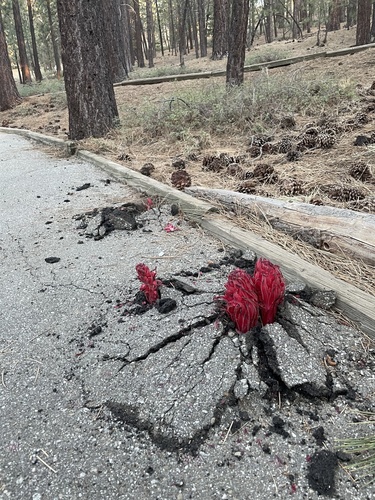
Sarcodes sanguinea is a fleshy, non-photosynthetic perennial in the heath family that lacks chlorophyll and is colored entirely bright red. Rather than making its own food, it draws nutrients from soil fungi linked to the roots of conifers, a strategy called mycoheterotrophy. The plant emerges as a thick, asparagus-like red stalk 6-12 inches (15-30 cm) tall, often pushing up through melting snow in spring. The stalk is wrapped in overlapping red scale-like leaves and topped with a dense cluster of bell-shaped red flowers, each about 0.5-0.75 inch (12-18 mm) long. There is no green tissue at any stage. It grows in the deep humus and duff of montane and subalpine conifer forests in California and into Oregon and Nevada, usually between 4,000 and 10,000 feet (1,200 and 3,000 m). The plant appears for only a few weeks as snow recedes, then withers as the soil dries. Because it depends on a specific fungal and conifer association, it cannot be transplanted or cultivated, and it is protected from collection in many areas. It is seen in the wild rather than grown in gardens.
Native Range
Native to the mountains of California, Oregon, and western Nevada, in montane and subalpine conifer forests.Suggested Uses
Not a garden plant; it is encountered on forest trails and in conifer woodland after snowmelt. It is seen as a wildflower sighting in mountain parks and forests. It serves as an indicator of intact conifer and fungal communities.How to Identify
Appearance
Size & Dimensions
Height6" - 1'
Width/Spread3" - 6"
Bloom Information
Detailed Descriptions
Foliage Description
red, reduced to scalesGrowing Conditions
Sun Requirements
Tolerates up to 3 hours of direct sunlight daily
• Full Sun: 6+ hours of direct sunlight
• Partial Shade: 3-6 hours of direct sunlight
• Full Shade: Less than 3 hours of direct sunlight