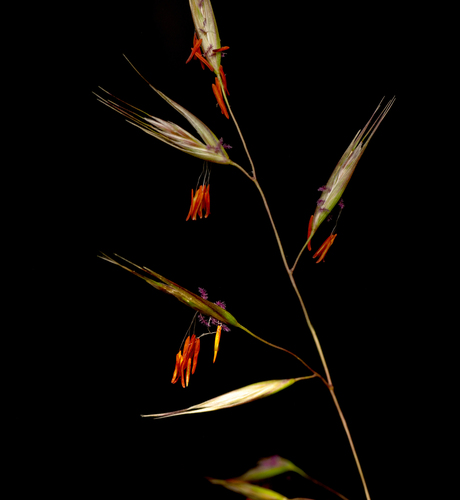
Rytidosperma, Genus, spp., Multiple species,
- Genus
- Multiple species
wallaby grasses
Overview
Rytidosperma is a genus of about 90 species of tufted perennial grasses, sometimes called wallaby grasses, native mainly to Australia and New Zealand, with further species in South America, New Guinea, and Southeast Asia. Plants form dense, narrow-leaved tussocks 4-24 in (10-60 cm) tall and 6-18 in (15-45 cm) wide, with narrow, often rolled green to grey-green leaf blades that may dry to straw colour in summer. In late spring and summer, slender flowering stems rise above the foliage carrying open or compact seed heads of soft, white-hairy florets that catch the light and give the heads a fluffy look. These are cool-season (C3) grasses that grow actively in autumn, winter, and spring and slow in summer heat. The genus tolerates drought, frost, low fertility, and grazing, and several Australian species are valued as native pasture and lawn grasses. Plants spread slowly by seed and short rhizomes, forming open swards rather than dense turf. Rytidosperma grows in full sun on a wide range of soils, including poor, sandy, and clay ground, but does not persist in deep shade or permanently wet sites.
Native Range
Native mainly to Australia and New Zealand, with additional species in temperate South America, New Guinea, and the mountains of Southeast Asia. In Australia the genus is widespread in grasslands, open woodland, and grassy hills.Suggested Uses
Used in native grassland restoration, low-input lawns, pasture, and naturalistic plantings, spaced 8-16 in (20-40 cm) apart for groundcover. The fluffy seed heads suit meadow and dry-garden designs.How to Identify
Appearance
Size & Dimensions
Height4" - 2'
Width/Spread6" - 1'6"
Colors
Bloom Information
Flowering and seeding occur mainly in late spring and summer, generally October to January in the Southern Hemisphere range, after the main cool-season growth. The white-hairy seed heads persist for several weeks. Some species flower again after autumn rain.
Detailed Descriptions
Flower Description
White-hairy, strawFoliage Description
Green to grey-green, straw in summerGrowing Conditions
Sun Requirements
Requires 6-12 hours of direct sunlight daily
• Full Sun: 6+ hours of direct sunlight
• Partial Shade: 3-6 hours of direct sunlight
• Full Shade: Less than 3 hours of direct sunlight
Care & Maintenance
Care Guide
Grow in full sun on free-draining soil of low to moderate fertility; the genus tolerates sand, clay, and rocky ground but not deep shade or waterlogging. Water is rarely needed once established, as these grasses are drought-tolerant and summer-dormant in dry spells. Growth is strongest in the cooler months, so autumn is a good planting time. The genus tolerates frost, grazing, and occasional mowing, recovering from the tussock base. Heavy fertilizer favours weeds over the slow-growing native grass. Hardiness suits USDA zones 7-10 depending on species.Pruning
Cut or mow established plants in late summer or early autumn to remove old growth and seed heads. Plants recover from the tussock base after cutting. Burning or grazing is used to renew large native stands.Pruning Schedule
Prune: February–March
summerfall
Container Growing
Suitable for container growing
Minimum container size: 2 gallons
