Richardia, Genus, spp., Multiple species,
- Genus
- Multiple species
Mexican clovers
Tropical and subtropical America (Mexico, Central and South America), naturalized widely in warm regions
SunFull Sun – Part Shade
Overview
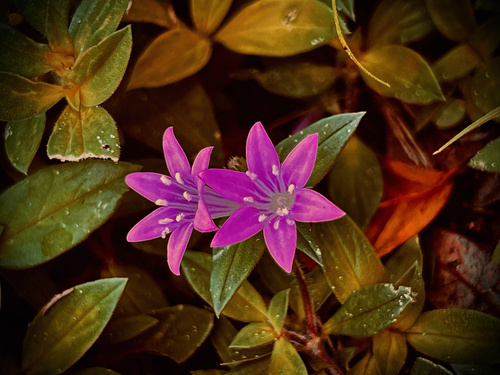
Richardia is a genus of about 15 species of low, spreading herbs in the family Rubiaceae, native to warm regions of the Americas and widely naturalized as weeds elsewhere. Most species are summer annuals, though a few are short-lived perennials. Stems are hairy, prostrate to ascending, and 4 to 16 in (10 to 40 cm) long, branching from the base to form loose mats. The leaves are opposite, oval, and roughened with stiff hairs, joined across the stem by a fringed sheath typical of the family. Small flowers gather in dense terminal heads ringed by a collar of leaf-like bracts; each flower is white, sometimes pink, and has a tube opening into six pointed lobes 0.2 to 0.4 in (5 to 10 mm) across. R. scabra, known as Florida pusley, and R. brasiliensis, Brazil pusley, are common weeds of lawns, sandy fields, and roadsides in warm climates. The plants seed freely and tolerate heat and drought, which is why they persist in turf and bare ground. Limitations for any garden use include the weedy, self-seeding habit and the coarse, hairy foliage.
Native Range
Richardia is native to Mexico, Central America, and tropical South America, with R. brasiliensis originating in Brazil. Several species have naturalized across the southern United States, Africa, Asia, and Australia. Plants grow in sandy soils, disturbed ground, pastures, lawns, and roadsides.Suggested Uses
Richardia is rarely grown on purpose and is usually managed as a weed of lawns, sandy gardens, and croplands. In its native range it acts as a quick-covering pioneer on bare and disturbed soil. The flowers supply nectar for small bees and butterflies where the plants are tolerated.How to Identify
Appearance
Size & Dimensions
Height4" - 1'4"
Width/Spread8" - 2'
Bloom Information
Richardia flowers through the warm months, mainly from June to October in temperate summers and over a longer span in the subtropics. The small white to pink flower heads open over many weeks as the plant keeps branching and setting seed. Bees and butterflies visit the flowers for nectar.
Detailed Descriptions
Flower Description
white, sometimes pinkFoliage Description
greenGrowing Conditions
Sun Requirements
Requires 6-10 hours of direct sunlight daily
• Full Sun: 6+ hours of direct sunlight
• Partial Shade: 3-6 hours of direct sunlight
• Full Shade: Less than 3 hours of direct sunlight
Water & Climate
Water Needs
Drought Tolerance
Drought tolerant when established