Rhodotypos, Genus, scandens, Species,
- Genus & species
jetbead
Overview
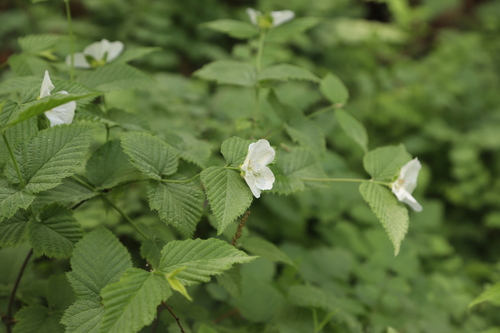
Rhodotypos scandens, jetbead, is a deciduous shrub in the rose family, growing 3-6 ft (1-2 m) tall and 4-9 ft (1.2-2.7 m) wide with arching, spreading branches. Unlike most of the rose family, the leaves are opposite, bright green, 2-4 in (5-10 cm) long, sharply doubly toothed, with deeply impressed veins that give a pleated look. In April and May single white flowers 1.5-2 in (4-5 cm) across, each with four rounded petals, open at the branch tips, with scattered later flowers into summer. The flowers give way to clusters of four shiny black, bead-like fruits that sit above the leaves and persist through winter. The shrub grows in sun or shade and tolerates poor soil, urban conditions, and drought once established. It is native to China, Japan, and Korea and has naturalized in parts of the eastern United States, where its shade tolerance and bird-spread seed let it invade woodland understories. The hard black fruits contain cyanogenic compounds and are regarded as poisonous if eaten. Its opposite leaves and four-petalled white flowers separate it from the related single-flowered kerria Kerria japonica, which has yellow flowers.
Native Range
Rhodotypos scandens is native to China, Japan, and Korea. It has been widely planted and has naturalized in parts of the eastern and central United States, spreading into woodland edges and understories from cultivated stock.Suggested Uses
Rhodotypos scandens has been used as a shade-tolerant foundation and border shrub and for difficult sites with poor soil or low light. Because it naturalizes into woodlands, its planting is discouraged in regions where it has become invasive. Where grown, it is kept in check by removing fruit before seed disperses.How to Identify
Appearance
Size & Dimensions
Height3' - 6'
Width/Spread4' - 9'
Bloom Information
The main flowering runs from April to May, with scattered flowers continuing into summer. The white four-petalled flowers open singly at the shoot tips. Shiny black bead-like fruits ripen by late summer and remain on the branches through winter.
Detailed Descriptions
Foliage Description
bright greenGrowing Conditions
Sun Requirements
Requires 2-8 hours of direct sunlight daily
• Full Sun: 6+ hours of direct sunlight
• Partial Shade: 3-6 hours of direct sunlight
• Full Shade: Less than 3 hours of direct sunlight
Care & Maintenance
Care Guide
Rhodotypos scandens grows in full sun to full shade on a wide range of soils and tolerates drought, urban pollution, and poor ground once established. It is hardy within USDA zones 4-8 and needs no winter protection. Growth is moderate, and the shrub spreads by arching stems and bird-dropped seed. Because it self-sows into nearby woodland, its spread is hard to contain where native plant communities are present. Little feeding is needed on average soils. The black fruits are poisonous if eaten.Pruning
Pruning is done after flowering in late spring, thinning old or crowded stems at the base to keep the shrub open. Removing fruiting stems before the black drupes ripen reduces self-seeding into nearby ground. The shrub resprouts readily from hard cutting.Pruning Schedule
Prune: May–June
late spring