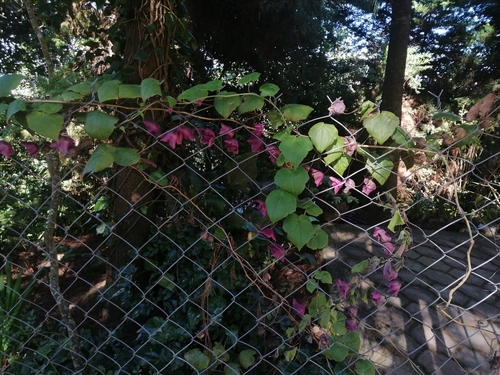
Rhodochiton, Genus, atrosanguineus, Species,
- Genus & species
purple bell vine
South-central Mexico (Oaxaca, Veracruz, Puebla) — cloud forests and montane scrub at 4,000-8,000 feet elevation
SunFull Sun – Part Shade
WaterMedium
Overview
Rhodochiton atrosanguineus is a slender climbing annual (perennial in USDA zones 10–11) reaching 72–120 inches (180–300 cm / 6–10 feet) in a single growing season. The vine carries two-toned pendant flowers produced continuously from July until the first hard frost: a persistent inflated 4-lobed calyx 0.75–1 inch (2–2.5 cm) across in deep rose-pink to magenta, from which hangs a narrow tubular corolla 1–1.5 inches (2.5–4 cm) long in near-black dark purple-maroon. The persistent calyx remains on the plant after the corolla drops, extending the two-tone display beyond the life of the corolla itself by 1–2 weeks per flower. Leaves are simple, heart-shaped, toothed, 1.5–3 inches (4–8 cm) long in medium to dark green. The vine climbs by twining leaf petioles rather than by stem-twining or tendrils — a mode atypical for warm-season climbers, and one that requires a narrow support structure such as plastic netting, thin wire, or string for the petioles to wrap around; thicker trellises and pergola posts do not support the vine because the petioles cannot wrap around large-diameter surfaces. The genus name translates as 'red cloak' (Greek rhodon + chiton), referencing the persistent rose-pink calyx. The specific epithet 'atrosanguineus' translates as 'dark blood-red,' referencing the near-black corolla color. Seed is started indoors 10–12 weeks before last frost, with germination taking 2–4 weeks at 65–70°F (18–21°C). The genus is monotypic or nearly so, with R. atrosanguineus being the only species in widespread cultivation. Not known to be toxic to pets or humans.
Native Range
Rhodochiton atrosanguineus is native to cloud forests and montane scrub of south-central Mexico (Oaxaca, Veracruz, Puebla), growing at 4,000–8,000 feet (1,200–2,400 m) elevation in moist cool-temperate mountain habitats.Suggested Uses
Used on trellises, obelisks, wire-netting arches, and container supports in annual borders and container plantings at containers of 5+ gallons (19+ L). The pendant two-toned flowers read as a curtain of rose-pink calyces with dark tubular tails across the growing season and suit positions where the vine can be viewed from below or at eye level — such as overhead arches, pergola climbers on narrow supports, or container trellises on patios at seated-viewing height. Pairing the vine with silver-foliaged annuals such as Helichrysum petiolare or pale pink-flowered trailing companions such as Diascia cultivars at the base of the support heightens the near-black corolla contrast across the composition. Consistent moisture is the cultural requirement that separates success from failure — the vine does not grow well in dry positions, hot full-afternoon exposures without reliable irrigation, alkaline limestone soils, or wind-exposed sites where the slender stems break.How to Identify
Appearance
Size & Dimensions
Height6' - 10'
Width/Spread1' - 2'
Bloom Information
Two-toned pendant flowers consisting of a persistent rose-pink to magenta inflated 4-lobed calyx 0.75–1 inch (2–2.5 cm) across and a narrow tubular near-black dark purple-maroon corolla 1–1.5 inches (2.5–4 cm) long appear continuously from July through the first hard frost — a 12–16 week bloom window in USDA zones 5–9 under annual culture. The persistent calyx remains on the plant 1–2 weeks after each corolla drops, extending the two-tone display beyond the corolla itself. Hummingbirds visit the flowers during the summer bloom.
Detailed Descriptions
Flower Description
Two-toned pendant: persistent inflated 4-lobed calyx in deep rose-pink to magenta 0.75-1 inch across, with a narrow tubular corolla 1-1.5 inches in near-black dark purple-maroon hanging below; July through first hard frostFoliage Description
Medium to dark green; simple, heart-shaped, toothed, 1.5-3 inches long; occasionally with reddish tinge on new growthGrowing Conditions
Sun Requirements
Requires 4-8 hours of direct sunlight daily
• Full Sun: 6+ hours of direct sunlight
• Partial Shade: 3-6 hours of direct sunlight
• Full Shade: Less than 3 hours of direct sunlight
Care & Maintenance
Care Guide
Grow in partial sun to full sun with 4–8 hours of direct light in moist well-drained fertile loam or peat-enriched soil at pH 6.0–7.0. Consistent soil moisture during the growing season is the principal cultural requirement — wilting during hot afternoon periods reduces flower production by 30–50% and repeated wilting progressively weakens the vine. Seed is started indoors 10–12 weeks before the last frost at 65–70°F (18–21°C); germination takes 2–4 weeks. A narrow support structure — plastic netting, thin wire to 0.25 inch (6 mm) diameter, or string — is installed at transplant time so the twining petioles have something to grip; thicker trellises and pergola posts are not used because the leaf petioles cannot wrap around large-diameter surfaces. The growing tip is pinched at 12 inches (30 cm) to stimulate branching. In USDA zones 10–11 the vine behaves as a tender perennial and is cut back by one-third in early spring to renew flowering wood. In all other zones the vine is composted after the first hard frost.Pruning
Pinch the growing tip at 12 inches (30 cm) of vine growth to stimulate lateral branching and a fuller display across the support. Train stems onto the support structure as they extend, wrapping the twining petioles around the support wires or netting. No deadheading is needed — the persistent calyx remains on the vine and continues as a secondary display after each corolla drops. The whole vine is composted after the first hard frost in USDA zones 5–9. In USDA zones 10–11 where the vine overwinters as a tender perennial, stems are cut back by one-third in early spring before new growth resumes.Pruning Schedule
Prune: May
late spring
Container Growing
Suitable for container growing
Minimum container size: 5 gallons
Toxicity
Non-toxicPlanting Guide
Planting Methods & Timing
Planting Method
transplant
Indoor Start
11 weeks before last frost
Direct Sow Timing
Not recommended — requires 10–12 week indoor start for adequate season length in temperate climates
Days to Maturity
100–120 days
Plant Spacing
18 inches