Rhodamnia, Genus, rubescens, Species,
- Genus & species
scrub turpentine
Overview
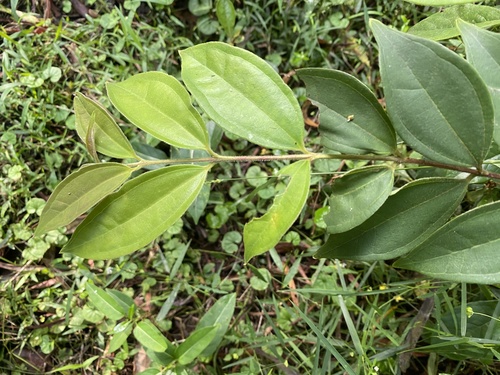
Rhodamnia rubescens is an evergreen tree or large shrub in the myrtle family, reaching 30-80 feet (9-24 m) tall in rainforest but commonly 10-25 feet (3-8 m) in open or cultivated settings. The trunk is fluted and covered in fibrous brown bark. Leaves are opposite, ovate to lance-shaped, 1.2-3.5 inches (3-9 cm) long, with three prominent veins running from the base, dull green above and paler with soft hairs beneath. New growth emerges pink to reddish. White flowers 0.3-0.5 inch (8-12 mm) across, each with five petals and a central tuft of stamens, form in clusters in the leaf axils from spring into summer. Flowers are followed by rounded berries 0.2-0.3 inch (5-8 mm) wide that ripen from red to purple-black and hold several small seeds. Growth rate is moderate. The species is highly susceptible to myrtle rust (Austropuccinia psidii), a fungal disease that disfigures new growth and has driven population decline across its range.
Native Range
Native to eastern Australia, from the New South Wales south coast north to southeastern Queensland. Grows within and along the margins of subtropical and warm-temperate rainforest, and in wet sclerophyll forest, on a range of soils from sea level to about 3,300 feet (1,000 m).Suggested Uses
Used as a screen, windbreak, or rainforest-regeneration plant in frost-free coastal gardens, spaced 8-15 feet (2.4-4.6 m) apart. Berries draw fruit-eating birds. Susceptibility to myrtle rust restricts its use in humid regions where the disease is established.How to Identify
Appearance
Size & Dimensions
Height10' - 25'
Width/Spread8' - 15'
Bloom Information
Flowers from October to January, spanning spring and early summer. Individual flower clusters last 2-3 weeks, and total bloom extends 6-8 weeks. Berries mature 2-3 months after flowering, ripening through autumn. Warm coastal sites flower earlier than cooler upland sites.
Detailed Descriptions
Foliage Description
green, paler beneathGrowing Conditions
Sun Requirements
Requires 4-8 hours of direct sunlight daily
• Full Sun: 6+ hours of direct sunlight
• Partial Shade: 3-6 hours of direct sunlight
• Full Shade: Less than 3 hours of direct sunlight
Care & Maintenance
Care Guide
Grows in moist, well-drained soil rich in organic matter, in part shade to full sun; young plants are prone to leaf scorch in hot afternoon sun without shelter. Water regularly during establishment and in dry spells, reflecting its origin in moist forest. Mulch maintains the cool, moist root zone the roots require. Myrtle rust (Austropuccinia psidii) is the main health threat, attacking soft new growth and flower buds and capable of killing young plants; infection is worst in warm, humid weather. No serious insect pests are typical. Plants are long-lived where rust pressure stays low.Pruning
Prune in late winter to shape the canopy or remove rust-damaged growth before the spring flush. Removing infected shoots reduces the spread of myrtle rust spores. Plants reshoot from older wood after moderate cutting. Routine pruning is otherwise minimal.Pruning Schedule
Prune: July–August
winter