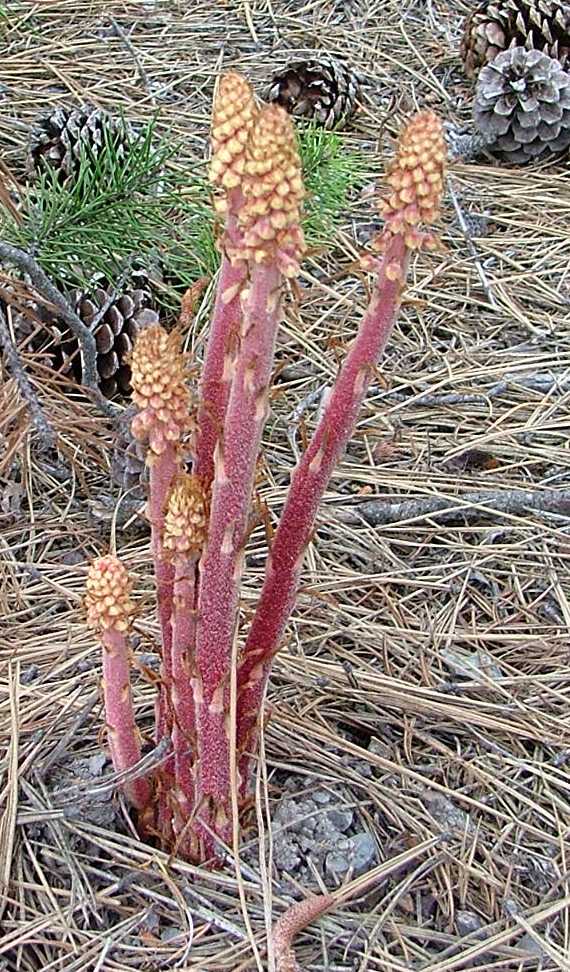
Pterospora, Genus, andromedea, Species,
- Genus & species
woodland pinedrops
Overview
Pterospora andromedea is a non-photosynthetic perennial of coniferous forests across much of North America, drawing all its nutrition from soil fungi linked to the roots of pines and other conifers. It produces a single reddish-brown, sticky-hairy flowering stalk 1-3 feet (30-90 cm) tall, with no green leaves, only small brown scales along the stem. From June to August the upper stalk carries many nodding, urn-shaped flowers 0.25 inch (6 mm) long, white to pale pink. After seed release the dried, rigid stalk can stand through the following year. Because it lives on a specific fungus-conifer partnership, the plant cannot be transplanted or grown from seed in cultivation and appears only in established forest. It grows in deep duff under conifers, often in dry montane woodland. The plant is uncommon and protected in parts of its range, including some eastern states where it is rare.
Native Range
Native to North America, scattered from Canada and the western mountains across to the Great Lakes and the northeastern United States, in coniferous and mixed forest.Suggested Uses
Seen in natural coniferous forests and protected woodlands rather than in gardens. It serves as an indicator of intact conifer-fungus communities. The dried stalks add interest along woodland walks.How to Identify
Appearance
Size & Dimensions
Height1' - 3'
Width/Spread4" - 8"
Bloom Information
Flowers open from June to August along the upper stalk. The nodding urn-shaped blooms are white to pale pink and 0.25 inch (6 mm) long. Each stalk flowers once, then dries and persists.
Detailed Descriptions
Flower Description
white to pale pinkFoliage Description
leafless; reddish-brown stem with scalesGrowing Conditions
Sun Requirements
Tolerates up to 4 hours of direct sunlight daily
• Full Sun: 6+ hours of direct sunlight
• Partial Shade: 3-6 hours of direct sunlight
• Full Shade: Less than 3 hours of direct sunlight