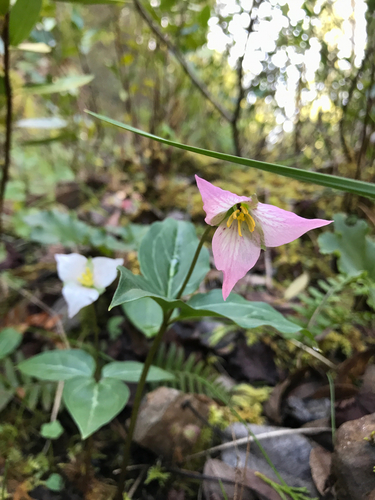
Pseudotrillium, Genus, rivale, Species,
- Genus & species
brook wakerobin
Klamath-Siskiyou region of southwestern Oregon and northern California; stream banks, moist seeps, and shaded ravines, often on ultramafic (serpentine) soils
Overview
Pseudotrillium rivale is brook wakerobin (brook trillium), a small clumping deciduous perennial growing 4-8 inches (10-20 cm) tall and 4-6 inches (10-15 cm) wide. White 3-petaled flowers 0.5-0.75 inch (1.3-2 cm) spotted and blushed with pink-purple, solitary at the center of the leaf whorl, in April-May (3 weeks). Leathery glossy blue-green broadly oval leaves 1.5-3 inches (4-7 cm) with conspicuous silver-white vein markings, in a whorl of 3. In Melanthiaceae. Formerly Trillium rivale — reclassified as the sole species in the monotypic genus Pseudotrillium. Rivale = of streams. Endemic to the Klamath-Siskiyou region of southwestern Oregon and northern California, typically on ultramafic (serpentine) soils. This extreme habitat specificity and narrow endemic range are the primary conservation and cultural limitations. Very slow to establish from seed (5+ years). Not drought-tolerant. Requires well-drained gritty soil with consistent moisture. Contains steroidal saponins — toxic if ingested. Deer-resistant. Zones 5-8. Full shade to part shade. Growth rate is very slow.
Native Range
Endemic to the Klamath-Siskiyou region of southwestern Oregon and northern California. Found on stream banks, moist seeps, and shaded ravines, often on ultramafic (serpentine) soils.Suggested Uses
Grown in woodland gardens, shade rock gardens, and botanical collections, spaced 4-6 inches (10-15 cm). Rare PNW endemic. Silver-veined foliage. Very slow. Purchase only nursery-propagated stock. Toxic. Zones 5-8.How to Identify
Appearance
Size & Dimensions
Height4" - 8"
Width/Spread4" - 6"
Bloom Information
Mid spring (April-May). White 3-petaled flowers 0.5-0.75 inch (1.3-2 cm) spotted and blushed pink-purple. Solitary. 3 weeks. Bee-visited.
Detailed Descriptions
Flower Description
White petals spotted and blushed with pink-purple, 3 petals, 0.5-0.75 inch (1.3-2 cm); single flower, nodding to erect, at the center of the leaf whorlFoliage Description
Leathery, glossy blue-green, broadly oval to heart-shaped, 1.5-3 inches (4-7 cm), prominently marked with contrasting silver-white veins; 3 leaves in a single whorl — the leaf venation pattern is the most visually conspicuous featureGrowing Conditions
Sun Requirements
Requires 1-3 hours of direct sunlight daily
• Full Sun: 6+ hours of direct sunlight
• Partial Shade: 3-6 hours of direct sunlight
• Full Shade: Less than 3 hours of direct sunlight
Care & Maintenance
Care Guide
Full shade to part shade (1-3 hours). Well-drained gritty soil pH 6.0-7.5 with consistent moisture. Not drought-tolerant. Endemic to Klamath-Siskiyou on ultramafic soils. Very slow from seed (5+ years). Do not disturb. Toxic (steroidal saponins). Deer-resistant. Zones 5-8.Pruning
Cut dead foliage in late summer (August) when it withers. No other pruning needed. Do not disturb the rhizome.Pruning Schedule
Prune: August
summer