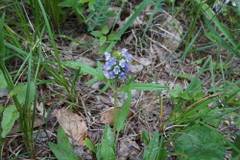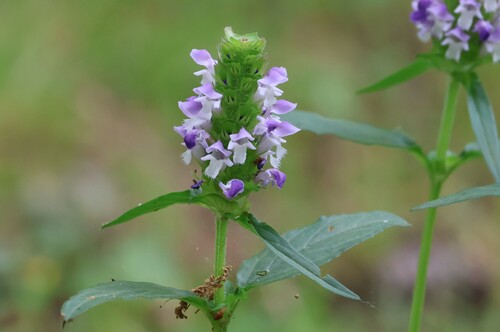
Prunella, Genus, vulgaris, Species,
- Genus & species
self heal
Circumboreal; native genotypes occur across North America, Europe, and Asia, with the introduced European genotype more aggressive in managed turf; lawns, meadows, woodland edges, and moist disturbed ground from sea level to approximately 8,000 feet (2,400 m).
Overview
Prunella vulgaris is a low stoloniferous perennial reaching 4-12 inches (10-30 cm) tall and 12-24 inches (30-60 cm) wide, forming dense creeping mats. Stems are square (the Lamiaceae family identification feature), prostrate to ascending, rooting at the nodes, and sparsely hairy. Leaves are opposite, ovate to lance-shaped, 1-3 inches (2.5-8 cm) long, with entire to slightly toothed margins, on short petioles. Two-lipped purple to violet-blue flowers 0.4-0.5 inch (10-13 mm) long open from May through September in dense cylindrical terminal heads (verticillasters) 1-2 inches (2.5-5 cm) long, subtended by broad purplish bracts that remain visible after the flowers drop. Each bract pair subtends 3-6 flowers; the upper corolla lip is hood-shaped and the lower lip is three-lobed with a fringed central lobe. Fruit consists of four smooth nutlets per flower, the typical Lamiaceae fruit type. A single plant produces 500-3,000 seeds. Stolons root at the nodes, and established plantings expand laterally into circular patches. Both native North American genotypes and introduced European genotypes occur; the introduced form tends to spread more aggressively in managed turf. Plants are common in moist shaded turf across the Pacific Northwest, and the species has a long historical record of use in European and Chinese traditional medicine for the rosmarinic acid and ursolic acid content of the foliage. Hardy in USDA zones 3-9 (-40°F / -40°C).
Native Range
Prunella vulgaris has a circumboreal distribution, with native genotypes across North America, Europe, and Asia, and an introduced European genotype that tends to be more aggressive in managed turf. Plants grow in lawns, meadows, woodland edges, and moist disturbed ground from sea level to approximately 8,000 feet (2,400 m). The species is common in moist partially shaded lawns throughout the Pacific Northwest.Suggested Uses
The species is used in Lamiaceae identification courses for teaching the square stem, opposite leaves, two-lipped corolla, and four-nutlet fruit, with the dense cylindrical flower head (verticillaster) serving as a teaching example of this inflorescence type. The native-versus-introduced genotype question parallels similar situations in Phalaris arundinacea and Phragmites australis and is a teaching case in invasion biology. Plants have a long historical record of use in European and Chinese traditional medicine for rosmarinic acid and ursolic acid content in the foliage. The species is retained in pollinator gardens and meadow plantings where the native genotype is present.How to Identify
Appearance
Size & Dimensions
Height4" - 1'
Width/Spread1' - 2'
Bloom Information
Two-lipped purple to violet-blue flowers 0.4-0.5 inch (10-13 mm) long open from May through September in dense cylindrical terminal heads 1-2 inches (2.5-5 cm) long, with heads blooming from the base upward over a total span of 8-12 weeks and peak bloom in June through August in the Pacific Northwest. Individual flowers last 2-3 days. Bees and butterflies work the flowers during bloom, and the species is self-compatible. After flowering, the purplish bracts remain on the stem and the head turns brown, with the dried structure persisting into fall as visible markers of previous bloom.
Detailed Descriptions
Flower Description
Purple to violet-blue two-lipped (bilabiate) flowers 0.4-0.5 inch (10-13 mm) long in dense cylindrical terminal heads (verticillasters) 1-2 inches (2.5-5 cm) long subtended by broad purplish bracts; the upper lip is hood-shaped, the lower lip three-lobed with a fringed central lobeFoliage Description
Dark green; ovate to lance-shaped, opposite, 1-3 inches (2.5-8 cm) long, with entire to slightly toothed margins; sparsely hairy; on short petioles; held on square stems (the Lamiaceae family-level identification feature)Growing Conditions
Sun Requirements
Requires 3-8 hours of direct sunlight daily
• Full Sun: 6+ hours of direct sunlight
• Partial Shade: 3-6 hours of direct sunlight
• Full Shade: Less than 3 hours of direct sunlight