Polymeria, Genus, calycina, Species,
- Genus & species
slender bindweed
Overview
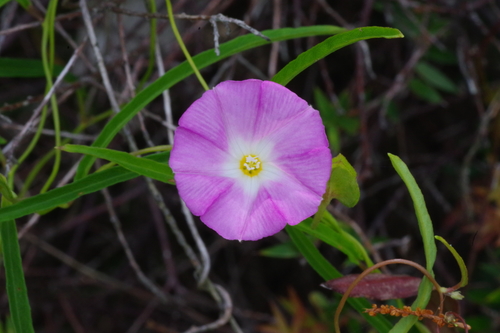
Polymeria calycina is a prostrate to weakly twining perennial herb reaching 4-12 inches (10-30 cm) tall, with trailing stems spreading 12-32 inches (30-80 cm) across from a deep woody rootstock. Leaves are alternate, narrow-oblong to linear, 0.6-2 inches (1.5-5 cm) long and 0.1-0.4 inch (3-10 mm) wide, softly hairy, with margins flat or slightly inrolled. Funnel-shaped flowers are pink to mauve with a paler throat, 0.4-0.6 inch (10-15 mm) across, borne singly in the leaf axils. Flowering occurs mainly in the warmer months. The fruit is a small rounded capsule containing hairy seeds. Stems regrow each season from the persistent rootstock, recovering after grazing, fire, or seasonal drying. Growth is low and mat-forming rather than upright. In cultivation it spreads laterally and can extend beyond its intended position over several seasons. Foliage may die back during prolonged dry periods and reshoot after rain.
Native Range
Native to eastern and northern Australia, occurring in Queensland, New South Wales, and parts of the Northern Territory. Grows in grassland, open eucalypt woodland, and disturbed roadsides, often on clay or sandy loam soils from near sea level to inland plains.Suggested Uses
Used as a low groundcover in native and water-conserving gardens, spaced 16-24 inches (40-60 cm) apart. Suits rockeries, embankments, and informal borders where its trailing stems spread over open soil. The spreading habit may crowd small neighbouring plants in confined beds.How to Identify
Appearance
Size & Dimensions
Height4" - 1'
Width/Spread1' - 2'8"
Colors
Bloom Information
Flowers mainly from spring through summer (September to February in its native range), with scattered flowering after rain at other times. Individual flowers open for a single day. In cultivation, bloom timing shifts with local temperature and rainfall.
Detailed Descriptions
Flower Description
pink to mauveFoliage Description
green to grey-greenGrowing Conditions
Sun Requirements
Requires 4-8 hours of direct sunlight daily
• Full Sun: 6+ hours of direct sunlight
• Partial Shade: 3-6 hours of direct sunlight
• Full Shade: Less than 3 hours of direct sunlight
Care & Maintenance
Care Guide
Grows in full sun to light shade in well-drained sandy or clay-loam soils. Water occasionally during establishment in the first season; established plants tolerate extended dry periods by dying back to the rootstock. Tolerates light frost, regrowing from the rootstock in spring. Spreads laterally by trailing stems and can extend across open ground over several seasons. Few pest or disease problems are recorded. Cut back spent stems after flowering or in late winter to contain spread.Pruning
Cut trailing stems back to near ground level in late winter before new growth begins to remove old growth and limit lateral spread. Light trimming after the main flowering flush reduces self-layering. No structural pruning is required.Pruning Schedule
Prune: July–August
winter
Container Growing
Suitable for container growing
Minimum container size: 3 gallons