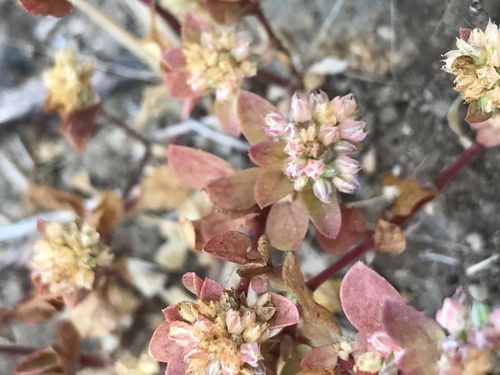
Polycarpon, Genus, tetraphyllum, Species,
- Genus & species
fourleaf manyseed
SunFull Sun – Part Shade
Overview
Polycarpon tetraphyllum is a small annual herb in the family Caryophyllaceae, growing 2-6 inches (5-15 cm) tall with a prostrate to ascending, much-branched habit. The smooth, spoon-shaped leaves are 0.2-0.6 inch (5-15 mm) long and appear in whorls of four at the nodes, a feature reflected in both its scientific and common names. Tiny white to greenish flowers, about 0.04 inch (1 mm) across, are crowded in dense, branched clusters through spring and summer. Each flower has five small petals shorter than the sepals and produces a capsule holding many minute seeds. The species is native to the Mediterranean region and Europe and has naturalised across Australia and much of the world as a weed of disturbed ground. It grows in gardens, footpath cracks, cultivated soil, and waste places on a wide range of soils. The shallow root system is pulled easily, and plants complete their life cycle within a single season. It is not cultivated and is generally managed as a garden and pavement weed. Dense seeding allows rapid recolonisation of bare soil. Growth is fastest in warm, moist conditions and slows in dry or shaded sites.
Native Range
Polycarpon tetraphyllum is native to the Mediterranean region and Europe. It has naturalised widely across Australia and other temperate and warm regions, growing in disturbed ground, gardens, cultivated soil, and paved areas.Suggested Uses
Polycarpon tetraphyllum is not grown as a garden plant and has no ornamental use. It occurs as a weed of paths, garden beds, and cultivated ground. Removal before seeding limits its build-up in cultivated soil.How to Identify
Appearance
Size & Dimensions
Height2" - 6"
Width/Spread4" - 10"
Bloom Information
Flowering occurs through spring and summer, from September to March in its naturalised Australian range. Tiny white to greenish flowers form in dense, branched clusters. Flowering and seeding continue over an extended period in warm conditions.
Detailed Descriptions
Flower Description
white to greenishFoliage Description
greenGrowing Conditions
Sun Requirements
Requires 4-12 hours of direct sunlight daily
• Full Sun: 6+ hours of direct sunlight
• Partial Shade: 3-6 hours of direct sunlight
• Full Shade: Less than 3 hours of direct sunlight
Water & Climate
Water Needs
Drought Tolerance
Drought tolerant when established