Overview
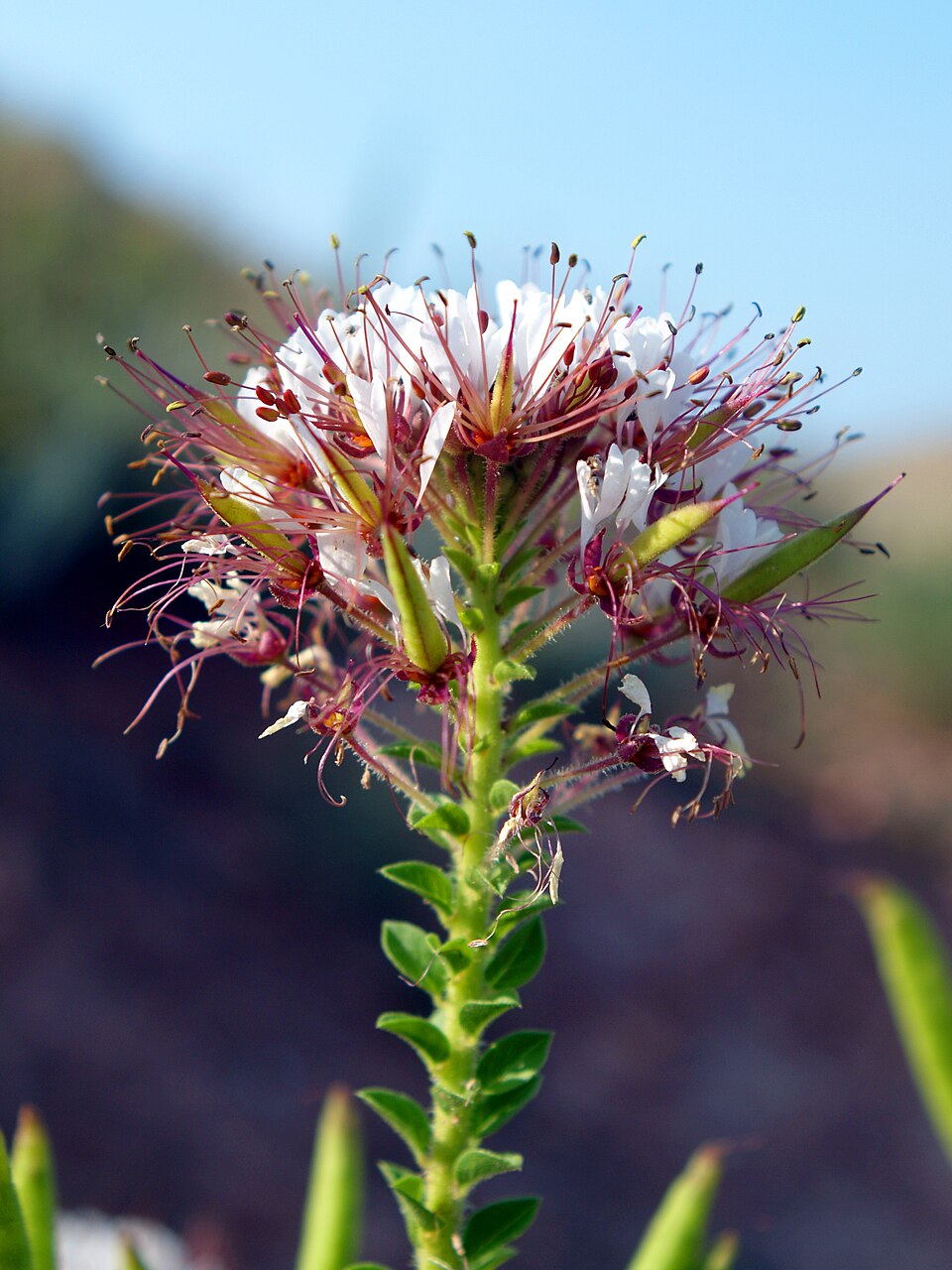
Polanisia dodecandra, redwhisker clammyweed, is an annual herb in the spiderflower family, growing 1-3 feet (30-90 cm) tall on branching stems coated in sticky, glandular hairs that give off a pungent scent. The alternate leaves are divided into three oblong leaflets, each 0.5-2 inches (1.5-5 cm) long, and feel clammy to the touch. From early summer into autumn the stems carry upright clusters of white to pinkish four-petalled flowers, each with notched petals and a tuft of long purple-pink stamens that reach well beyond the petals, the source of the redwhisker name. The flowers ripen into slender, upright seed pods 1-3 inches (2.5-8 cm) long that split to scatter many small seeds. Native across much of the United States, southern Canada, and Mexico, P. dodecandra grows on open, sandy, and gravelly ground such as riverbanks, gravel bars, prairies, roadsides, and disturbed fields. As an annual it dies after autumn seed set. The flowers draw bees, butterflies, and hawkmoths, and the plant is a larval host for several sulphur butterflies. One limitation is the sticky, strong-smelling foliage, which clings to hands and clothing. It self-sows freely on bare, open ground.
Native Range
Polanisia dodecandra is native to North America, ranging across most of the United States, southern Canada, and into northern Mexico. It grows on open, sandy, and gravelly ground including riverbanks, gravel bars, prairies, and disturbed sites.Suggested Uses
Polanisia dodecandra is grown in native wildflower meadows, pollinator gardens, and gravel or rain-garden plantings, and is sown in restoration mixes for sandy and disturbed sites. It suits hot, dry, open ground where many plants struggle. The long-stamened flowers support bees, butterflies, and moths.How to Identify
Appearance
Size & Dimensions
Height1' - 3'
Width/Spread8" - 1'6"
Bloom Information
Flowering runs from early summer into autumn, roughly June through September. The white to pink flowers with long stamens open over many weeks and draw bees, butterflies, and night-flying hawkmoths. Slender upright pods follow and split to release the seed.
Detailed Descriptions
Flower Description
white to pink with purple stamensFoliage Description
greenGrowing Conditions
Sun Requirements
Requires 6-10 hours of direct sunlight daily
• Full Sun: 6+ hours of direct sunlight
• Partial Shade: 3-6 hours of direct sunlight
• Full Shade: Less than 3 hours of direct sunlight
Water & Climate
Water Needs
Drought Tolerance
Drought tolerant when established
Care & Maintenance
Care Guide
Polanisia dodecandra grows in full sun on dry to moderately moist, sandy or gravelly, sharply drained soils across a pH of about 6.0 to 8.0. As a warm-season annual it germinates in late spring on open, bare ground and flowers through summer with little water. It tolerates heat, drought, and poor, stony soil but declines in shade or rich, wet ground. The seed self-sows on disturbed soil and needs light to germinate. Plants colonize gravel bars and sandy banks that flood and scour. Frost ends the plant in autumn.Pruning
As an annual, P. dodecandra is not pruned. Removing spent pods before they split reduces self-sown seed, while leaving them lets the plant reseed. The sticky, scented stems coat hands and tools when cut.Toxicity
Non-toxicPlanting Guide
Planting Methods & Timing
Planting Method
direct sow
Plant Spacing
10 inches