Podolobium, Genus, ilicifolium, Species,
- Genus & species
prickly shaggy pea
Overview
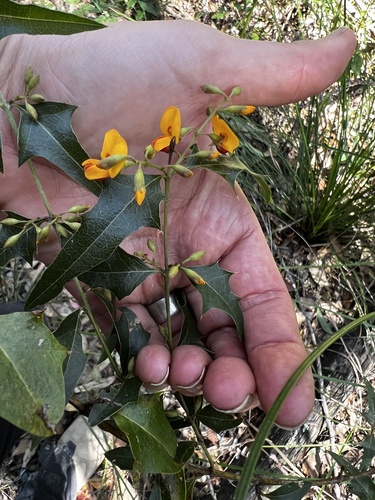
Podolobium ilicifolium is an evergreen shrub in the pea family reaching 2-8 feet (0.6-2.5 m) tall, with an upright to straggling, open habit. Leaves are stiff and leathery, 0.8-2.5 inches (2-6 cm) long, triangular to oblong with wavy, holly-like margins ending in sharp spiny teeth. Young stems carry rusty hairs. Pea flowers 0.4-0.6 inch (10-15 mm) across appear in loose clusters at the branch tips, with a yellow to orange standard petal marked with red and a darker red keel. Flowering occurs in spring. Flowers are followed by inflated, slightly hairy pods 0.4-0.6 inch (10-15 mm) long, each holding a few seeds. Growth is moderate. The prickly leaves make the plant difficult to handle, and the open, straggling habit can look sparse without pruning.
Native Range
Native to eastern Australia, from Victoria through New South Wales to Queensland. Grows in dry and moist sclerophyll forest and along rainforest margins, often on sandstone-derived sandy soils, from the coast to the ranges.Suggested Uses
Grown in native and habitat gardens and as a low barrier planting, spaced 3-5 feet (0.9-1.5 m) apart, where the prickly foliage deters traffic. The spring flowers feed native bees and insects. The sharp leaves and open habit limit its use in gardens used by children or in confined spaces.How to Identify
Appearance
Size & Dimensions
Height2' - 8'
Width/Spread2' - 5'
Bloom Information
Detailed Descriptions
Flower Description
yellow-orange with red markingsFoliage Description
dark greenGrowing Conditions
Sun Requirements
Requires 4-8 hours of direct sunlight daily
• Full Sun: 6+ hours of direct sunlight
• Partial Shade: 3-6 hours of direct sunlight
• Full Shade: Less than 3 hours of direct sunlight
Care & Maintenance
Care Guide
Grows in well-drained sandy or gravelly soil in part shade to full sun; it does not tolerate wet, heavy soils. Water through the first one to two seasons to establish; mature plants withstand dry spells with little extra water. As a legume it fixes nitrogen and seldom needs fertiliser, and phosphorus-rich feeds can damage the roots. Root-rot fungi cause dieback in poorly drained ground. The spiny leaves make weeding and handling around the plant slow.Pruning
Tip-prune after flowering to promote denser growth and reduce a straggly habit. Plants tolerate removal of up to one-third of the recent growth. Hard cutting into bare old wood often fails to reshoot. The spiny foliage slows the work, so pruning is usually limited to shaping.Pruning Schedule
Prune: November–December
late springsummer
Container Growing
Suitable for container growing
Minimum container size: 5 gallons